


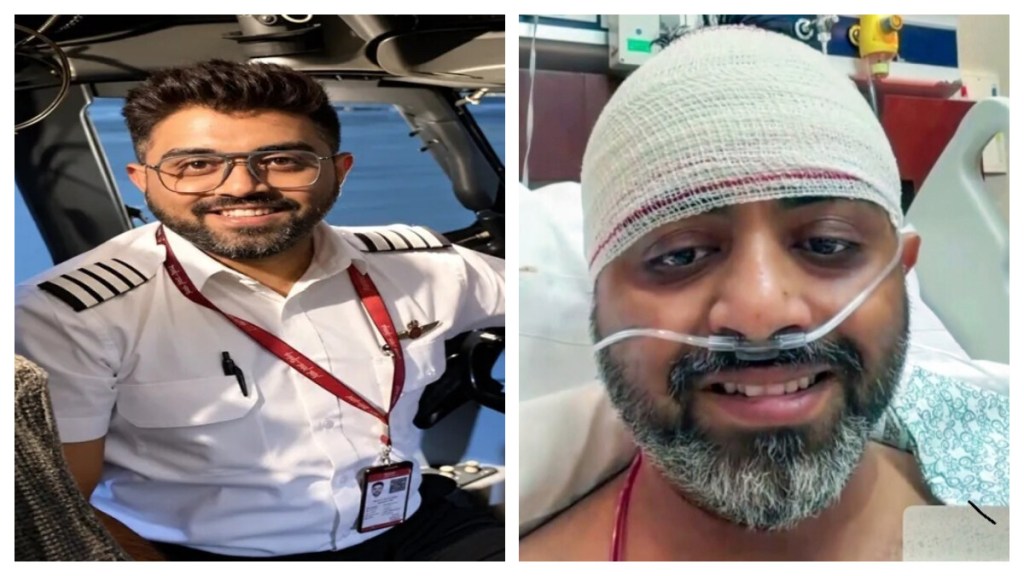

“I was in and out of consciousness frequently,” Indian pilot Smit Machchhar said as he recalled being attacked with a crash axe inside the cockpit of a flydubai flight bound for Tel Aviv. Despite his injuries, he knew he had to act. “I can’t accept my death,” he told Sky News Arabia in an interview while still sitting on his hospital bed wearing the patient’s gown.
Machchhar’s bravery is being discussed all over the world after he was struck on the head by his co-pilot, Hammam al-Hammami, mid-air in a flight on September 30. The investigation agencies prima-facie called it a terrorist attack intended to crash the plane. There were over 180 people onboard the flight.
Machchhar described moments of blurred vision and confusion before realising he was being attacked. “I realised I have to do something,” he told Sky News, describing his survival as “a miracle”.
Machchhar managed to open the cockpit door, allowing others on board to intervene. Cabin crew, passengers and off-duty pilots restrained al-Hammami, and the aircraft made an emergency landing at Tabuk in Saudi Arabia. All people on board got off safely.
UAE authorities are investigating the incident as an attempted hijacking. Al-Hammami has been arrested.
A routine flight before a sudden blow
Speaking to Sky News Arabia, Machchhar said the flight had been proceeding normally when his co-pilot said he wanted to pray. Al-Hammami then stood up and began praying. Machchhar explained that the Boeing 737 cockpit was small and he generally avoided looking at someone while they were praying. He turned his attention to his computer to check the timing.
He then felt what he described as “a very hard hit at the back of my head”.
The blow felt as though it had come from a strong, hard object, but he did not immediately understand what had happened.
“I didn’t know at that point what had hit me,” he told the Sky News.
‘I had that one last fight left in me’: Smit
Machchhar said he was struck more than once. As his vision blurred and he repeatedly lost consciousness, he initially thought something had gone wrong with the aircraft, which appeared to be descending rapidly.
He later realised that the danger was coming from an attack inside the cockpit. At one point, he feared he would not survive. He said he then forced himself to respond, knowing he had to do something to stay alive.
Machchhar gave a similar account during a call with Israeli Prime Minister Benjamin Netanyahu from his hospital bed. He described lying on the cockpit floor and hearing passengers scream. “I had that one last fight left in me,” he told Netanyahu.
Crew and passengers intervened
Once the cockpit door opened, cabin crew, passengers and off-duty pilots intervened and restrained al-Hammami. Israeli passengers were among those who helped overpower him, Indian Express reported. Machchhar recalled panic and screaming as the emergency unfolded. He also spoke about a colleague who stepped in to help manage the situation, saying the intervention would remain with him.
Off-duty pilots subsequently landed the aircraft at Tabuk, bringing the flight to an end without any deaths.
Machchhar was taken to hospital with injuries to his head, neck and hands. Prime Minister Narendra Modi, Netanyahu and US President Donald Trump have described him as a hero.
Investigation examines the co-pilot’s background
The investigation has also raised questions about al-Hammami’s flying history and how he was permitted to operate the flight.
According to an Indian Express report, Al-Hammami had reportedly been barred from flying in Oman because of extremist views. Authorities are examining how he was subsequently allowed to fly an aircraft carrying Israeli passengers. That reported background remains separate from the findings authorities may reach in the current investigation.
It also reported that two other flydubai pilots were arrested in Dubai on suspicion of planning a terror attack. Both had reportedly flown to Israel and worked with al-Hammami. Their arrests concern allegations under investigation, not established findings of guilt.
For Machchhar, the account centres on the moments when he struggled to remain conscious and decided to act despite his injuries. Opening the cockpit door gave others on board a chance to intervene before the aircraft was brought down safely in Saudi Arabia.