


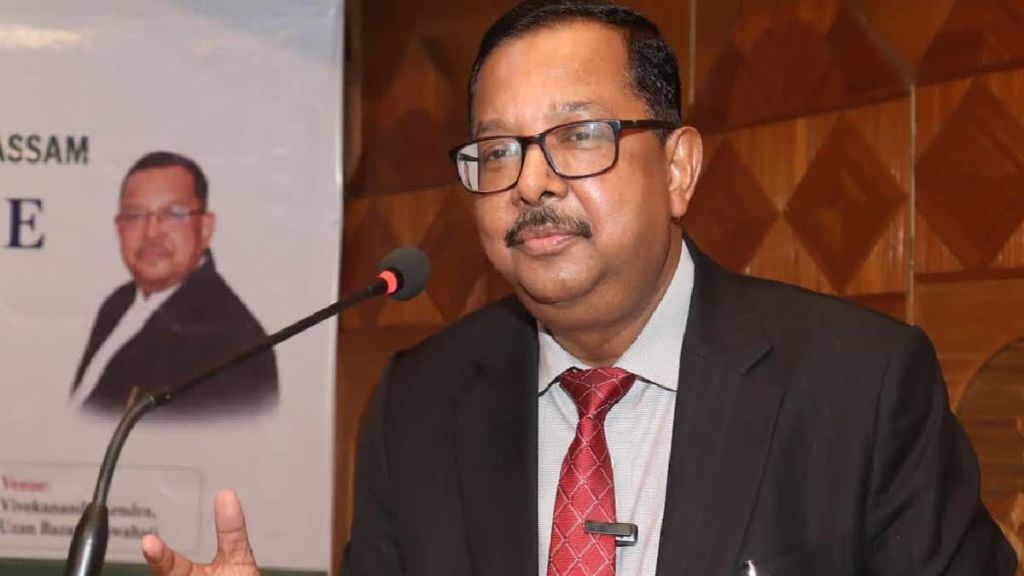

Amid the row over the SIR of electoral rolls, Justice Ujjal Bhuyan on Sunday said any process that results in the mass disenfranchisement of Indian citizens would be contrary to the Constitution, reported The Indian Express. A petition questioning the functioning of Chief Election Commissioner Gyanesh Kumar and seeking to declare the nationwide Special Intensive Revision (SIR) of electoral rolls illegal is already set for hearing in the Supreme Court.
Speaking at the valedictory ceremony of the Justice Bodh Raj Sawhney Memorial Moot Court Competition at NALSAR University of Law in Hyderabad, Justice Bhuyan said citizens could not be separated from their constitutional right to vote.
“If any process results in disenfranchising millions and millions of Indian citizens, making them second-class citizens in their own country, in the sense of being citizens without voting rights, such a process is intrinsically arbitrary. No amount of whataboutery can justify it.”
He said such a situation would strike at the foundation of the constitutional system.
“It strikes at the very heart of the Constitution and I would go to the extent of saying that it is a negation of the constitutional order, which we have adopted under the Constitution of India,” he said.
Justice Bhuyan on right to vote, universal adult suffrage
Justice Bhuyan said the right to vote and the right to be included in an electoral roll were inseparable from the status of an Indian citizen.
“From the persona of an Indian citizen, the right to vote or right to be included in the voters’ list cannot be detached. It will be like taking out the soul from the body.”
He traced the idea of adult franchise in India to the Constitution of India Bill of 1895, also known as the Swaraj Bill. He also referred to the Constituent Assembly’s discussions on universal adult suffrage and the constitutional provisions that eventually became Articles 325 and 326.
“Article 325 of the Constitution of India declares that there shall be one general electoral roll for every territorial constituency for election to the Lok Sabha or to the Legislature of a State; no person shall be ineligible for inclusion in any such roll or claim to be included in any electoral roll for any such constituency on grounds only of religion, race, caste, sex or any of them.”
Justice Bhuyan said Article 326 provides the constitutional basis for elections to the Lok Sabha and state Legislative Assemblies through adult suffrage.
“As per Article 326 of the Constitution, election to the Lok Sabha and to the Legislative Assembly of every State shall be on the basis of adult suffrage. In other words, every person who is a citizen of India and who is not less than 18 years of age (prior to March 28, 1989, it was 21 years) and who is not disqualified under the Constitution of India or by any law made by the appropriate legislature on the ground of non-residence, unsoundness of mind, crime or corrupt or illegal practice, shall be entitled to be registered as a voter at any such election,” he said.
Justice Bhuyan cites Ambedkar on adult franchise
Referring to the Constituent Assembly’s debates, Justice Bhuyan cited Dr B R Ambedkar’s argument in favour of placing adult suffrage within the constitutional framework rather than leaving the issue entirely to ordinary legislation.
“Justifying universal adult suffrage, Dr Ambedkar said since we have taken a very important decision, which practically nullifies the past, it is better that the Constitution should, in express terms, state it is the basis for insertion of Articles 289A and 289B in the draft Constitution, which are now Articles 325 and 326,” he said, The Indian Express reported
Justice Bhuyan said Ambedkar had also cautioned against leaving the right to vote to the discretion of future parliamentary legislation.
“Dr Ambedkar’s closing speech warned that the right to vote and the Indian citizen’s entitlement to adult suffrage should be written into the Constitution of India, instead of being left to the whims of parliamentary legislation,” he was quoted as saying in The Indian Express report.
Justice Bhuyan described universal adult franchise as a key decision taken by the Constituent Assembly after India’s freedom struggle and said it reflected faith in the country’s citizens and their ability to participate in democracy.
“Adoption of universal adult franchise reflects the determined opinion of the Constituent Assembly that years of freedom struggle and the revolt against foreign rule made the adoption of universal adult franchise a natural choice and an essential ingredient of democracy, which we have adopted as the form of governance,” he said, according to the report
“Therefore, it was an act of faith for our founding fathers in the common man of India and in his pragmatism and wisdom. It was the first step taken to achieve equality in India.”
Justice Bhuyan also highlighted the principle of political equality inherent in universal adult suffrage, saying a person’s social or economic position does not determine the value of their vote.
“One may be a billionaire, and one may be a rickshaw-puller. Yet both will have their votes, and the value of their votes would be equal. Likewise, a socially high-placed temple priest on the one hand and a person belonging to the lowest strata of the society compelled to work as a manual scavenger have an equal vote with equal value. This is the transformational vision of the Indian Constitution,” he said.
He concluded his address by congratulating the students of NALSAR for their participation in the moot court competition.