


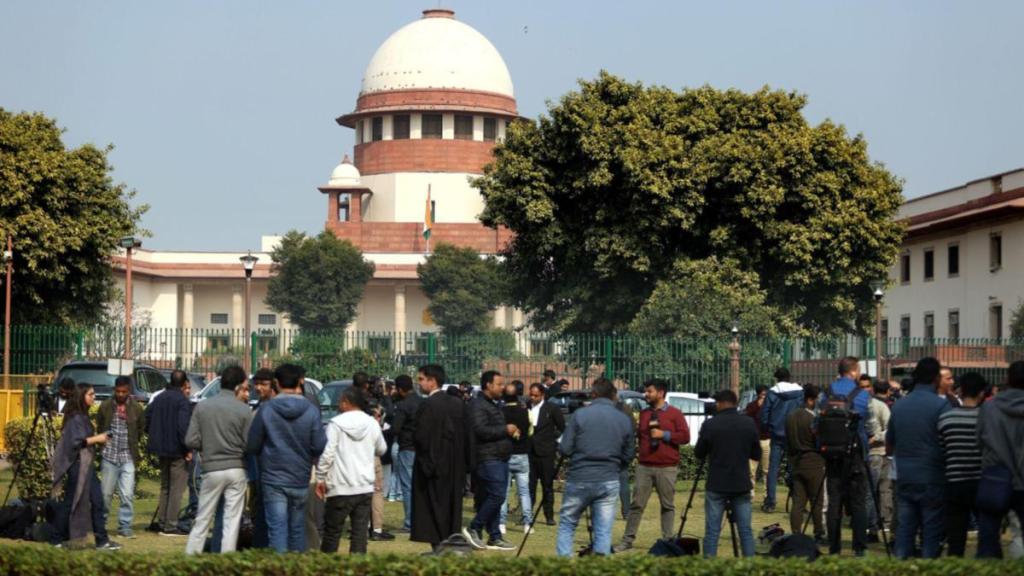

The Supreme Court on Tuesday said a balance must be struck between citizens’ privacy and press freedom as it sought the Centre’s response to a challenge against India’s data protection law.
The Digital News Publishers Association (DNPA) has argued that the law, which does not explicitly exempt journalism, could make reporting dependent on consent from the people being investigated. It has warned of consequences for investigative stories, confidential sources and the everyday functioning of newsrooms.
A three-judge bench headed by Chief Justice of India Surya Kant issued notice on the petition challenging provisions of the Digital Personal Data Protection Act, 2023, and Rules, 2025. The bench also sought a response on an application to stay the challenged provisions and listed the case for November 17.
Why are news publishers worried?
At the heart of the challenge is a practical question: how can journalists investigate wrongdoing if using information about someone requires that person’s permission?
“News has to be new. It will shut down the newsroom. What’s the point if I have to ask for permission and consent?” senior advocate Madhavi Divan, appearing for the association, told the court, according to IE.
The DNPA’s concern extends beyond publishing a finished story. Reporters collect documents, cross-check claims and speak to sources while deciding whether there is a story to report. The association argued that consent requirements could interfere with that process before anything reaches the public.
“It’s then a complete regime of pre-censorship. We have to ask your permission if we report on you. How can that ever be?” Divan said.
She argued that publishers were already regulated and could face consequences for incorrect or inaccurate reporting. Their objection was to requirements that could prevent a report from being produced in the first place.
What does the data protection law do?
According to the Digital Personal Data Protection Act, 2023, the law covers personal information collected digitally or collected offline and subsequently digitised. In its explanatory note on the 2025 Rules, the ministry says the framework aims to give individuals greater control over their data and protect it against misuse.
The Act generally requires consent for processing personal data, while allowing specified uses without it, including responding to medical emergencies. Journalism is not expressly listed among these uses.
The Act also excludes personal data that individuals themselves make public or that someone is legally required to disclose. Its requirements would therefore not apply to every piece of information used in reporting.
Under the Act, individuals can seek deletion of personal data processed with their consent, subject to exceptions. These include retaining information necessary for its stated purpose or to comply with the law. Publishers nevertheless fear that deletion demands could affect news archives.
Was journalism treated differently earlier?
Parliament’s Joint Committee report on the Personal Data Protection Bill, 2019, reproduced a proposed exemption for journalistic work that complied with ethics codes issued by the Press Council of India or media self-regulatory organisations.
The current Act contains no equivalent express exemption. The DNPA argued that journalism needs specific protection because of its role in informing citizens and holding those in power accountable.
The association has also relied on the Supreme Court’s 2017 Puttaswamy judgment, which recognised privacy as a fundamental right, while arguing that the present framework infringes freedom of expression and the right to information, IE reported.
What about sources and public records?
Publishers are also concerned about powers allowing the government to demand information. They argued that these could expose confidential sources and discourage people from sharing information with journalists.
The challenge also covers the law’s enforcement arrangements and blocking powers. Blocking requires specified steps, including penalties in at least two instances, a recommendation from the Data Protection Board and a hearing.
Another contested change concerns the Right to Information Act. The data law broadens the wording of its exemption for personal information, raising concerns about access to records used to scrutinise public officials.
However, the government has maintained that disclosures in the public interest remain possible. In an August 2025 parliamentary response published by PIB, it said authorities could release information when public interest outweighed harm to protected interests.
What has the Supreme Court said?
The court has emphasised that citizens’ rights must also be protected.
“It’s between the rights of innocent citizens and your rights. So, a balance has to be struck…” the CJI said, according to Indian Express. He asked publishers to suggest safeguards against misuse.
“You are the domain experts because you are in this field. You are the best persons to suggest (to) the Union as well as (to) us how you will ensure there’s no misuse,” he told the association.
Much of the law’s core framework is scheduled to take effect in May 2027 under MeitY’s commencement notification. The RTI amendment is already in force.
For now, the court has sought the Centre’s response. It has not decided the constitutional challenge or granted the stay requested by the publishers.