


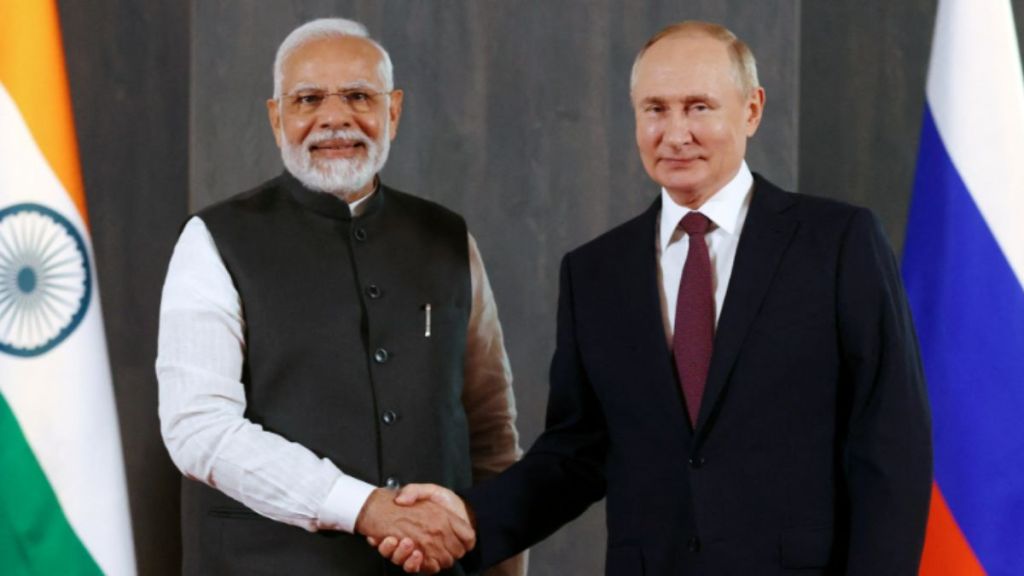

Prime Minister Narendra Modi and Russian President Vladimir Putin are confirmed to meet on Friday on the sidelines of the BRICS summit. A wide range of topics is expected to remain at the top of the high-stakes agenda as the global leaders sit down for a private meeting in the Indian capital, New Delhi.
The two leaders last crossed paths in Bishkek, Kyrgyzstan, on the sidelines of the Shanghai Cooperation Organisation Summit (SCO) in late August. SCO, like BRICS, is yet another bloc viewed as a counterweight to US influence. Before that, Putin even visited India for the 23rd India-Russia Annual Summit in December 2025.
Ahead of tomorrow’s meeting, which will focus on India-Russia bilateral ties among other factors, Kremlin spokesperson Dmitry Peskov shed light on the broader sectors that will emerge as the primary talking points between Modi and Putin. These include defence, energy and technology, in addition to the repatriation of the remaining Indian nationals working with the Russian military.
During a Tuesday virtual briefing with the Indian media hosted by Sputnik India, Peskov also highlighted that Russia welcomes any peace efforts made by New Delhi to end Moscow’s war in Ukraine, which is now in its fifth year. Talks surrounding bilateral trade will also foreground India’s concerns about the increasing trade deficit favouring Russia.
As per Peskov’s prior acknowledgement, the pre-BRICS summit will double down on “de-dollarisation” as the international organisation currently comprising ten countries, including India and Russia, shifts away from trading with each other using the US dollar and embraces the importance of international exchange using national currencies.
Here are the details of the various talking points expected on the Modi-Putin meet’s agenda this Friday. The talks will serve as a precursor for the two-day BRICS summit on September 12 and 13, 2026. India is set to host this year under the official theme banner of “Building for Resilience, Innovation, Cooperation and Sustainability.”
Bilateral talks and focus on national currencies
According to PTI, the Kremlin spokesperson acknowledged earlier this week that Russia is cognisant of India’s concern about the growing trade deficit in Russia’s favour, adding that Moscow is looking at ways to address the issue.
Speaking on India-Russia trade and how the issue of accumulated rupee payment is slowly being resolved, Peskov said, “The majority of our trade is now in national currencies.”
Having long criticised the BRICS bloc, US President Donald Trump again spoke out against countries “aligning themselves with the Anti-American policies of BRICS,” threatening to hit them with an additional 10% tariff last year. In 2024, he warned BRICS countries with 100% tariffs if they moved forward with their own currency to reduce reliance on the US dollar, which has generally emerged as dominant in case of international trade.
As for where trade between India and Russia stands, External Affairs Minister Dr S Jaishankar, on his part, raised concerns about the widening trade deficit during his meeting with Putin in Moscow on August 24. While the top Indian official pointed out that the gap has remained above $50 billion and flagged it as one of India’s “foremost priorities,” Putin told him at the time that Russia is “doing everything” to help India and its farmers with fertiliser supplies, which have otherwise been hindered by the US-Israel war on Iran.
India’s trade deficit with Russia especially expanded during the 2022-23 period as the country’s refiners started buying Russian oil, which got cheaper following Western sanctions fuelled by Russia’s invasion in Ukraine. While bilateral trade stood at around $13 million in 2021-22, it eventually grew over four times to almost $60 million in 2025-26, as highlighted by Jaishankar. He further stressed that, as a result, the trade imbalance has widened from $6.6 billion to over $50 billion.
Peskov particularly emphasised New Delhi’s surging interest in the Russian market and wanting to broaden investments in Moscow’s economy in various fields. Similarly, he expressed his own country’s desire to reciprocate the gesture by expanding Russian companies’ presence in the Indian market.
Russian oil and US sanctions
While speaking to Indian journalists during a virtual briefing days ago, Kremlin spokesperson Peskov asserted that India and Russia’s ties remain as robust as ever. When asked about the volume of India’s Russian oil procurement, the Russian official held back from giving any figures, but highlighted that “every month we have a new record.”
Akin to Peskov’s admission, international headlines have been repeatedly revising mentions of India’s reliance on Russian crude oil hitting a brand-new “all-time high” each month. From a relatively lower figure of 1 million barrels per day in February, the South Asian nation’s Russian oil imports surged to a massive 2.47 million barrels per day in July, according to trade sources’ data cited by Reuters.
The resulting number was up 62.4% from a year earlier, but still down from June’s record figure of 2.6 million bpd. Back in January, Indian refiners started reducing their Russian oil import shares to steer clear of higher US tariffs amid ongoing negotiations of a trade deal with Washington. Nonetheless, as the Iran war disrupted the oil and energy supply in West Asia, with the Strait of Hormuz still not fully opened, Indian companies were forced to continue purchasing the Russian alternative.
In August, the US Senate ultimately passed a bill to impose 100% tariffs on Russian oil buyers, as a means of exerting more pressure on Russia to end its 2022 invasion of Ukraine. When recently discussing the development during the virtual briefing hosted by Sputnik India, Peskov described the legislation as “illegal, unfair and unexpected.”
That same month saw India’s Russian oil imports falling even further to about 2.1 million bpd, according to maritime intelligence firm Kpler’s data. India still accounted for one of Russia’s largest oil buyers.
EAM Jaishankar has repeatedly defended India’s purchase of Russian oil. During his recent Kyiv visit, he pushed back against Ukraine’s stance on economic pressure possibly bringing an end to the fighting. Insisting that dialogue, diplomacy and negotiation would ultimately help resolve the conflict, he said at a joint media presser with Ukrainian Foreign Minister Andrii Sybiha, “This conflict, which is today in its fifth year, will not be solved because somebody is buying or not buying oil or alumina or minerals or metals or fertilizer.”
He reiterated his remarks just days ago, when confronted by a Polish journalist during his trip to Warsaw.
“Let’s diagnose the problem correctly. This conflict has gone on for 5 years. It will not be stopped by someone not buying oil. It will end with diplomacy,” Jaishankar responded when asked about the comments he delivered in Kyiv. At the time, he had even highlighted the pains of providing energy security for the country’s 1.4 billion people, especially at a time when the global energy situation is “very, very difficult.”
Beyond the exchange on Russian oil, both nations’ leaders are expected to bring up the adverse effects of the current situation in West Asia, especially with shipping traffic through the Strait of Hormuz still at an all-time low due to renewed attacks between the US and Iran in the region. The critical waterway would generally account for the passage of a fifth of the world’s oil and liquefied natural gas (LNG) in the pre-war times.
Repatriation of Indians employed with the Russian Army
The virtual briefing also saw External Affairs Ministry spokesperson Randhir Jaiswal disclosing that over two dozen Indians are currently working with the Russian military. After Modi-Putin talks in Bishkek last week, Foreign Secretary Vikram Misri said that about 51 Indians working with the Russian military amid the ongoing Ukraine conflict have died so far.
Meanwhile, Dmitry Peskov affirmed that Russia is currently working to identify the Indian nationals employed with the Russian Army so that they could be sent back home. New Delhi has repeatedly urged Moscow to release all Indians contributing to the Russian forces in various roles, including those serving support staff duties as cooks or helpers.
“Work is being done to make a list of those Indian citizens who are now on the battlefield. They will be back home,” the Kremlin spokesperson said at the briefing on Tuesday.
Modi-Putin ‘friendship’ fuels Ukraine peace talks
On the same page of conversation, Indian officials continue to stress that the country is in contact with both Ukraine and Russia to serve any role possible in helping bring the conflict to its closure. Talks on the sensitive topic between India and Russia have especially been facilitated by the countries’ decades-old cordial ties as close allies, owing to Modi and Putin’s close relationship.
Describing the exchanges between the leaders as “pragmatic,” Peskov said that they engage in discussions of the global agenda in an “open and constructive” manner, adding that both sides have been in “close personal contact.”
“It will be another opportunity for President Putin to inform his Indian friend on the current situation on the fronts, on the war with Ukraine and it will be a great opportunity for exchange and opinions on international issues,” Peskov said of the upcoming Modi-Putin meeting ahead of the BRICS summit.
Given how Modi urged for an immediate cessation of the conflict, calling for Putin to move “endless war towards end of war,” and Jaishankar is also expressing India’s willingness to contribute in any way possible during his visit to the Ukrainian capital, Peskov added, “We welcome the willingness of the Indian side to contribute.”
Admitting Russia also welcomes the efforts of US President Trump, the Russian spokesperson said, “We know the position of India on the Ukrainian conflict, and to a great extent, it corresponds with our own position because we do want the solution to the Ukraine conflict by peaceful means, and Russia is open for this process.”
Missile upgrades and fighter jets
Back in 2018, India signed a $5.43 billion agreement with Russia to buy five S-400 air defence systems. Delivery of the remaining systems will be on the agenda when Modi and Putin sit down for a private chat on Friday.
“Russia is capable of fulfilling its obligations, and they will be fulfilled. This issue is being mentioned during the conversations of our two leaders,” Peskov confirmed during the Sputnik India-hosted event.
Chaired by Defence Minister Rajnath Singh, the Defence Acquisition Council (DAC) approved the acquisition of additional Russian-made S-400 systems in March.
“The S-400 system will counter enemy long-range air vectors targeting vital areas, while the Remotely Piloted Strike Aircraft will enable undertaking Offensive Counter and Coordinated Air Operations, also providing stealth Intelligence, Surveillance and Reconnaissance activities. The overhaul of the Su-30 aero engine and its aggregates will increase the service life of the aircraft and fulfil the operational requirement of the Air Force,” the Defence Ministry said at the time.
In light of the advancement of the long-standing defence ties between both countries, Peskov recently illuminated interest in exploring ways to upgrade the existing BrahMos missile system.
“We are satisfied with our cooperation in the military field and in the technical-military field with India. It has very rich traditions, and it is a deeply rooted cooperation. We have very good military equipment—some of which is the best in the world—and we are ready to share this equipment with our Indian partners,” he said during the virtual press briefing. ” We have even gone further in this cooperation than just buying and selling: we are producing jointly. As you know, with BrahMos, we are producing missiles jointly. It is now time to think about improving those missiles, adding additional capabilities, and making them more competitive on the market and more effective.”
On top of that, the Russian spokesperson officially confirmed that both sides are already actively discussing technology transfer for the Sukhoi Su-57 fifth-generation stealth fighter jet, proving that India wants more than just imports of finished products. It also marks a sharp reversal of India’s initial rejection of the program.
Although countries generally prefer to gate-keep such complex and advanced military technologies, Peskov said that Russia is willing to share them with India to strengthen its partnership with India.
The Russian official even signalled that both sides are eyeing negotiations for India’s plan to set up new civil nuclear reactors.
Peskov foregrounded that Russia’s engagement with India also extends to the nuclear energy sector, as he said, “I’m not speaking only about hydrocarbon supplies to India, but also the nuclear sphere.”
“You know that Russia is one of the global leaders in the nuclear sphere, and we are a country that is involved in the construction of nuclear units in the world,” the Kremlin spokesperson added. “So we’re constructing more nuclear units currently than any other country in the world.”