


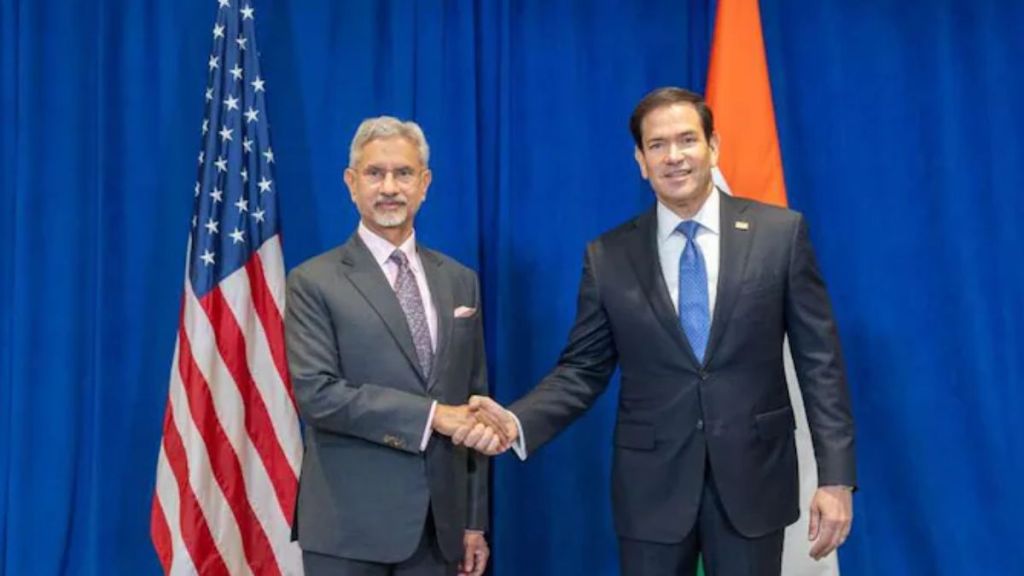

US Secretary of State Marco Rubio will arrive in Mumbai on Tuesday for a three-day visit to India, with a proposed trade deal, talks with External Affairs Minister S. Jaishankar and energy security expected to be among the key issues on the agenda.
The visit comes as Washington signals that a trade agreement with New Delhi could be close to completion. Rubio said on Monday that the two countries were working to finalise the deal and were “very close” to reaching an agreement.
Rubio, who is currently in Uzbekistan, will also travel to Jamnagar in Gujarat, home to one of the world’s largest oil refineries. His visit is expected to focus on the India-US strategic partnership, economic ties and regional stability.
Trade deal, energy security on Jaishankar-Rubio agenda
According to the official schedule released by the Ministry of External Affairs (MEA), Rubio will arrive at Chhatrapati Shivaji Maharaj International Airport in Mumbai at 2.15 pm on Tuesday, October 20.
At 3.40 pm, the US Secretary of State will pay tribute to the victims of terrorism by laying a wreath at the Taj Memorial inside the historic Taj Mahal Palace Hotel.
Rubio will then meet External Affairs Minister S Jaishankar at the same venue at 3.50 pm. The two leaders are expected to discuss the India-US strategic partnership, economic cooperation and regional stability.
Later in the evening, Rubio will attend the “Freedom 250 Reception” at the Jio World Convention Centre at 6.35 pm. The event will mark important milestones in US history and celebrate diplomatic ties between the two countries. Media access to the reception is being arranged through the US Embassy and Consulate.
On Wednesday, October 21, Rubio will leave Mumbai for Jamnagar in Gujarat. He is scheduled to depart from Chhatrapati Shivaji Maharaj International Airport at 10.30 am.
US-India trade deal ‘very close’, says Rubio
Speaking to reporters in Samarkand, Uzbekistan, on Monday, Rubio said the US and India were close to finalising a trade agreement.
“We’re trying to finalise a trade deal with India right now. We’re very close to doing that,” he said.
Rubio also explained that the US had been forced to reconsider some sanctions because of their possible impact on global energy supplies and prices.
“We’ve had to waive sanctions over the past few months because of the impact on global supplies and prices… We have to manage all of these things,” he said.
Rubio backs pause on Russia sanctions, cites India’s energy needs
Rubio added that energy needs, geography and national security considerations all played a role in decisions on sanctions and trade.
“That’s one of the things we take into consideration when the President makes a decision about national security waivers and things of that nature. Every country has a complex set of factors that it has to take into account. Geography is real. For some countries, it’s very difficult to acquire energy from alternative sources. That’s not an excuse, but all of that has to be balanced when making foreign policy,” Rubio said.
His remarks come as the Trump administration weighs how to deal with countries that continue to buy Russian oil and gas while also maintaining important economic and diplomatic relationships with them.
“You’ve got countries like India, for example, that have voluntarily diversified their energy portfolio, but are still getting a substantial amount of energy from Russia because it’s hard to pivot from one day to the next. But they’re also an important ally and partner of the United States. So we need that period of time to sort of study all this and figure out what the right combination is,” he added.
Trump invoked Section 115 of the Graham Act on Friday. The provision allows the US President to waive certain sanctions against foreign individuals or entities, restrictions on individuals and duties imposed under the law.
Why Trump paused sanctions that could affect India
A day before Rubio’s remarks, US President Donald Trump waived several sanctions related to Russian fuel sales that were due to take effect under the Lindsey O. Graham Sanctioning Russia and Iran Act.
The law, which has now been put on hold, could have imposed tariffs of up to 100% on goods entering the US from the five largest importers of Russian crude oil or gas. India and China were among the countries that could have been affected.
Rubio said India was an important US partner and that Washington needed time to understand how the proposed measures would affect the global and American economies.
“These sanctions were not just sanctions on Russia. They include tariffs on a number of countries—India, for example, and others. And so I think the president wants to take the 60-day period of time to sort of analyse what imposing both sanctions and tariffs will mean to the global economy and even to the U.S. economy,” he said.
Rubio’s India visit to focus on business ties
According to the US State Department, Rubio is scheduled to meet business leaders to discuss investment opportunities and ways to strengthen economic cooperation between the two countries. Reports suggest that Rubio could meet leading Indian business figures in Mumbai, including Gautam Adani and Tata Group chairman N Chandrasekaran. His schedule also includes a meeting with External Affairs Minister S Jaishankar and other senior government officials.
US Ambassador to India Sergio Gor has described the visit as “more business-focused” than Rubio’s earlier trip to India in May for the Quad foreign ministers’ meeting.
The focus on business comes as India and the US work towards finalising a trade deal. Energy, investment, defence and technology are also expected to feature in discussions.
Rubio to visit Reliance refinery in Jamnagar
Rubio’s planned visit to Jamnagar is another key part of his India trip. The Gujarat city is home to Reliance Industries’ refinery, the world’s largest single-site refining complex, with a capacity of around 1.4 million barrels of oil per day.
US Ambassador Sergio Gor confirmed that Rubio would meet “some of the folks at Reliance” during the visit. He also indicated that Reliance Industries chairman Mukesh Ambani was expected to be present, adding that Ambani runs the company.
The visit comes after Reliance announced plans to invest in a major new refinery project in Brownsville, Texas. US President Donald Trump described the project in March as the first new refinery in the US in 50 years. The reported cost of the project is around $300 billion.
Could Rubio’s visit lead to changes in US visa rules?
Rubio’s focus on business and investment comes at a time when recent US immigration measures have raised concerns among Indian companies and professionals.
These measures include the suspension of certain companies, including major Indian IT firms, from the Permanent Labour Certification (PERM) programme. The programme is used by employers to sponsor eligible foreign workers for employment-based green cards.
Changes to the H-1B visa system and related immigration processes have also affected Indian professionals and companies with business operations in the US.
During his May visit to India, Rubio had introduced an “America First” visa scheduling tool that gives priority to business professionals. The aim was to support commercial ties by making it easier for business travellers to secure visa appointments.
No new visa announcements have been confirmed for the current visit. However, discussions with business leaders could provide an opportunity to raise concerns about skilled workers, talent mobility and visa processes for professionals involved in India-US business projects.
Trump open to meeting Putin and Xi without Zelenskyy
On the other hand, Trump has said he is willing to hold a trilateral meeting with Russian President Vladimir Putin and Chinese President Xi Jinping to discuss ending the war in Ukraine and reducing nuclear weapons, even if Ukrainian President Volodymyr Zelenskyy is not part of the talks.
Speaking to reporters at the White House on Monday, before leaving for Kansas, Trump said he would be ready to meet the Russian and Chinese leaders if it could help end the war or advance global denuclearisation.
“Anything I can do to end the war, whether somebody’s there or not, whatever I could do to end the war,” Trump said when asked whether he would meet Xi and Putin without Zelenskyy.
Trump said he would be travelling to China in November and suggested that the meeting could focus on reducing nuclear weapons. Asked about the possibility of meeting the Russian and Chinese presidents without Zelenskyy, Trump said the main purpose would be to discuss nuclear weapons rather than the war in Ukraine.
He suggested that Beijing could host the meeting after his planned visit to China.