


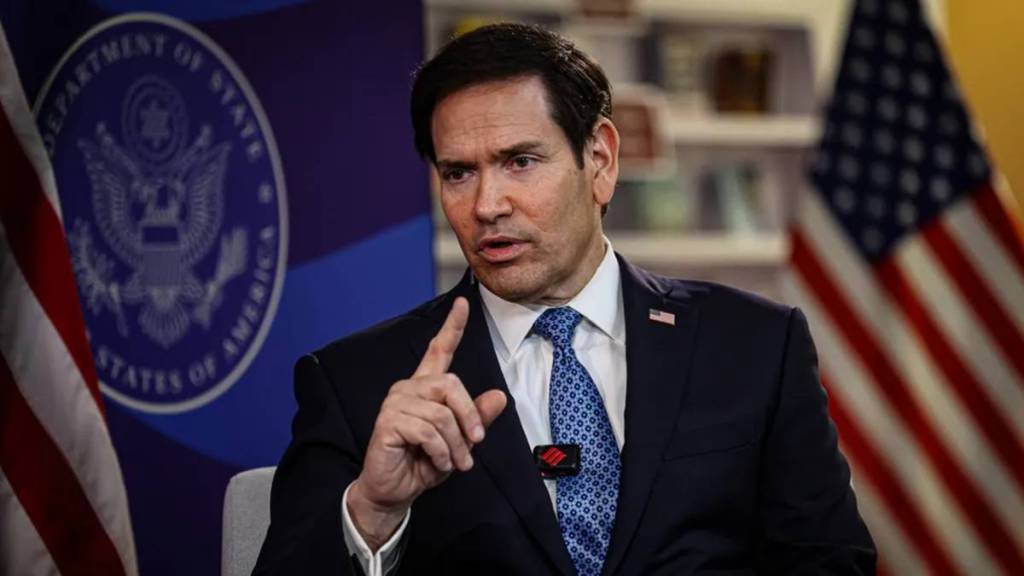

US Secretary of State Marco Rubio described the Cockroach Janta Party-led protests against Chief Election Commissioner Gyanesh Kumar as India’s “domestic political matter” and refused to comment on the issue. He also criticised United Nations experts who raised concerns over the Indian police’s response to the demonstrations, calling them an “oxymoron”.
Reacting to the UN experts’ criticism, Rubio told reporters, “Oh, UN experts, my favourite. The UN experts are the oxymoron.” “It is a domestic political matter. I am not going to comment on it. This is a democracy, they have elections here. I am not going to opine on their domestic, political matters. We have protests every day in US,” he said.
Rubio also distinguished peaceful demonstrations from riots involving vandalism and destruction of property. He said the ability to express differing political opinions was an important feature of democratic societies. “I am not talking about the riots, what you see in Europe. They are vandalizing and breaking and burning down buildings. I am not talking about that,” he said.
UN experts raise concerns over police response
More than 20 UN human rights experts in Geneva had expressed alarm over what they described as a “repeatedly heavy-handed police response” to youth-led protests in Delhi. The experts criticised the police response and urged Indian authorities to protect the right to peaceful assembly. They also called for justice for alleged human rights violations during these and earlier demonstrations.
The experts raised concerns over alleged restrictions on peaceful assembly, the excessive use of force against demonstrators and reports of enforced disappearances. Rubio’s remarks come amid a diplomatic exchange over the concerns raised by the UN experts about India’s handling of the protests.
India rejects criticism at the United Nations
India pushed back against the criticism at the United Nations on Tuesday, rejecting what it described as attempts to portray the country negatively based on unverified allegations and incomplete statistics. Barkha Tamrakar, deputy secretary in the Ministry of External Affairs, while speaking during a discussion on the agenda item concerning the Working Group on Enforced Disappearances explained the constitutional and institutional safeguards available in India to address allegations of human rights violations.
Indian diplomat Tamrakar said constitutional safeguards, including Article 21, protect human rights and ensure due process. “India firmly opposes any attempt to convert unverified allegations, incomplete statistics, or a report that contains no India country observation into a negative characterization of the world’s largest democracy,” Tamrakar said.
“Human rights should not be used as an instrument of political pressure or selective country targeting,” she added. Tamrakar said India engages with international human rights mechanisms but stressed that such engagement must follow the principles of dialogue, consultation, cooperation, non-selectivity and transparency. India also called for impartial and evidence-based engagement on human rights, opposing what it described as selective scrutiny of countries.