



The BJP has emerged as the stronger force in Rajasthan’s urban local body elections but the verdict falls well short of a sweeping mandate. The party’s advantage is visible both in the overall seat tally and in the number of civic bodies where it holds the upper hand. Of the 10,244 wards spread across 309 municipal bodies, BJP candidates won 4,166 seats, while Congress secured 3,595, giving the BJP a lead of 571 seats.
The party’s dominance is more pronounced at the civic-body level. It has crossed the majority mark in 85 ULBs and finished as the largest party in 60 more. That gives the BJP the lead in 145 civic bodies, just under half of the total. On the other hand, Congress has a majority in 46 ULBs and is the single-largest party in another 54. It therefore leads in 100 bodies.
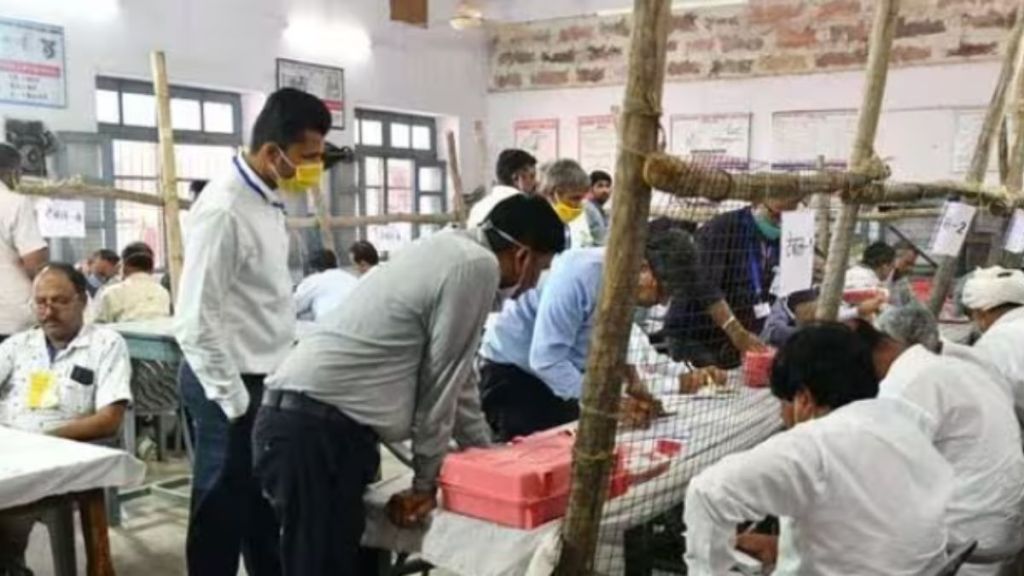
Counting of votes for councillor posts in 309 urban local bodies across Rajasthan began on Monday amid tight security, with counting taking place at designated centres across the state.
Security personnel have been deployed in and around the counting centres, while entry has been restricted to authorised persons, officials said.
The civic polls are being closely watched as a political test for the ruling BJP and opposition Congress ahead of the 2028 Rajasthan Assembly elections. Polling was held in two phases on September 9 and 11.
Rajasthan municipal polls: 309 urban bodies, 10,245 seats
A total of 10,245 councillors will be elected across 309 urban local bodies in Rajasthan. These include 10 municipal corporations, 51 municipal councils and 248 municipalities.
More than 1.44 crore voters were eligible to cast their votes in the elections.
In the first phase, polling was held across 162 urban local bodies on September 9, with voter turnout reaching 76.42%. The remaining 147 urban local bodies voted on September 11, recording a turnout of 70.68%.
The elections saw an intense campaign between the BJP and Congress, while Independents and candidates from other parties also contested in several urban bodies.
Key contest areas: Jaipur, Jodhpur, Udaipur, Kota and more
The results in major urban centres are being closely watched, particularly Jaipur, Jodhpur, Udaipur, Kota, Alwar, Ajmer and Bikaner.
Jaipur is among the most significant contests. The Jaipur Municipal Corporation has 150 wards in the current election and more than 24 lakh registered electors.
The outcome in these cities could offer clues about the BJP and Congress’ relative support among Rajasthan’s urban voters. The results are also important for both parties as they prepare for the 2028 Assembly polls.
The campaign featured several senior BJP and Congress leaders. Chief Minister Bhajanlal Sharma, former chief minister Ashok Gehlot, Rajasthan Assembly Leader of Opposition Tikaram Jully, BJP state president Madan Rathore and Congress state president Govind Singh Dotasra campaigned for their respective parties.
Last Rajasthan municipal elections: BJP vs Congress
The previous urban local body elections provide an important benchmark for this year’s contest.
In Jaipur’s 2020 civic elections, the city was divided into two municipal corporations, Jaipur Greater and Jaipur Heritage. The BJP and Congress each secured control of one corporation.
The structure has changed for the current election, with Jaipur now voting for a single 150-ward municipal corporation. This makes the Jaipur result particularly important when comparing the two elections.
The wider Rajasthan civic contest is also being watched for changes in the BJP-Congress balance across urban areas. A strong performance by either party could provide political momentum ahead of the next Assembly election.
What happens after Rajasthan municipal election results?
The election process will not end with the declaration of councillor results.
Once the newly elected urban local bodies are constituted, the next stage will be the election of their heads.
Mayors and chairpersons will be elected on September 21, followed by the election of deputy mayors, deputy chairpersons and municipal vice-presidents on September 22.
The final results will therefore determine not only which parties perform strongly at the councillor level, but also which political formations are positioned to control Rajasthan’s major civic bodies.