


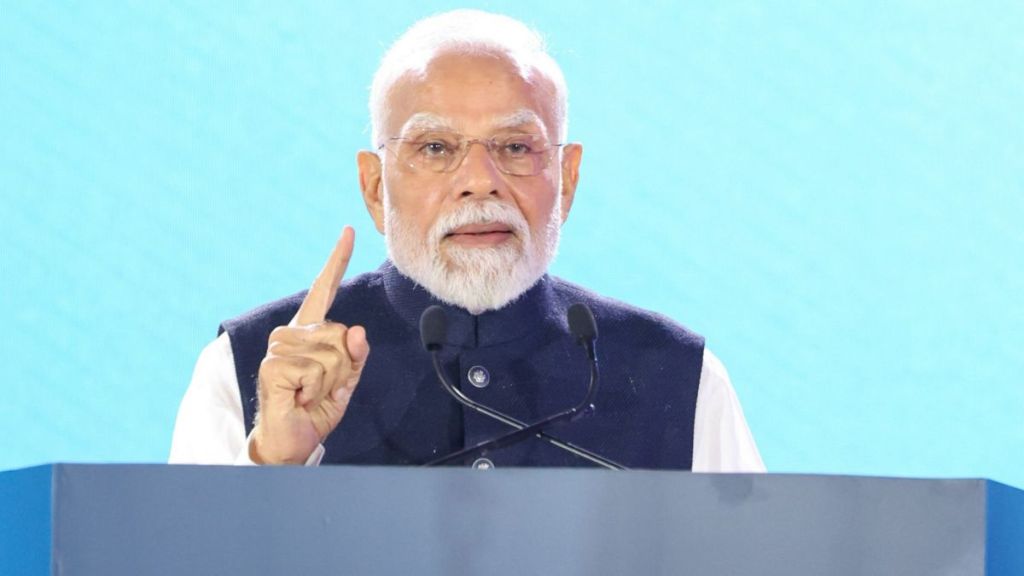

Prime Minister Narendra Modi on Tuesday laid out India’s economic vision and aims to expand global collaborations at the Bloomberg New Economy Forum. Given the current global situation, he posed a critical question: “The real question is not who has the power. The real question is, how is this power being used,” pushing for better understanding between countries when faced with countless challenges.
The Bloomberg Forum is being held in India for the first time, with this year’s theme being “A World in Play: Defining the New Levers of Power.” In light of the current dynamic geopolitical situation, Narendra Modi tapped into a forward-looking approach focused on future growth centred around collaborative effort while addressing hundreds of global leaders from the private and public spheres.
PM Modi puts India at the centre of ‘power to empower’ narrative
As global powers feel compelled to put themselves first, PM Modi pitched India’s growth as a major potential source of technology and talent, while also presenting solutions for challenges faced by other economies. To support his argument, he looked back at how India empowered COVID-19 vaccine supplies, sending them to more than 100 countries during the pandemic, and how it emerged as a prime example of a single move that fuelled domestic presence while meeting global needs.
Laying emphasis on the motto “power to empower,” he stressed that advancements across sectors, particularly technology, should be more inclusive. The prime minister asserted that technology and other resources backing power, authority and progress should benefit millions across income groups and geographies by creating a vast pool of opportunities, instead of becoming an exclusive strength in the hands of a few, as the focus must be on the potential to improve lives.
PM Modi’s speech bridges gap between domestic capabilities and global connect
He cited the country’s 7.8% economic growth in the April-June period, foreign-exchange reserves surpassing $700 billion and wide-ranging reforms tied to taxation, labour laws and other factors as signs of the nation’s resilience amid growing geopolitical tensions.
Most importantly, he emphasised that the country’s rise didn’t hinge on bringing other nations down. Stressing the need for a united front against the backdrop of multiple global wars, he said, “We do not grow at anyone’s cost. We grow with the world and for the world.”
Consolidating India’s position as a reliable economic partner, PM Modi went on to say, “In this world full of uncertainties, India inspires reliability and stability,” while also drawing attention to the dramatic decrease in the nation’s current account deficit from over 4% over a decade ago to about half a per cent now.
Consequently, he put the spotlight on India’s digital public infrastructure, expansion of the startup ecosystem and clean-energy capacity as instances of domestic strengths that could empower inclusive growth. PM Narendra Modi also said India had only a few hundred startups before 2014, compared to today’s more than 250,000.
Celebrating the diverse and empowering set-up, he further shed light on how most started out of small cities and towns, and over 45% of them have at least one woman director or partner. He also drew attention to the nation pulling 250 million people out of poverty over the past decade and empowering them enough to become self-reliant and not dependent on the government.
Warning that supply chains, energy, critical minerals, payment systems and technology are becoming “tools for coercion and for exerting pressure,” he announced that India wants to expand and deepen its international partnerships. The prime minister noted that the same could be achieved by sharing the nation’s expertise in digital payments and identity, and public infrastructure, especially with countries in the Global South.