


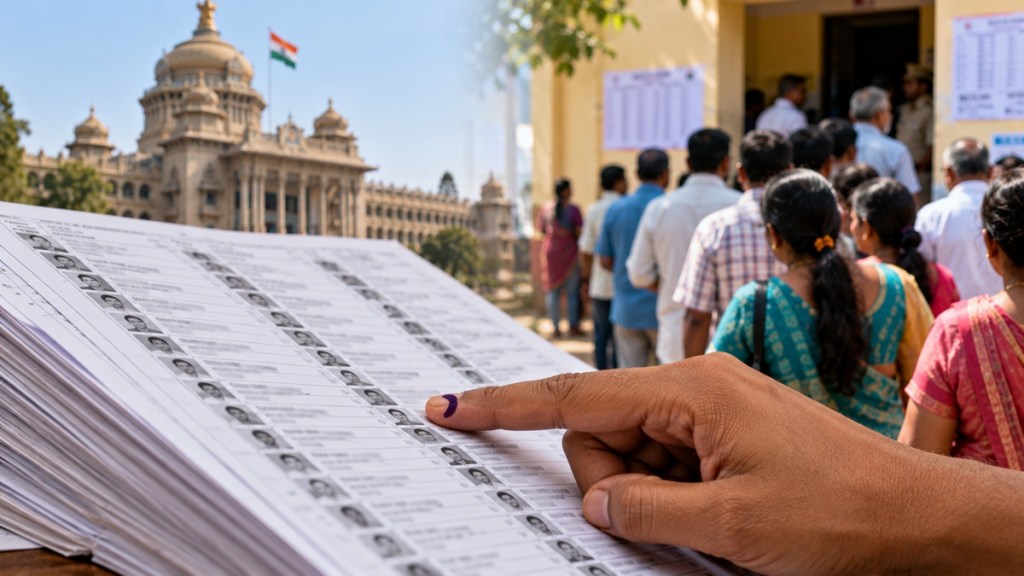

Karnataka‘s electorate has shrunk by 99.32 lakh following the Special Intensive Revision (SIR), with the final electoral roll, published on Tuesday, recording 4.55 crore voters against 5.54 crore before the exercise began.
According to the data from the Office of the Chief Electoral Officer (CEO), Karnataka, it shows the final electorate comprises 2.26 crore male voters, 2.29 crore female voters and 2,841 third-gender electors. The roll includes 6.83 lakh young voters aged 18-19 and 3.92 lakh electors aged 85 years and above.
The final count shows a decline of around 17.92% from the pre-revision electorate. However, it marks a net increase of 8.64 lakh voters compared with the draft roll published on August 24, which had recorded 4.46 crore electors.
Why Karnataka’s voter count fell after SIR
The revision exercise began with house-to-house verification by 60,923 Booth Level Officers (BLOs) between June 30 and August 17. Enumeration forms were generated for all 5.54 crore electors on the existing rolls, of whom 4.46 crore, or 80.52%, submitted their forms.
The remaining 1.08 crore electors, accounting for 19.48% of the pre-revision electorate, did not submit enumeration forms and were excluded from the draft roll.
According to the CEO’s data, the probable reasons recorded for their non-inclusion were 19.01 lakh electors marked absent, 65.46 lakh who had permanently shifted, 16.40 lakh who were reported dead and 7.10 lakh entries classified as duplicates or already enrolled.
The draft roll therefore recorded a reduction of approximately 1.08 crore electors from the initial count. Subsequent claims, objections and verification led to additions, deletions and corrections before the final list was published.
Over 10 lakh additions during claims and objections
During the claims and objections period, 10.08 lakh additions were recorded. These included 8.77 lakh additions through Form 6, 2,312 through Form 6A and 1.29 lakh through Form 8 for shifting.
The process also resulted in 1.88 lakh deletions and 8.97 lakh modifications or corrections to existing entries.
In addition, notices were generated for 43.83 lakh electors whose details did not match during verification. The CEO’s office said all notices were delivered and hearings were conducted. Following verification, 61,867 electors were marked ineligible for inclusion in the final roll.
The net increase of 8.64 lakh electors between the draft and final rolls brought the electorate to 4.55 crore, leaving the final count nearly one crore below the pre-SIR figure.
Congress criticises SIR exercise
The revision exercise has drawn criticism from the Congress. Karnataka Chief Minister DK Shivakumar said it was the responsibility of the state government and the party to protect voters.
Leader of the Opposition in the Lok Sabha Rahul Gandhi has also filed a public interest litigation (PIL) in the Supreme Court seeking a halt to the nationwide SIR exercise and the suspension of Chief Election Commissioner Gyanesh Kumar, alleging discrepancies.
The CEO’s office said the exercise covered all 224 Assembly constituencies in Karnataka and involved election officials, BLOs and representatives of seven recognised political parties: the Aam Aadmi Party (AAP), Bahujan Samaj Party (BSP), Bharatiya Janata Party (BJP), Communist Party of India (Marxist), Congress, National People’s Party and Janata Dal (Secular).
How voters can check their names
The CEO’s office has asked electors to verify their names through Electoral Registration Officers, Assistant Electoral Registration Officers and BLOs. The final electoral roll is also available on the CEO Karnataka website and the Election Commission’s voter services portal.
Under Section 24(a) of the Representation of the People Act, 1950, a person aggrieved by an Electoral Registration Officer’s decision can appeal to the District Magistrate. A second appeal can be filed before the Chief Electoral Officer under Section 24(b).
The CEO’s office thanked BLOs for conducting house-to-house visits covering 5.54 crore electors and holding hearings for 43.83 lakh electors. It reiterated the guiding principle of the exercise: “No eligible citizen is left out while no ineligible person is included in the electoral roll.”