


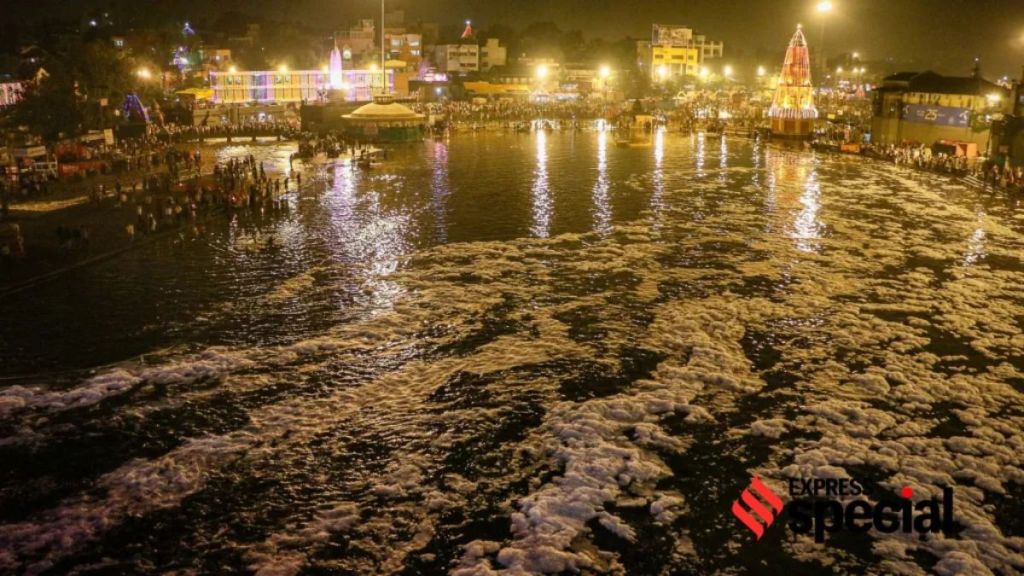

Water samples collected near Nashik’s Ambad industrial area have recorded chromium levels more than 1,000 times the permissible limit for drinking water, raising concerns about industrial pollution ahead of the 2027 Kumbh Mela, reported The Indian Express.
The laboratory report found total chromium concentration of 50.5 mg per litre, of which 50.3 mg per litre was highly toxic hexavalent chromium. The Bureau of Indian Standards (BIS) sets the permissible limit for chromium in drinking water at 0.05 mg per litre. A copy of the report was accessed by The Indian Express.
The samples were collected from the Nandini river system near the Ambad industrial area. The river flows into the Godavari, where large numbers of devotees are expected to gather for ritual bathing during the Kumbh Mela. The findings have raised questions about the extent of industrial contamination in the river system and its potential implications for water quality.
On Thursday, state minister Girish Mahajan, who is overseeing preparations for the religious gathering, visited the affected area and discussed the findings with Maharashtra Environment and Climate Change Minister Pankaja Munde. An official from Munde’s office said she had instructed Maharashtra Pollution Control Board officials to take immediate and appropriate action against industries found to be responsible for pollution.
Water samples tested at accredited laboratory
Environmental activist Rajesh Pandit, who has campaigned for river rejuvenation and pollution control in Nashik for more than a decade, said complaints about discoloured water from residential borewells in Ambad had prompted the investigation.
“We have been fighting for river rejuvenation and against water pollution for over a decade. We received complaints that several residential borewells in Ambad were supplying yellow water,” said Nashik-based environmental activist Rajesh Pandit, who has been campaigning against pollution in the region, reported The Indian Express.
Pandit said he and Parineeta Dandekar of the South Asia Network on Dams, Rivers and People (SANDRP) visited the area and collected water samples for analysis at an accredited laboratory.
The samples were tested on October 3 by Ashwamedh Engineers and Consultants, a private laboratory. After receiving the findings, Dandekar shared the report with government authorities, prompting Mahajan to raise the matter with Munde.
The report has brought renewed attention to the possible effects of industrial wastewater on the Nandini river and the Godavari. With the Kumbh Mela expected to draw large crowds to Nashik in 2027, the quality of water at bathing ghats is likely to remain a key concern for authorities.
Residents report health concerns, groundwater contamination remains unclear
Hexavalent chromium is a known human carcinogen, and exposure can pose serious health risks. However, the extent of contamination in groundwater around Ambad and its impact on local residents have not yet been established through a detailed investigation.
Pandit said residents had reported skin problems and other illnesses that he attributed to exposure to polluted water. He cited complaints of chemical ulcers, rashes and blisters, along with swollen lymph nodes and chronic illnesses. According to him, two women in the affected settlement had also reported miscarriages.
“Because of the low and inconsistent water supply from the Nashik Municipal Corporation, families are forced to depend on this water for bathing, washing clothes and cleaning utensils,” Pandit said.
He alleged that authorised industrial units as well as illegal operators were releasing untreated wastewater into the open. Pandit also said the extent to which the contamination may have spread through groundwater was still unknown and called for a detailed study to determine its reach.
The laboratory findings point to a need for further investigation into the source and spread of chromium contamination, including its possible presence in nearby groundwater and the risks faced by residents. Authorities will also need to assess the implications for the Nandini-Godavari river system as Nashik prepares for the 2027 Kumbh Mela.