


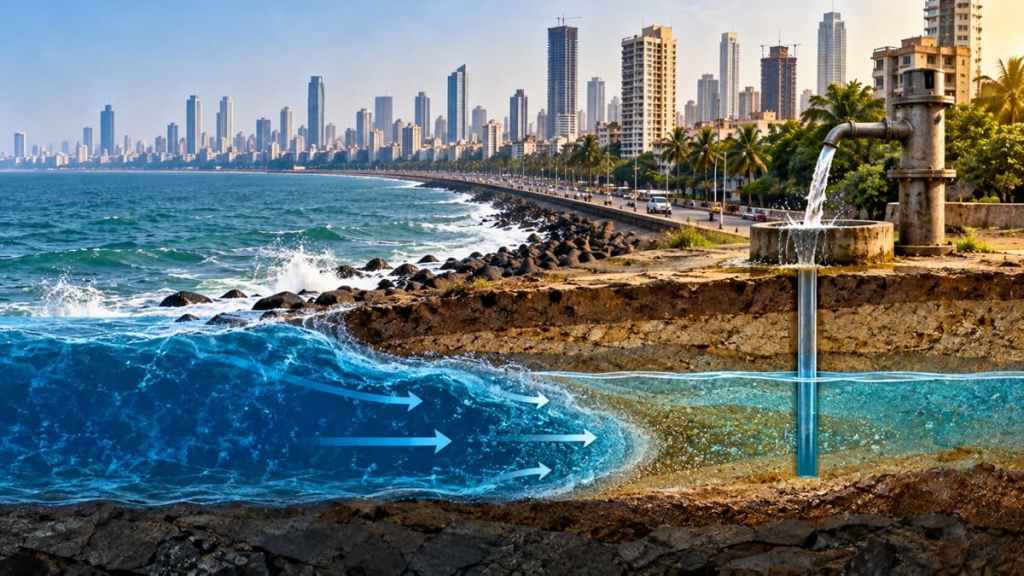

Nearly 35% of Mumbai’s geographical area is highly vulnerable to seawater intrusion into freshwater aquifers, raising concerns about groundwater quality and its long-term usability, according to a study by the Central Ground Water Board (CGWB), The Indian Express reported.
The warning comes as parts of Maharashtra face drought-like conditions. The CGWB assessment found saline groundwater in areas including Fort, Shivaji Park in Dadar and Mulund East, highlighting the risk of coastal salinity affecting groundwater resources even when overall extraction levels are not considered high.
According to The Indian Express, the findings are part of the CGWB’s 2025 Aquifer Management Plan, presented by the Union Ministry of Jal Shakti’s Department of Water Resources, River Development and Ganga Rejuvenation. The assessment mapped aquifers across 603 sq km covering Mumbai city and suburban districts.
Which parts of Mumbai face the risk?
The study found that shallow aquifers along Mumbai’s western and southern coastlines are particularly vulnerable to seawater intrusion. In the eastern part of the city, deeper aquifers near creeks face a greater risk of salinity.
Saline intrusion was observed particularly during the pre-monsoon period, the assessment found. Fort, Mulund East and Shivaji Park were among the locations where electrical conductivity (EC) levels exceeded 10,000 microsiemens per centimetre, indicating highly saline groundwater. Mahim was also identified among the areas where saline groundwater was encountered.
Electrical conductivity measures how readily water conducts electricity and is used as an indicator of dissolved salts. Elevated EC levels can signal salinity that may affect groundwater quality and its suitability for use.
The CGWB has recommended restricting groundwater development in Fort to depths of up to 60 metres. In Shivaji Park, where highly saline water was found at shallow depths, it has recommended a complete prohibition on groundwater development.
Why seawater intrusion can occur even when extraction is low
The CGWB estimated the stage of groundwater extraction at 46% in Mumbai city district and 26% in the suburban district. While these figures do not indicate high overall extraction levels, the report cautioned that they do not rule out localised seawater intrusion.
Excessive pumping can lower freshwater pressure within an aquifer, allowing saline water to move inland or into freshwater-bearing formations. Once an aquifer becomes salinised, its water may become unsuitable for some uses.
This means that district-wide extraction figures alone may not capture the risks faced by individual neighbourhoods, particularly those near the coast or creeks. Local geological conditions, groundwater depth and pumping patterns can influence the extent of intrusion.
Mumbai’s dependence on reservoirs
Mumbai relies primarily on seven surface-water reservoirs for its drinking water supply. These reservoirs are replenished by the southwest monsoon, which typically runs from June to September.
Groundwater, once drawn more widely from wells and other local sources, is now largely used to supplement the city’s water supply. However, the CGWB findings underline the need to protect groundwater quality, particularly in vulnerable coastal and creek-side areas.
The report’s warning is significant because the availability of groundwater does not necessarily mean that it is suitable for use. Salinity can limit its usability even where water remains physically accessible through wells and borewells.
What measures has the CGWB recommended?
To limit further seawater intrusion, the CGWB has called for groundwater recharge structures in vulnerable areas. These include recharge pits fitted with filters, recharge shafts and percolation tanks or ponds, particularly in parks and gardens.
Such structures can help replenish freshwater aquifers and maintain the pressure needed to resist the movement of saline water.
The report has also recommended regular monitoring of electrical conductivity in coastal observation wells to track changes in groundwater salinity. New deep borewells tapping fractured rock zones, meanwhile, should be permitted only after detailed hydrogeological and geophysical investigations.
The recommendations seek to balance groundwater use with the need to preserve freshwater aquifers in areas where seawater intrusion is already a concern.
BMC commissions separate groundwater salinity study
Separately, the Brihanmumbai Municipal Corporation (BMC) has commissioned the All India Institute of Local Self Government to assess salinity levels in Mumbai’s groundwater.
The agency will collect water samples from wells across the city to determine the extent of salinisation. The results are expected to provide a clearer picture of groundwater quality across different locations.