


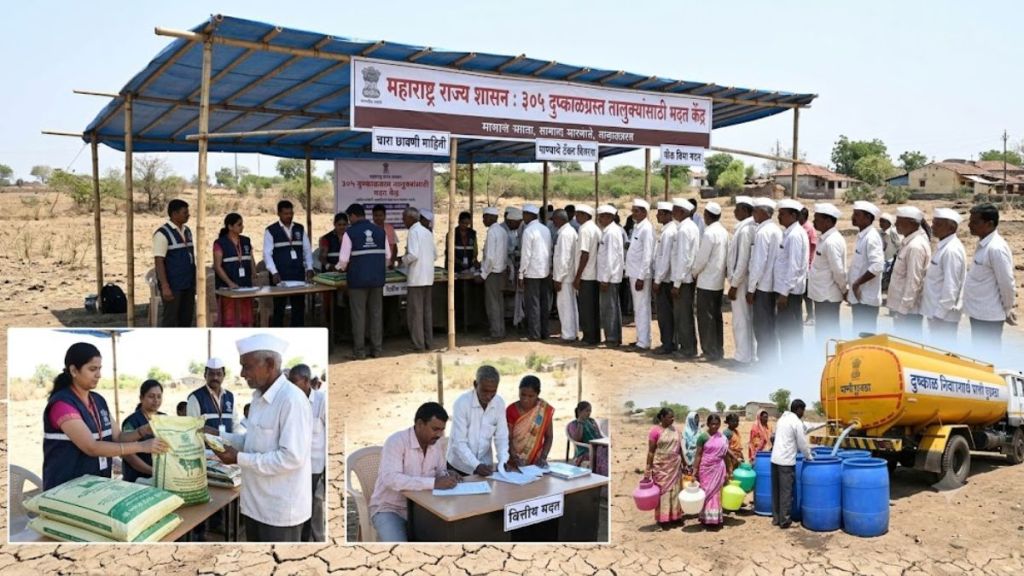

More than 85% of Maharashtra’s talukas have been declared drought-hit after the state government added 40 more talukas to the list, taking the total number of affected regions to 305 out of 358, Chief Minister Devendra Fadnavis said on Wednesday.
The state government will also deposit Rs 5,000 into farmers’ bank accounts before Diwali as initial financial assistance, Fadnavis said. The move is intended to provide immediate relief as the formal administrative process and assessment by the Centre could take longer to complete.
“Drought was initially declared in 265 talukas. After evaluating complaints, 40 additional talukas were added, bringing the total to 305 talukas. All 12 standard state drought relief concessions are now extended to these talukas,” Fadnavis told reporters after the cabinet meeting.
The government had declared 265 talukas drought-hit last month following a rainfall deficit. The relief package included measures such as restructuring crop loans, concessions on land revenue and subsidies on electricity bills.
Fadnavis said a supplementary Government Resolution (GR) had been issued to formally include the additional 40 talukas. He added that the government usually declares drought by the end of November and extends assistance by December. However, the severity of the current situation prompted the state to issue the drought notification in October.
Maharashtra drought relief: Loan recovery curbs, fee waivers for farmers
The chief minister said the government had processed an authenticated list of another 3.5 lakh farmers who are scheduled to receive debt relief payments alongside the existing measures.
The state has also removed conditions dating back to a 1992 resolution that limited educational fee waivers for farmers’ children. The exemption will now apply universally across the drought-affected areas, Fadnavis said.
District Central Co-operative (DCC) banks and credit societies have been warned against pressuring farmers to repay loans, harassing borrowers or carrying out coercive recovery, he said. The government is also working to extend similar restrictions to private banks and financial institutions.
Farmers will not face coercive recovery or pressure over outstanding electricity bills, Fadnavis said. Under the state’s policy, agricultural pumps with a capacity of up to 7.5 horsepower are eligible for free electricity.
Water tankers, groundwater levels and fodder availability
The chief minister flagged the worsening water situation in Marathwada, where groundwater levels in observation wells have dropped below three metres. The state plans to deploy water tankers early, during October and November, with GPS tracking to monitor their movement.
Nearly 16,000 illegal water connections have been disconnected to protect drinking water supplies. The government will maintain a zero-tolerance approach towards unauthorised water extraction, Fadnavis said.
Fodder availability across the state ranges from 90 days to seven months, depending on the region. In areas with access to irrigation or dam water, farmers have been encouraged to grow rabi jowar and fodder crops. The state government will purchase all harvested fodder at the Minimum Support Price (MSP), he said.
The cabinet also passed a resolution congratulating Prime Minister Narendra Modi on completing 25 years as head of government, Fadnavis said.
Modi first became chief minister of Gujarat on October 7, 2001, and subsequently served as prime minister after the BJP won three consecutive Lok Sabha elections. He has remained at the helm of government since that date.