


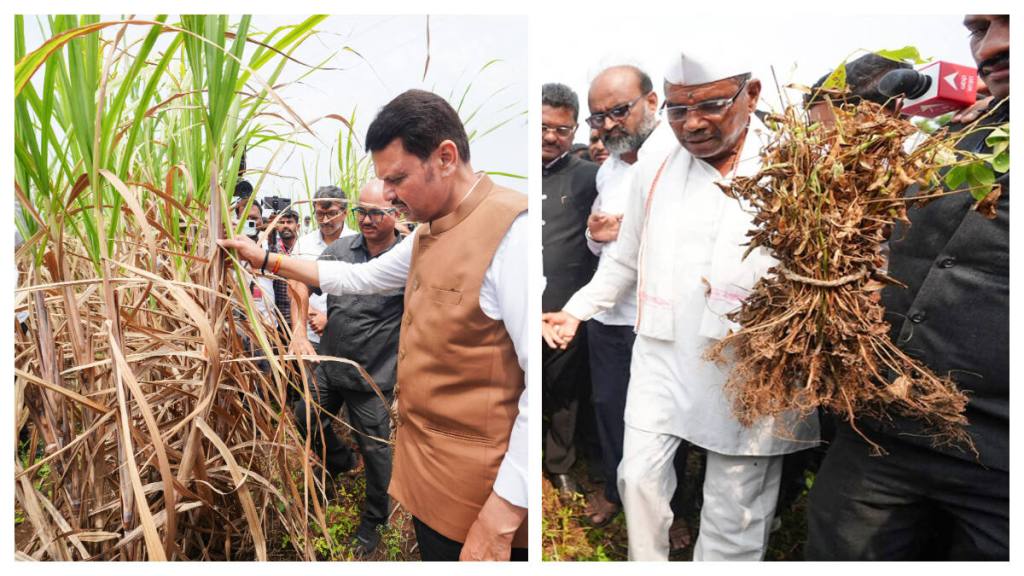

More than 265 of Maharashtra’s 358 talukas have been officially declared drought-hit after a deficient and erratic monsoon, with the entire Yavatmal district in Vidarbha reeling under severe dry conditions. All 16 talukas in Yavatmal, including Kalamb, fall under the “Trigger‑1” drought category, which activates 12 relief concessions, even as farmers watch their crops wither and festival savings disappear.
As a Central inter‑ministerial team began its on‑ground assessment from October 8–11 to estimate crop damage and water scarcity, farmers in Yavatmal told The Indian Express that they had little to celebrate Dussehra or Diwali this year.
Cotton, soybean and tur crops that usually generate the year’s income are yielding a fraction of normal output. This leaves households facing unpaid loans, sold‑off livestock and the prospect of migrating for wage labour.
What is ‘Trigger-1’ drought category
Trigger‑1 drought category is the first level of drought alert under Maharashtra’s Drought Management Code, 2016. It is declared when a taluka’s monsoon rainfall falls short by 20–40% of the normal level and early crop indicators show stress.
Once Trigger‑1 is announced, the state must roll out a standard set of 12 relief concessions, including measures like waiver of water rates for irrigation, priority drinking‑water supply, fodder camps, and relaxed norms for loan rescheduling and recovery, to help farmers and rural households cope with the emerging shortage.
Cotton fields that never opened
In Narsapur, Ashok Dasreji Landge (63) normally expects cotton bolls to be at his doorstep by Dussehra. This year, his seven acres—and the six acres cultivated by his son Swaroop (36)—remain stubbornly bare.
In a normal season, his fields would produce 25–50 quintals of cotton. Now, estimates range from five to eight quintals, with some farmers expecting just 10–25% of a normal crop. Landge, who spent about Rs 21,000 per acre, said, “But this year there is no production.”
The impact has reached every corner of the household. The family has already sold four cows and two buffaloes for around Rs 60,000 because fodder and water could no longer be sustained. Crop loans of Rs 2.10 lakh (Landge) and Rs 1.10 lakh (his son) remain overdue. To keep farming, they have pledged household utensils.
“Diwali and Dussehra will come, but we will have to continue according to whatever the situation is,” Landge told The Indian Express.
Soybean failed, cotton shrunk: ‘What will come out of this?’
In Dhanodi, Chitaman Vitthal Bhoyar (49) faces a similar squeeze on his 3.16‑hectare holding: one hectare under soybean, two under cotton and 16 gunthas under tur. The soybean crop barely developed due to lack of water.
“In a good year, I would have got about 25 quintals of soybean. This year, I may get only five,” he told The Indian Express. For cotton, I would have got around 35 quintals. This year, just seven to eight. His cultivation expenditure has climbed to about Rs 2.75 lakh, while expected crop income is only around Rs 90,000. Pulling out a stunted plant, he asked, “Look at this. What will come out of this?”
The crisis is now threatening his children’s education. His elder daughter is pursuing BSc Nursing in Yavatmal; two years of fees total Rs 1.25 lakh, of which he has paid only Rs 25,000. He is considering withdrawing her from the course.
“I will have to work somewhere,” he said, adding that he has already sold his bullocks, bought for Rs 70,000 but sold for Rs 40,000 as fodder became unavailable.
From harvest to wage labour: ‘Construction work may be the only possibility’
In Ichora, Nitin Gangadhar Nagose (34) owns five acres and grows only cotton. Last year, he harvested around 25 quintals; this year, he expects seven to eight.
Nagose told The Indian Express that even if it rains now, losses won’t be covered. He said with the farm unlikely to provide income through the year, he expects to take up daily wage work and construction work in a nearby city may be the only possibility.
Nagose lives with his wife, two sons and parents. He worries about how to explain the situation to his children as they do not understand what is happening and will demand new clothes for Diwali.
Behind his field, Subhash Meshram (52) and his wife Sumanbai (48) face another failed cotton crop on five acres of cotton and tur. A 35‑foot well he dug has no water. He expects only four to five quintals of cotton against about 50 quintals in a normal year.
Sumanbai told The Indian Express that this time Dussehra and Diwali will not be celebrated as Meshram has a crop loan of Rs 1.30 lakh and no clear plan to repay it.
“I can die, I can hang myself from this tree, but what will that achieve?” Despair is visible in the words of Arun Balkrishna Deotale (55) of Ichora, who cultivates 3.5 acres under tur and cotton and expects only about 10% of the expected crop.
Ramchandra Warhade, 34, who farms vegetables and cotton on four acres, fears farmer suicides could rise this year. He told The Indian Express that Vidarbha continues to face a serious water crisis despite several chief ministers from the region. Rising input costs have added to farmers’ problems, with fertiliser prices increasing by Rs 200–300 per bag, except urea.
Sandeep Thakre (45) of Ichora, whose cotton, soybean and tur have all suffered, has already spent more than Rs 2.5 lakh.
Thakre told The Indian Express that even if we recover what we have invested, that would be enough and how much will the government give us- Rs 8,000 or Rs 15,000?.
Panchnamas underway, relief decision with state
On the ground, revenue officials have begun panchnamas (crop‑damage assessments) in Kalamb and surrounding areas.
“We have started conducting panchnamas across the area and will complete them as soon as possible and submit the report to the government,” Kalamb tehsildar Abhay Deshpande told The Indian Express.
He said the final decision on relief would be taken by the state government. Sub‑divisional magistrate (SDM) Vikas Kardile said 15–20 water‑conservation works were under way in Kalamb, with a focus on recharge pits on farm lands and repairs to deteriorated bunds and gates.
“Our priority going forward is water conservation,” Kardile said. “March and April will be challenging here. This area largely depends on kharif farming, and that itself is lost.”
How is the state government helping?
Maharashtra Chief Minister Devendra Fadnavis on October 7 said he met Union Home Minister Amit Shah in Delhi and sought maximum assistance under the National Disaster Response Fund (NDRF) for drought‑hit areas.
“Drought has been declared in more than 265 talukas in Maharashtra, and drought relief measures have been announced. In such a situation, a request was made to him to provide maximum assistance on behalf of NDRF,” Fadnavis said in a post on X.
हमारे नेता, मा. केंद्रीय गृह एवं सहकारिता मंत्री अमितभाई शाह इनसे आज नई दिल्ली में मुलाकात कर महाराष्ट्र में सूखे की स्थिति पर विस्तृत चर्चा की। उन्हें राज्य की पूरी स्थिति से अवगत किया और राज्य सरकार द्वारा किए जा रहे उपायों की जानकारी दी। इस संबंध में राज्य सरकार की ओर से एक निवेदन भी सौंपा।
महाराष्ट्र की 265 तहसीलों में सूखा घोषित किया गया है और विभिन्न सूखा राहत उपाययोजनाएं लागू की गई हैं। ऐसी स्थिति में एनडीआरएफ के माध्यम से महाराष्ट्र को अधिक से अधिक सहायता उपलब्ध कराने का अनुरोध उनसे किया।
मा. अमितभाई शाह इन्होंने महाराष्ट्र को अधिकतम सहायता उपलब्ध कराने का आश्वासन दिया। उन्होंने यह भी जानकारी दी कि केंद्र सरकार की टीम 8 से 11 अक्टूबर के बीच महाराष्ट्र का दौरा कर स्थिति का जायजा लेगी।
केंद्र सरकार मजबूती से महाराष्ट्र के साथ खड़ी रहेगी, ऐसा आश्वासन देने के लिए मैं उनका अत्यंत आभारी हूं।
@AmitShah @HMOIndia
#NewDelhi— Devendra Fadnavis (@Dev_Fadnavis) October 7, 2026
He added that Shah assured him that the Centre would provide maximum assistance and informed him that a Central government team would visit the state for an assessment from October 8 to 11.
“The Central government will firmly stand behind Maharashtra,” Fadnavis said.
The Centre has constituted an inter‑ministerial team headed by Agriculture Department Joint Secretary Muktanand Agrawal, with representatives from multiple Central departments and agencies. The team is expected to assess crop damage, water scarcity and the overall impact of the drought before submitting its findings for consideration of relief and rehabilitation measures, including assistance under disaster‑response funds.
The Maharashtra government had declared drought in 265 talukas in September 2026 following deficient and erratic monsoon rainfall and announced a relief package for affected areas. These talukas account for nearly three‑fourths of the state’s 358 talukas.
CM Fadnavis has also indicated that some areas not in the initial drought list could be considered for relief, citing the impact of erratic rainfall and dry spells on crops even where the standard Trigger‑1 criteria under the Drought Management Code, 2016 were not fully met.