


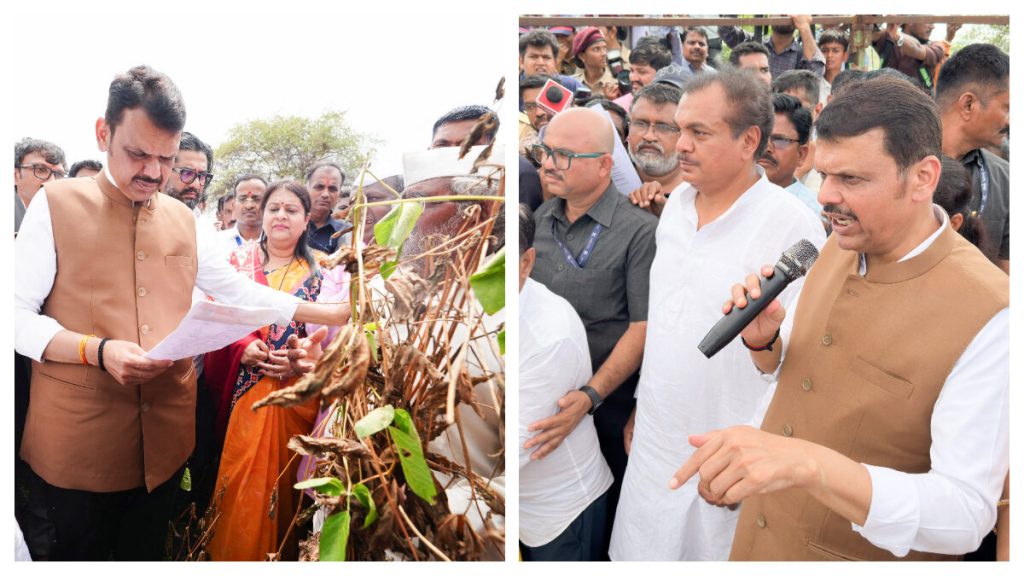

Maharashtra Chief Minister Devendra Fadnavis has described the state’s drought-like situation as extremely serious and announced that the government will issue an order on September 25 (Friday) to provide immediate assistance to affected farmers. The relief will be released under the first trigger of the state’s drought management code without waiting for financial support from the Centre.
After visiting drought-affected areas of Washim district in eastern Maharashtra, CM Fadnavis admitted that the situation was “extremly serious”, and said the government would provide assistance under ‘Trigger 1’ of the state’s drought relief code without waiting for assistance from the Centre.
The announcement came after CM Fadnavis visited drought-hit villages in Washim district, where he inspected damaged soybean and tur crops and spoke to farmers about crop losses, water shortages and the impact on household incomes.
The state’s response comes as a prolonged dry spell threatens crops, livestock and drinking-water supplies across parts of Maharashtra. The government has formed a cabinet sub-committee headed by Revenue Minister Chandrashekhar Bawankule to monitor the situation, assess damage and recommend relief measures.
Standing With Our Farmers in These Difficult Times 🌾
Every crop carries the hard work and hopes of our farmers. But extremely low rainfall has put our farmers under severe strain. At this difficult time, standing with every affected farmer and ensuring timely relief and support… https://t.co/KF1GoIAtd0 pic.twitter.com/BnYroKbQna
— Devendra Fadnavis (@Dev_Fadnavis) September 24, 2026
Relief order to be issued
CM Fadnavis said the state government would issue a Government Resolution (GR) on Friday to provide assistance under “Trigger 1” of the state’s drought relief code.
“The order for providing assistance to farmers will be issued tomorrow,” he told media after completing his visit to Washim.
The Chief Minister said some areas that may not have been covered under the initial trigger could later be added under the third trigger after further assessment.
“We will initiate a government resolution on the dry drought and provide help to all farmers,” Fadnavis said while interacting with farmers.
He also said the state would not wait for central assistance before taking action. The government would provide relief from its own resources and seek additional assistance from the Centre separately.
Crop losses and water shortage
During his visit, Devendra Fadnavis inspected farms in Mhasla village in Karanja taluka, Mohgavhan in Mangrulpir taluka and Jaulka in Malegaon taluka. Soybean and tur crops have been badly affected by the lack of rain. Farmers told the Chief Minister that crops had dried up and that water was unavailable in several locations.
“There is no water anywhere. Crops have dried up, especially soybean, which has been greatly affected. Farmers have suffered losses,” Fadnavis said.
He warned that the dry spell could create shortages of fodder and drinking water in the coming weeks. The government’s relief package will therefore cover not only crop losses but also foodgrains, livestock support, education expenses and irrigation assistance for the Rabi season.
In a post on X, Fadnavis said, “Every crop carries the hard work and hopes of our farmers. But extremely low rainfall has put our farmers under severe strain.”
🔸CM Devendra Fadnavis inspected the areas affected by the drought-like situation in Jaulka, Malegaon taluka, in Washim district. During the visit, he interacted with farmers and assessed the damage caused.
MP Anup Dhotre, MLC Bhavana Gawali and concerned officials were present.… pic.twitter.com/8mSPGZ3B4j— CMO Maharashtra (@CMOMaharashtra) September 24, 2026
Washim rainfall remains below normal
Washim district received 77.9% of its average rainfall between June and September, according to an official statement. All 13 talukas in the district experienced dry spells lasting more than 20 days. Rainfall in August was 53.7% of the average. In September, the district had received only 30.7% of its normal rainfall at the time of the assessment.
Fadnavis said the situation in some parts was particularly severe, with rainfall in certain areas reaching only around 30% of normal levels.
“Thirty per cent rainfall has occurred. A 70% deficit means it is a very severe drought,” he said.
The rainfall deficit has affected standing crops and reduced water availability for both households and livestock. Farmers are also concerned about their ability to finance the next sowing season.
Direct support beyond loan waivers
The state government has already begun implementing a loan waiver scheme and has waived electricity bills for farmers, Fadnavis said. He added that banks would be instructed to provide fresh loans to farmers who had received loan waivers under the applicable rules. Banks would also be asked not to pursue recoveries during the crisis.
However, the Chief Minister said loan relief alone would not be enough.
“Farmers will now need direct assistance because in some places they may face fodder problems, in some places children’s education will be at risk, and in some places there will be a shortage of foodgrains,” he said.
The government plans to provide direct assistance to affected families, support Rabi irrigation and help ensure that children do not have to discontinue their education because of the crop losses. Fadnavis said the administration would try to ensure that the assistance reaches farmers before Diwali.
Cabinet panel to monitor situation
The cabinet sub-committee headed by Bawankule will conduct weekly reviews of the drought-like situation and monitor the implementation of relief measures.
The committee will examine:
- Crop damage and compensation requirements.
- Availability of drinking water.
- Fodder requirements for livestock.
- Progress of crop-loss assessments.
- Implementation of relief measures.
- Water-conservation and employment works.
The committee includes ministers from the departments of water resources, disaster management, water supply, soil and water conservation, agriculture, animal husbandry, rural development, transport, relief and rehabilitation, and cooperation. The Chief Secretary will serve as its secretary. The state has instructed local authorities to conduct ‘panchnamas’ of damaged crops so that eligible farmers can be identified for assistance.
Water conservation and employment works
The government will focus on watershed-related works in drought-affected areas. These will include desilting dried-up water bodies and repairing or constructing water-conservation structures. The works are expected to serve two purposes: improve water availability and provide employment to rural households affected by crop losses.
Fadnavis said the government would also make arrangements to prevent shortages of drinking water and fodder over the coming months. The administration is preparing for a longer period of water stress rather than treating the problem as a short-term crop failure.
Procurement at support prices
The state government will procure agricultural produce at the prescribed minimum support prices (MSP), Fadnavis said. Registration for procurement will begin soon. The measure is expected to protect farmers from being forced to sell crops at distress prices, particularly if the affected areas receive some late-season harvest.
Opposition demands special session
The drought response has also triggered political criticism. Shiv Sena (UBT) chief Uddhav Thackeray has demanded that the government declare drought on a taluka-wise basis and convene a special session of the state legislature.
“Don’t look at the almanac, look at the drought. The government should declare it taluka-wise,” Thackeray said.
He also called for a public drought dashboard showing the number of farmers assessed, compensation paid, loan waivers completed and the availability of water and fodder. Thackeray questioned the delay in crop-loss assessments and demanded that assistance reach farmers within a fixed period.
“Whatever help is announced from the legislature, at least within 45 days the help should reach the farmers,” he said, while calling for priority to be given to drinking water, fodder and farm debt relief.
Congress leader and Maharashtra Assembly Opposition Leader Vijay Wadettiwar also demanded an immediate drought declaration, financial compensation of Rs 50,000 per affected farmer and a three-day special session of the legislature.
“There are tears in the eyes of the farmers,” Wadettiwar said, urging the government to announce a comprehensive relief package.
The government has rejected the idea of turning the crisis into a political dispute. Responding to the demand for a special session, Fadnavis said, “Why should there be politics when our farmers are in distress? We will figure out how to help farmers.”
Financial pressure on the state
The drought response will add to Maharashtra’s financial burden at a time when the government is already implementing a farm-loan waiver and electricity-bill relief. State minister Pankaja Munde said the government had approved a loan waiver worth Rs 32,000 crore and had also waived farmers’ electricity bills. The additional direct assistance, fodder support, foodgrains, Rabi irrigation and employment works will require further state spending.
The government has not yet announced the total value of the new drought-relief package. The amount will depend on the number of affected farmers, the final crop-loss assessment and the areas brought under the different triggers of the drought code in Maharashtra.