


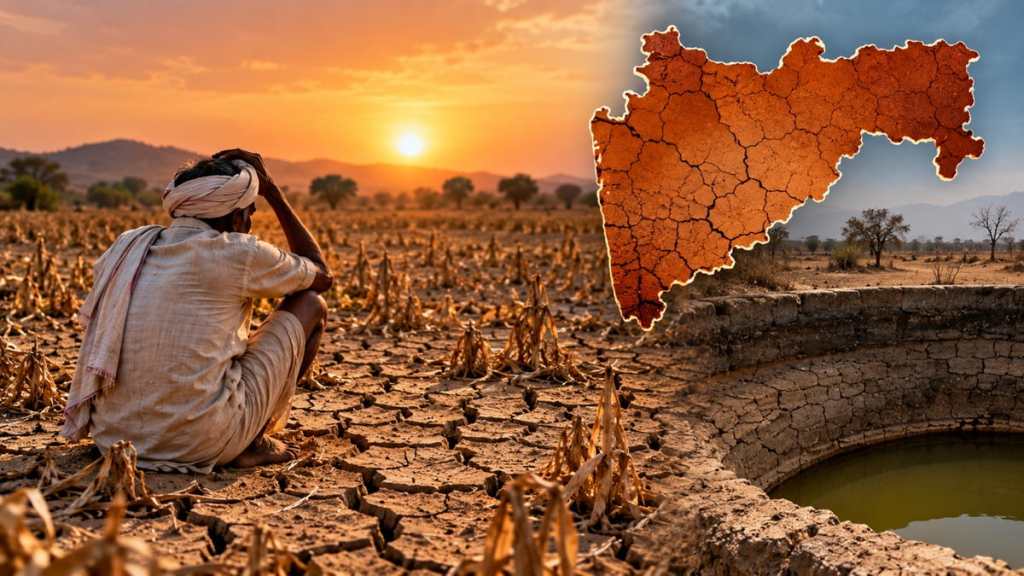

Prolonged dry spells and deficient rainfall have damaged crops across Maharashtra, leaving farmers facing losses and raising concerns over water and fodder availability. The crisis is also expected to put additional pressure on the state’s finances as the government prepares relief measures.
The state government on Saturday declared drought in 265 of its 358 tehsils and ordered an immediate assessment of crop losses, The Indian Express reported. The findings will determine financial assistance for affected farmers, while other relief measures take effect under the declaration.
The decision comes two days after Chief Minister Devendra Fadnavis, during a tour of rain-deficit areas, said the government would soon issue a drought notification.
According to the Government Resolution cited by The Indian Express, the Agriculture Commissioner’s report found drought-like conditions in 265 talukas from June onwards, citing rainfall deficiency and other factors.
Trigger 1, which applies when there is a continuous dry spell of at least 21 days without significant rainfall during the monsoon, was found applicable in these areas.
Maharashtra records 18.8% rainfall deficit
The rainfall deficit has been particularly sharp across several regions. The Chhatrapati Sambhajinagar division received 424.5 mm of rainfall between June 1 and September 18, against a normal rainfall of 613.1 mm, resulting in a 30.8% deficit. Dharashiv and five other districts in Marathwada fall under the division.
The Pune and Nashik divisions also recorded around a 30% rainfall deficit, while the Amravati and Nagpur divisions recorded deficits of around 27%. The Konkan division recorded a relatively lower deficit of 6.3%.
Overall, Maharashtra received 755.9 mm of rainfall between June 1 and September 18, compared with normal rainfall of 932.3 mm, a deficit of 18.8%.
At least six districts recorded rainfall deficits of 40-50%, including Amravati, Solapur and Latur.
The rainfall shortfall has come amid the impact of the El Nino phenomenon, with prolonged dry spells affecting standing crops and raising concerns over water and fodder availability.
What does the drought declaration mean?
District Collectors have been directed to immediately begin crop-loss assessments through panchnamas, according to the Indian Express report. Officials will document the condition of crops, including photographs with GPS coordinates, and submit the reports to the government through the Agriculture Commissioner.
The assessment will determine the extent of crop damage and form the basis for financial assistance to affected farmers. The government has said the monetary assistance will be announced through a separate Government Resolution after the prescribed assessment and verification procedures are completed.
The immediate relief measures triggered by the declaration include waiver of land revenue, restructuring of crop loans and a stay on recovery of agriculture-related loans, IE reported.
Fadnavis visits rain-hit areas
The declaration follows Fadnavis’ visits to several rain-deficit areas, where he interacted with farmers and assessed crop and water conditions.
During his visit to Washim district, the Chief Minister inspected farms in Karanja, Mangrulpir and Malegaon talukas. Soybean and tur crops have been badly affected by the prolonged lack of rainfall, according to the government.
“There is no water anywhere. Crops have dried up, especially soybean, which has been greatly affected. Farmers have suffered losses,” Fadnavis had said.
He also warned that the continuing dry spell could lead to shortages of fodder and drinking water in the coming weeks.
In a post on X earlier this week, Fadnavis said the government would take measures not only to provide crop relief but also to support affected families with foodgrains, ensure that farmers’ children can continue their education and provide assistance for Rabi crops.
Standing With Our Farmers in These Difficult Times 🌾
— Devendra Fadnavis (@Dev_Fadnavis) September 24, 2026
Every crop carries the hard work and hopes of our farmers. But extremely low rainfall has put our farmers under severe strain. At this difficult time, standing with every affected farmer and ensuring timely relief and support… https://t.co/KF1GoIAtd0 pic.twitter.com/BnYroKbQna
The government also plans to create employment through water-conservation works.
Relief to extend beyond loan waivers
Fadnavis has said loan relief alone will not be sufficient to address the impact of the drought-like conditions.
“Farmers will now need direct assistance because in some places they may face fodder problems, in some places children’s education will be at risk, and in some places there will be a shortage of foodgrains,” he said.
The government has already been implementing a farm-loan waiver scheme and has waived electricity bills for farmers, according to the Chief Minister. Banks will also be instructed to provide fresh loans to eligible farmers who have received loan waivers and refrain from pursuing recoveries during the crisis.
The state plans to provide direct assistance to affected families, support irrigation for Rabi crops and ensure that children do not have to discontinue their education because of crop losses. Fadnavis said the administration would try to ensure that assistance reaches farmers before Diwali.
Drought response adds to state finances
The drought response is expected to add to Maharashtra’s financial burden as the government is already implementing farm-loan waiver and electricity-bill relief measures.
State minister Pankaja Munde said the government had approved a Rs 32,000 crore loan waiver and had also waived electricity bills for farmers.
The additional spending on direct assistance, fodder, foodgrains, Rabi irrigation and employment-generating water-conservation works will add to the state’s expenditure.
However, the government has not yet announced the total value of the new drought-relief package. The final amount will depend on the crop-loss assessment, the number of affected farmers and the areas covered under the different triggers of Maharashtra’s drought management code.