


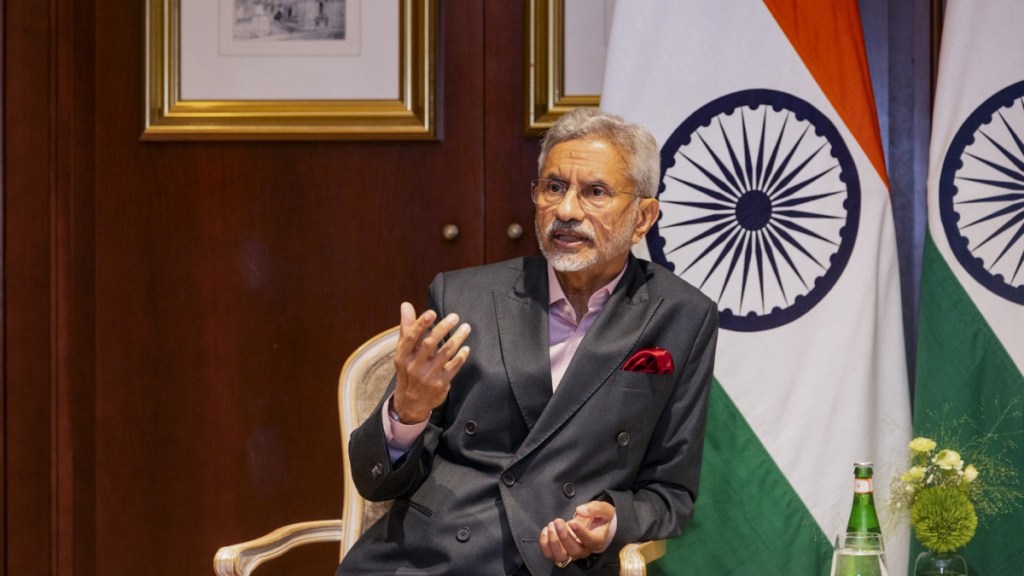

India mounted a vehement defence of its Russian oil purchase on Friday — with External Affairs Minister S Jaishankar insisting that a ‘boycott’ would not solve the Ukraine war. The senior official stressed the need for dialogue and diplomacy as he met with Ukrainian President Volodymyr Zelensky on Thursday. The visit to Kyiv came even as Prime Minister Narendra Modi met Vladimir Putin twice within weeks and the United States clamoured for a 100% tariff on India.
“This conflict, which is today in its fifth year, will not be solved because somebody is buying or not buying oil or alumina or minerals or metals or fertiliser. This conflict will be solved by dialogue, diplomacy, and negotiation. That is why, it is something we would encourage,” Jaishankar asserted.
The External Affairs Minister also met with Zelensky and held wide-ranging talks with his Ukrainian counterpart, Andrii Sybiha, earlier this week. He reiterated that India was ready to extend “any help in any manner” to end the war and highlighted “the existing threats to civilian shipping” in the Black Sea. Five Indian seafarers were killed earlier this year amid drone attacks between Russia and Ukraine.
“Prominent among them were attacks on commercial shipping. Indian seafarers man ships of many flags and have been among the unfortunate casualties. The impact on shipping is also significantly affecting many nations of the Global South in a variety of ways, leading to fuel, fertiliser, and food shortages. We exchanged views on these and related matters,” the EAM said.
‘Ready to supply as much as India needs’: Russian envoy
Russian officials have also insisted that the country remains ready to “supply as much oil as India needs”. Ambassador to India Denis Alipov told news agency ANI that Western secondary sanctions and tariffs targeting Russian oil trade were punitive “pressure tactics” rather than constructive global engagement. He also insisted that the global supply chain could not function if Russian crude was excluded. Alipov predicted that “Russian oil will stay in the market for India and other countries” despite pushback from the US.
“The question is how confident is India? India has shown that it’s able to stand its ground and defend its national interests. And when we speak about the sanctions pertaining to oil trade, the tariffs are also related to the cooperation between Russia and India in oil supplies. These interests are paramount for India,” Alipov emphasised.
Oil set for steepest weekly gain since mid-July
The assertions came even as oil prices rose steadily on Friday — on track for the steepest weekly gain since mid-July. Brent crude reversed earlier losses to touch $96 a barrel amid renewed hostilities and uncertainty over military strikes between the US and Iran. Brent crude futures rose 54 cents, or 0.6%, to $96.06 a barrel by 0100 GMT, while U.S. West Texas Intermediate crude futures climbed 80 cents, or 0.9%, to $92.10.
New Delhi had ramped up its purchase of crude from Moscow earlier this year — reaching a record high of 2.82 million barrels per day in July. The import figures fell dramatically in August as lower Russian seaborne exports, stronger Chinese competition and higher risks around Black Sea shipments reduced the availability of barrels for Indian refiners. Crude imports from Russia plunged 26.3% month-on-month to 2.08 million bpd in August, while overall crude imports fell 8.4% to 4.62 million bpd.
US mulls 100% tariffs for India
India appeared poised to face 100% tariffs after a sanctions bill cleared the US Senate with an overwhelming majority last month. But the Russia Sanctions Bill has reportedly stalled in the Republican-controlled House of Representatives amid concerns that it could expand President Donald Trump’s tariff powers and push up oil prices. According to a Bloomberg report, it will likely remain stalled at least until the November mid-term elections.
The sanctions bill also comes at a time when New Delhi continues to negotiate the “final one percent” of a bilateral trade agreement with the United States. Talks have stalled since the two countries announced an interim agreement in February 2026 — especially after the US Supreme Court struck down Trump’s sweeping reciprocal tariffs. Tariff structures have changed drastically in the ensuing months, and Indian officials insist that the future of any trade deal with the United States hinges on preferential terms.