


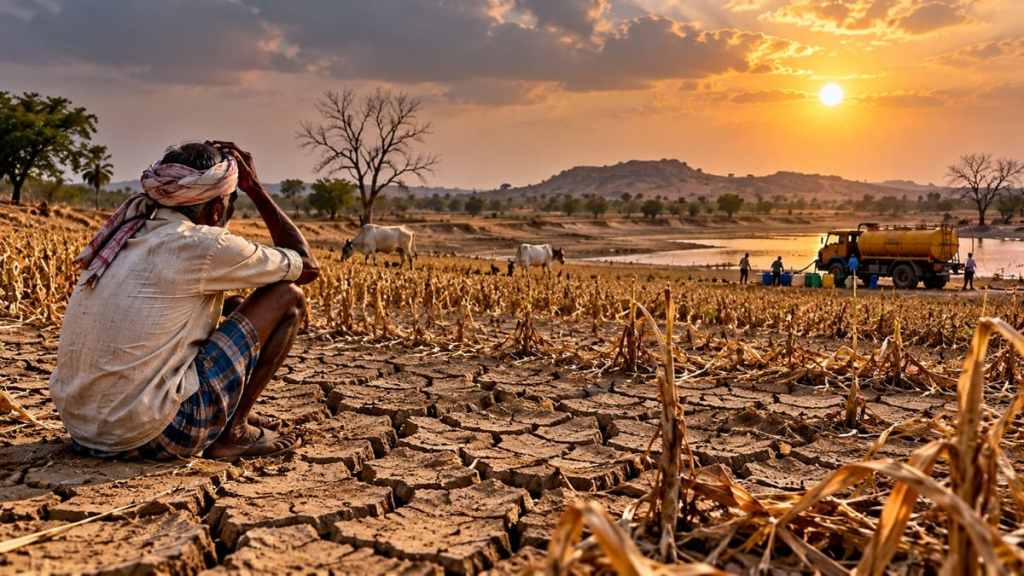

India faced its weakest monsoon in nearly two decades this year — with several states reporting drought conditions. The southwest monsoon recently ended 13% below the long-period average as the El Niño impact continued to grow.
“El Niño can bring drought to some regions and severe flooding to others – and in some cases both. These extremes damage crops, livestock and infrastructure, reducing food production and disrupting markets. As supply falls, prices rise and food becomes less affordable – especially for smallholder farmers and pastoralists who rely on rainfall. When combined with existing pressures such as conflict these climate shocks can quickly increase hunger,” the World Food Program warned in a recent analysis.
Weakest monsoon in over a decade
“India has recorded a 13% monsoon rainfall deficit. Rainfall has been below normal in some regions, including South India and the northeastern states. However, central and northwest India have received rainfall within the normal range,” IMD scientist Shashikant told IANS last week.
Data shared by the weather department indicates rainfall over the country (between June and September) was 87% of its long period average in 2026. Summer monsoon rainfall across the country was 759.4 mm — the fourth lowest since 2001 and 13th lowest since 1901.
According to the World Meteorological Organization, El Niño conditions are expected to strengthen through 2026 and continue into 2027. The ongoing super El Niño may become the strongest on record since 1950 — with WMO forecasting a peak around December 2026.
Meteorologist Ben Noll also wrote in an X thread last month that around 3 billion people worldwide could experience unusually high temperatures till the end of this year. He added that the record-breaking El Niño would peak higher “because of the planet’s warming trend: — with the global warming boost predicted at around 0.65°C.
Lower food production target
The central government lowered its food production target in late September — aiming to avoid water-intensive crops in areas that have received low rainfall. Union Minister Shivraj Singh Chouhan announced during a press conference that crops such as pulses and oilseeds would be cultivated in such regions.
“Against the target of 362.60 million tonnes, the production reached 376.56 million tonnes during 2025-26. In view of the situation created by El Niño, the production target has been fixed at 373.93 million tonnes for the year 2026-27, which includes the Rabi production target of 177.72 million tonnes,” Indian Express quoted him as saying.
The Agriculture Minister assured that there was no shortage of fertilisers for the ensuing Rabi season. There had reportedly been a 1% decrease in the area sown — with paddy crop witnessing the biggest dip. Chouhan added that there had also been a slight decline in the area used to sow maize, soybean and cotton. Meanwhile the area under pulses, oilseeds, and coarse cereals like urad, bajra, jowar, sesame, sunflower, and tur had reportedly increased.
Severe drought conditions in India?
Karnataka became the first state to declare drought conditions — announcing on August 27 that 101 taluks had been affected for the Kharif season. The tally hit 217 (out of 240 taluks) by October 2 as a Central government team visited to assess the damage. Multiple reports also cited Deputy Chief Minister G Parameshwara as saying on Friday that eight to 10 taluks more could be added to the list before a final memorandum is submitted to the Centre.
“The farmers are facing an acute drought situation, drinking water problems, and crop failure…nearly Rs 46,000 crores of crop loss has been estimated and submitted to them. We expect a rightful response from the Government of India. Last time they gave only Rs 3,400 crores; this time we expect much more than that because the impact is so big,” he had said earlier this month.
Several other states have also declared drought conditions at the taluk or mandal level in the ensuing weeks. Maharashtra declared drought in 265 of its 358 talukas on September 25 as crops wilted in the fields and farmers stared at massive losses. The state is also preparing to tackle possible shortages of drinking water and livestock fodder in some areas. Andhra Pradesh joined the list on October 2 — declaring 388 mandals across 21 out of 28 districts as drought-affected for the 2026 Kharif season. According to reports, the Telangana and Rajasthan governments are also working to identify drought-hit mandals and conducting a field-level assessment of crop losses.
Govt drought proofing schemes
The Indian government has initiated several schemes over the years — spending tens of thousands of crores for drought proofing, water conservation, and agricultural resilience.
A key example is the VB-G RAM G Act that replaced the longstanding Mahatma Gandhi National Rural Employment Guarantee Scheme earlier this year. According to data shared by the Press Information Bureau, a Central share provision of Rs 95,692.31 crore has been made for the Viksit Bharat-Guarantee for Rozgar and Ajeevika Mission (Gramin) for FY27. It provides for a slew of water security measures — like farm ponds, check dams, and protective tree plantations.
Millions of water-conservation and drought-proofing assets were also created across rural India under MGNREGA, with 6.289 million water-related works completed till 2025. Another 761,000 reportedly remain underway under the rural employment guarantee programme. A PIB release from March 2025 adds that the total expenditure incurred on these works was Rs 1,77,840.09 crore.
The lengthy list of interventions extends well beyond the MGNREGA scheme. More than 68,000 reservoirs have been constructed or rejuvenated in the first phase of ‘Mission Amrit Sarovar’. And according to the Rural Development Ministry, around 900,000 water-harvesting structures were created or rejuvenated under watershed-development programmes over the past 12 years. This included 7,602 watershed projects covering around 34 million hectares and extension of protective irrigation to about 2 million hectares.
At least one million groundwater recharge and over 2.7 million artificial recharge structures have been created under the Jal Sanchay Jan Bhagidari launched in 2024. The second phase of the initiative was launched in June 2025 with a focus on accelerating groundwater recharge in over-exploited and critical districts through low-cost, hyper-local interventions. The initiative has already exceeded its targets by more than 50% — with over 15 million groundwater recharge structures already reported across the country.
Drought despite outreach?
According to the India Drought Monitor maintained by the Water and Climate Lab of IIT Gandhinagar, around 52.5% of the country was under dry or drought conditions by mid-September. The recurrence of severe drought conditions despite extensive government outreach also points to deeper structural vulnerabilities — exacerbated by the ongoing El Nino conditions. Reports citing water conservation experts suggest the answer may lie in the location of these structures and how they are maintained over time.
According to data from the Central Ground Water Board, the country extracts around 247 billion cubic metres of groundwater every year. The figure makes India the world’s largest consumer of groundwater — accounting for about 25% of the global total — more than the United States and China combined. There are also regional extremes with critical and chronic depletion reported from certain areas. Reports suggested earlier this year that groundwater extraction was exceeding recharge by 150% in Punjab. CGWB data compiled in 2025 adds that 26% of the 6,762 groundwater blocks in Punjab, Haryana, Rajasthan, Karnataka, Madhya Pradesh, Tamil Nadu, Delhi, Uttar Pradesh, and Puducherry were ‘over-exploited, critical, or semi-critical’.
The choice of crops is yet another factor — with India heavily favouring water-guzzling crops such as paddy, sugarcane and wheat. According to the World Bank, agriculture accounts for up to 90% of all water used in India. A 2018 study by the Indian Council for Research on International Economic Relations and the National Bank for Agriculture and Rural Development adds additional nuance to this figure: rice, wheat and sugarcane take away “almost 80% of the irrigation water” that is available. It is pertinent to note that India is also a global exporter of rice and sugar — consuming copious amounts of water to produce the food it sells.
The El Nino conditions prevalent throughout 2026 have only worsened the water stress — with the government now stepping in to intervene.