


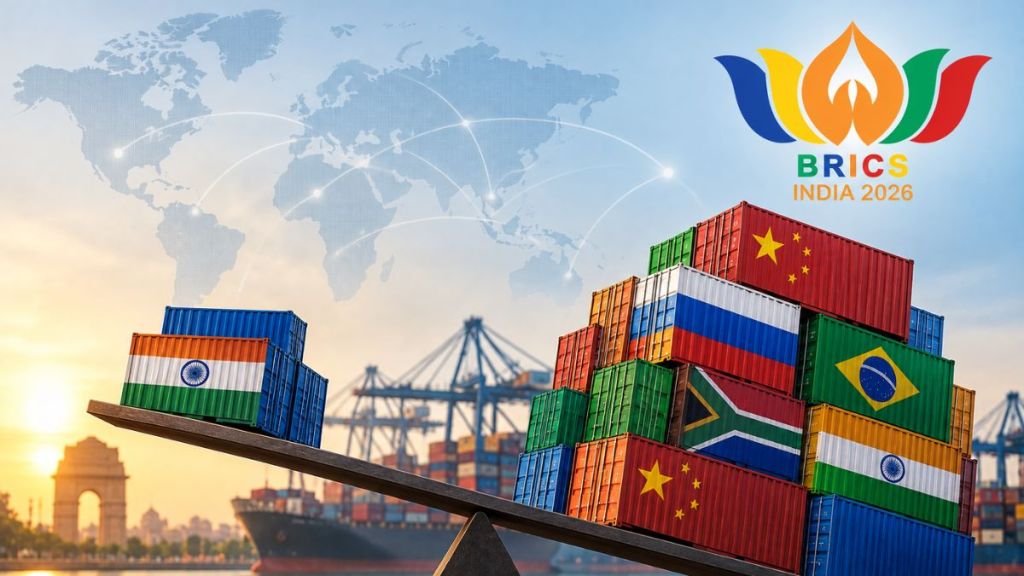

The BRICS Summit is taking place in the national capital right now. However, a recent report tells us an interesting aspect of India’s trade with the bloc i.e. the country is buying much more from BRICS nations than it is selling to them.
A report by Rubix Data Sciences found that the other 10 BRICS countries accounted for about 43% of India’s imports in this period, but only 20% of its exports.
In dollar terms, India imported nearly 3.7 times more from BRICS than it exported to the group. This shows how important BRICS has become as a source of goods for India, also showing India’s difficulty in selling more to these markets.
India is hosting the 18th BRICS Summit in New Delhi on September 12 and 13. BRICS started with Brazil, Russia, India, China and South Africa. It has now grown to 11 members, with Egypt, Ethiopia, Indonesia, Iran, Saudi Arabia and the UAE joining the group.
These countries account for about 49.5% of the world’s population and around 40% of the global economy, according to the Rubix Data Sciences and Vayana TradeXchange report. This is India’s fourth time leading the group, after earlier chairships in 2012, 2016 and 2021.
Exports are growing, but imports are growing faster
India’s exports to the other BRICS countries rose 4.6% to $48 billion in the first half of 2026. However, imports jumped 13.5% to $178 billion.
Total trade between India and the rest of BRICS reached $226 billion during this period, up 11.5% from a year earlier, according to the Rubix Data Sciences and Vayana TradeXchange report. Most of this growth came from imports, leaving India with a trade deficit of about $130 billion.
The gap has been growing for years. India’s exports to BRICS stood at $94 billion in 2022, fell slightly to $92 billion in 2023, recovered to $94 billion in 2024 and rose to $96 billion in 2025. Imports, meanwhile, increased from $293 billion in 2022 to $320 billion in 2025.
As a result, India’s trade deficit with BRICS grew from $199 billion in 2022 to $224 billion in 2025. It reached $130 billion in just the first six months of 2026.
Between 2022 and 2025, India’s imports from the other 10 BRICS members grew at an average annual rate of about 3%, while exports grew by only about 1% a year. The gap became much wider in the first half of 2026, when imports rose 13.5% while exports grew just 4.6%.
China and Russia are driving the trade gap
China is India’s biggest source of BRICS imports, accounting for 41% of them. Russia is next at 20%. India ran a trade deficit with eight of the other 10 BRICS countries in the first half of 2026, according to the report.
The biggest deficit was with China, at about $62.9 billion, followed by Russia at about $33.6 billion. India exported more than it imported only with Egypt and Ethiopia. Trade with China is growing quickly. Chinese exports to India rose from $65 billion in the first half of 2025 to $79 billion a year later. This made India China’s biggest BRICS customer.
Nearly 26% of everything China sells to BRICS countries goes to India. China mainly sends India electrical equipment, machinery, organic chemicals and plastics. India, in return, mainly sends China raw materials such as ores, minerals, iron, steel, chemicals and cotton, according to the Rubix Data Sciences and Vayana TradeXchange report.
India’s exports to China were worth only $12 billion in the first half of 2026, up from $9 billion a year earlier. This gave China a trade surplus of $67 billion with India in just six months.
China’s total trade with India reached $91 billion in the first half of 2026, up 23% from a year earlier. India’s exports to China actually grew faster in percentage terms, rising 33.3%, compared with 21.5% growth in China’s exports to India. However, India’s exports were starting from a much smaller base, so the gap remained large.
Russia’s trade with China looks different
Russia is also a major source of India’s imports. However, Russia’s trade relationship with China is different. It is mainly based on energy and raw materials rather than manufactured goods.
China’s trade with Russia reached $133 billion in the first half of 2026, up 25.5% from a year earlier. China sends Russia machinery, electronics, vehicles and plastics. Its exports to Russia rose 27.7% to $60 billion.
Russia sends China oil, fuel, ores and metals. Chinese imports from Russia rose 23.7% to $73 billion. This means China actually buys more from Russia than it sells to it, giving China a $13 billion trade deficit with Russia. India, however, runs a trade deficit with both China and Russia, according to the Rubix Data Sciences and Vayana TradeXchange report.
BRICS trade is recovering
India’s trade story is part of a larger trend. Trade across BRICS is recovering. The bloc’s total exports fell from $6.5 trillion in 2022 to $5.9 trillion in 2024. They recovered to $6.1 trillion in 2025 and reached $3.2 trillion in just the first half of 2026.
Imports also recovered, reaching $2.6 trillion during the same period. Total merchandise trade among BRICS countries stood at $5.8 trillion, up 15.4% from a year earlier, according to the Rubix Data Sciences and Vayana TradeXchange report.
Imports grew faster than exports. Imports rose 19.1%, while exports increased 12.5%. As a result, the bloc’s overall trade surplus fell from $660 billion a year earlier to $597 billion.
BRICS is becoming more important to global trade. The bloc accounted for about 24% of global merchandise exports and 19% of global merchandise imports in 2025.
China is becoming more dominant
China’s share of BRICS exports rose from 56% in 2022 to 66% in the first half of 2026. Its share of BRICS imports also rose to 59%. China’s exports reached $2.12 trillion, up 17% from a year earlier. Its imports reached $1.55 trillion, up 26%.
India, by comparison, accounted for about 8% of BRICS exports and 16% of BRICS imports during the same period. China also has the biggest trade relationships within the bloc.
It sold the most to India, at $79 billion, followed by Indonesia at $48 billion and Brazil at $42 billion. On the import side, Russia supplied nearly 28% of China’s BRICS imports, Brazil about 25% and Indonesia about 21%. Together, these three countries supplied roughly 74% of China’s imports from the bloc.
West Asia conflict is affecting BRICS countries differently
Not all BRICS countries are seeing the same level of growth. The ongoing conflict in West Asia is hurting some members more than others. Iran’s total merchandise trade fell 22.8% year-on-year in the first half of 2026, while the UAE’s trade fell about 10%. Saudi Arabia’s trade was almost flat.
At the same time, China’s total merchandise trade grew about 21%, South Africa’s about 20%, India’s about 12% and Russia’s about 11.6%. However, the report cautions against seeing China as unaffected by the conflict. China has major energy and trade links with the Middle East, including Iran. Disruptions to shipping and energy flows through the Strait of Hormuz have affected China’s access to regional crude supplies.
The report also cited the WTO’s assessment that the Middle East conflict affected regional merchandise trade. At the same time, strong demand in Asia for AI-related goods such as semiconductors, integrated circuits and electronic components helped support global trade growth in the first quarter of 2026.
The full impact of the Strait of Hormuz disruptions may become clearer in future trade data. BRICS is becoming more important to India’s economy. The key question now is whether Indian exporters can capture a bigger share of the opportunities within the bloc, or whether India will continue to be a large and growing market for other BRICS countries to sell into.