


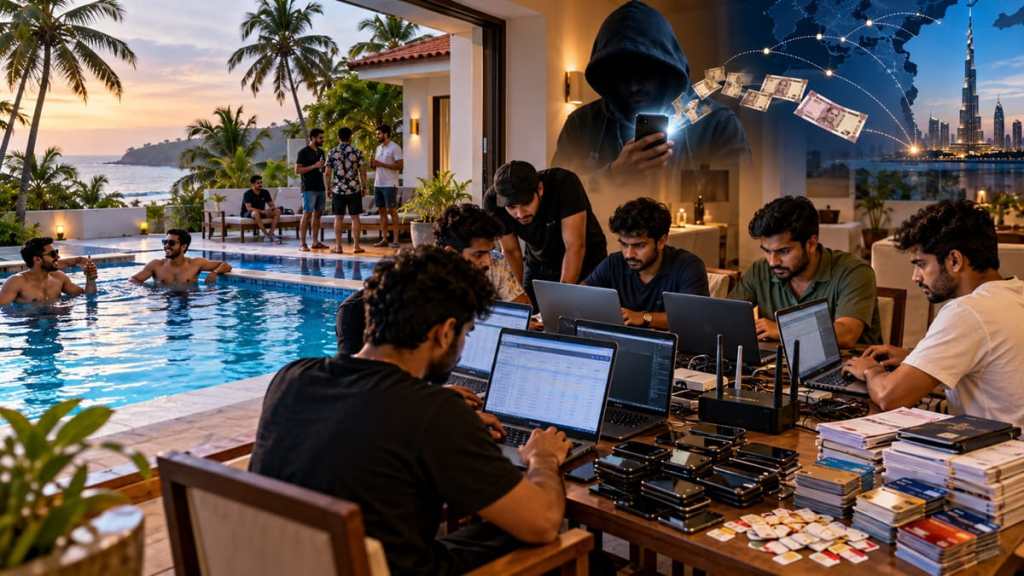

A rented villa in North Goa, where young men spent their free hours swimming in a pool and visiting casinos, allegedly served as the operational centre of a large cybercrime network that moved money from defrauded victims into thousands of bank accounts.
On August 4, 2026, the Mumbai Police Crime Branch raided Casa De Nicole, a villa in Candolim and arrested 12 men. A subsequent raid at another Goa villa, Sea Coast, led to 10 more arrests. The two cases together involve an estimated Rs 900 crore in alleged fraud, The Indian Express reported.
According to The Indian Express, investigators believe the groups were not the people who directly contacted victims and persuaded them to transfer their savings. Instead, they allegedly handled a crucial stage of the operation: rapidly moving money from the initial accounts receiving the funds into numerous other accounts, making it harder for banks and investigators to trace and freeze the money.
The investigation uncovered an alleged network involving operators in Dubai, account-procuring agents in Mumbai, individuals who supplied bank accounts, and teams in Goa that processed transactions through an app called Banker Panel.
How the investigation began in Mumbai
According to The Indian Express, the investigation began in July 2026 after Mumbai Crime Branch Deputy Commissioner of Police Raj Tilak Roushan received information about suspicious activity at an office in Parsvnath Chambers in the Masjid Bunder area of South Mumbai.
On July 3, police raided the premises, which displayed a sticker bearing the name G.D. Overseas. Investigators found that the company was allegedly a sham, existing only in the form of the sticker on the office.
The police found around 10-12 employees whose work involved opening current accounts across banks in Mumbai. Investigators noticed that although the accounts were opened and activated in Mumbai, they were subsequently operated from Goa.
The employees also allegedly purchased SIM cards linked to the bank accounts, which could be used for one-time passwords and banking authentication. These SIM cards and bank welcome kits were then sent to Goa, where the accounts were operated.
During questioning, one of the arrested employees, Mohammad Shabbir Sheikh, told police that he had met a man identifying himself as ‘Ranveer Kapoor’ while working in Dubai. Sheikh allegedly said the man had instructed him to travel to Mumbai and arrange bank accounts.
The FIR registered at Pydhonie police station quoted Kapoor as promising payments of Rs 50,000-70,000 per account, The Indian Express reported.
What police found inside the Goa villa
The investigation led police to Casa De Nicole, which falls under the jurisdiction of Goa’s Calangute police station.
According to The Indian Express, the Mumbai Crime Branch team seized 15 laptops, 128 ATM cards, 85 mobile phones, 76 SIM cards, 22 cheque books, 77 passbooks, six routers and three keyboards from the premises.
Investigators found that the account numbers recovered from the accused were linked to 186 cybercrime cases across the country. Police subsequently froze Rs 120 crore held across 7,500 bank accounts.
The police estimate that the group operating from Casa De Nicole moved nearly Rs 500 crore, The Indian Express reported.
The villa reportedly functioned less like a holiday home and more like an office. Police said each room had five to six laptops arranged in makeshift workstations.
The accused allegedly worked in three eight-hour shifts, keeping the operation active round the clock. At least four people were reportedly available at any given time to move funds, as investigators said it was difficult to predict when a victim would transfer money.
The men arrested from Casa De Nicole were allegedly paid a monthly salary of Rs 35,000, along with a 3% share of the money they moved each day.
The villa’s owner, Francis, told The Indian Express that he had rented the property to the group for two months for Rs 1 lakh and had no knowledge of the alleged cybercrime operation. He said the occupants had paid the rent upfront and presented themselves as people seeking accommodation for work.
The property was raided after the group had stayed there for about a month, according to the report.
How the alleged cybercrime network was structured
Investigators told The Indian Express that the Goa operation was one part of a larger hierarchy, with different participants assigned specific roles.
At the top was a Dubai-based group referred to by the accused as the “company”. Police allege that a man using the name Ranveer Kapoor and other Dubai-based operators directed the network. Investigators said they had identified Kapoor and were working with authorities in Dubai to bring him back to India.
Below this level were the “administrators”, the men operating from Goa who allegedly transferred money between accounts. They were followed by “masters”, “supermasters” and “customers”, according to the structure described in the investigation.
The “customers” allegedly supplied their bank accounts for use in fraudulent transactions in exchange for money. Such accounts are commonly referred to as mule accounts because they are used to receive and transfer funds on behalf of others.
The “masters” allegedly procured these accounts from people around the banking system in Mumbai, sometimes through inducements and, according to police, in some cases through force.
The “supermasters” were responsible for ensuring that the accounts were ready for transactions. Their alleged tasks included collecting bank welcome kits, activating accounts and arranging linked SIM cards for authentication.
The Goa-based administrators then handled the movement of funds between accounts.
According to The Indian Express, the accused told police that they had paid Rs 50 lakh upfront to obtain a franchise from the Dubai-based operation.
Banker Panel app allegedly moved money with one click
A key discovery in the investigation was the alleged use of a specialised application called Banker Panel.
Police suspected that the accused could not have manually accessed and operated thousands of bank accounts quickly enough to carry out the transactions described in the case. Investigators subsequently found that the Dubai-based group had allegedly provided the Goa administrators with access to the app.
According to The Indian Express, the operators entered the account receiving money from a victim in one field and listed the destination accounts in another. Once the details were entered, a single click allegedly triggered transfers to thousands of accounts.
The system was designed to move funds quickly, police said, reducing the time available to banks and law enforcement agencies to intervene.
The first one to two hours after a cyber fraud are often described as the “golden hour”, when a prompt complaint may help banks block or freeze the money. Investigators allege that the rapid splitting of funds across numerous accounts made tracing and recovery more difficult.
The money was subsequently withdrawn through ATMs or cheque books, according to the report.
Another group allegedly moved funds to Dubai through the angadia network, an informal, trust-based courier system used to transfer money.
How the alleged network paid commissions
Investigators also uncovered what they described as a method of paying commissions to the Goa operators through transactions made to appear legitimate.
According to The Indian Express, the Dubai-based group operated gaming platforms through which the operators could receive their share of the proceeds.
In the example described by police, an operator would place a Rs 1,000 bet on a gaming platform. The platform would return Rs 900 and add Rs 100 to the bet, creating a transaction through which the operator could allegedly receive commission in a seemingly legitimate form.
Police identified gaming portals named XXX247, 900 Panel and Rudra as being linked to the alleged network. The report said investigators had blocked the websites.
The police also told The Indian Express that the operators exploited the fact that online gaming platforms could be operated from outside India, even as the country had introduced legislation to regulate online gaming.
‘Ashwathama’ and the role of a shadowy intermediary
During the investigation, police came across a person using the name “Ashwathama” in WhatsApp groups used by the accused.
According to The Indian Express, investigators said the person played a role in organising mule account holders and communicating instructions to participants at lower levels of the network. The structure allegedly ensured that people operating at different levels did not meet one another or know the identities of those above them.
In the first week of September, police tracked down the individual in Jaipur and identified him as Bua Smith, who hailed from Ahmedabad.
The report said he had allegedly used the name Ashwathama, referring to the immortal warrior in the Mahabharata, believing that he would remain undiscovered even if other members of the network were arrested.
Second Goa villa raid points to a similar operation
The investigation did not end with Casa De Nicole.
In September, the Mumbai Crime Branch raided Sea Coast, another villa in Goa, and arrested 10 men. According to The Indian Express, investigators found a similar pattern: men operating from rented accommodation and moving funds through thousands of bank accounts.
Police suspect the group associated with Sea Coast moved around Rs 400 crore in allegedly fraudulently obtained money.
The men arrested from the second villa were reportedly paid a monthly salary of Rs 25,000, along with a percentage of the money transferred. A police officer told The Indian Express that their monthly earnings could range from Rs 1 lakh to Rs 1.5 lakh.
Assistant Police Inspector Sachin Barate, who was part of the team that raided Sea Coast, told the publication that the men arrested there were older than those found at Casa De Nicole and had said they wanted to send money back home.
Investigators also suspect that groups involved in such operations change villas when property owners or neighbours begin to question their activities.
Why Goa became an operating base
The choice of Goa as a base offered the alleged operators a combination of rented accommodation and access to leisure activities.
According to The Indian Express, a Goa Police cyber cell officer said the prospect of working from villas near beaches and casinos attracted young men to these operations.
The owner of Casa De Nicole said he had not known that the property was being used for cyber fraud. A local resident told the publication that the occupants frequently came and went at unusual hours but did not initially appear suspicious.
Police believe the Goa operations are not isolated cases. The Indian Express reported that investigators suspect similar networks have begun operating from other countries, including Sri Lanka, and may convert funds into cryptocurrency before transferring them to third countries through crypto wallets.
The investigation is continuing, with police seeking to trace the wider network and establish the roles of those allegedly involved.
What the cases reveal about cyber fraud
The Goa investigations point to the importance of the financial trail that follows a cyber fraud. While a scam may begin with a phone call, impersonation or other method used to persuade a victim to transfer money, investigators say the subsequent movement of funds can involve multiple people, bank accounts and jurisdictions.
In these cases, police allege that account procurement, account activation, transaction processing and the onward movement of money were handled by separate groups. The use of linked SIM cards and an application designed to facilitate transfers allegedly enabled the operation to move funds at scale.
The two cases also highlight the difficulty of recovering money once it has been distributed across multiple accounts and withdrawn or transferred further.
As reported by The Indian Express, the Mumbai Police have frozen Rs 120 crore across 7,500 accounts linked to the Casa De Nicole case, while the two Goa operations together are suspected of being connected to alleged fraud worth Rs 900 crore.