


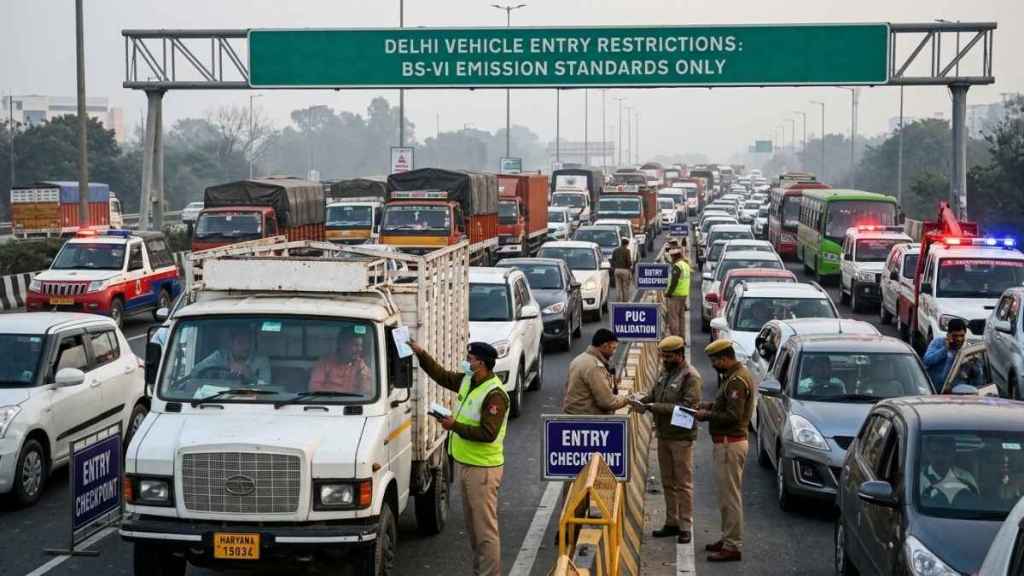

The first day of Delhi’s new vehicle entry restrictions on Sunday was marked by lengthy queues, repeated checks, and frustrated commuters. The restrictions came into effect on November 1 as part of the winter pollution-control measures.
Vehicles that do not comply with the BS-VI emission standards were stopped at several interstate borders, triggering massive traffic congestion on roads connecting Delhi with Haryana and Uttar Pradesh.
Under the new guidelines, petrol and diesel vehicles registered outside Delhi that did not meet BS-VI emission standards are not allowed entry to the national capital. Electric and CNG vehicles, along with BS-VI-compliant vehicles, are exempted.
The enforcement, which is being jointly carried out by Delhi’s environment and transport departments, and the traffic police, covers several important entry points, including Rajokri on NH-48, DND Flyway, Ghazipur, Singhu, Tikri and Badarpur. Enforcement personnel checked vehicle registration, pollution certificate details, and emission standards before letting them enter Delhi, leading to hour-long delays.
1,100 challans for PUCC violations issued in Delhi
The environment department issued around 1,105 challans for Pollution Under Control Certificate (PUCC) violations in Delhi, news agency PTI reported quoting sources.
The Transport Department, meanwhile, collected Rs 7.3 lakh in fine from 73 vehicles challaned for PUCC violations between 12 am and 6 pm, PTI reported.
The department found 3,335 non-Delhi vehicles not meeting BS-VI standards at the city’s borders during the day. Of these, 113 were turned back, 117 were challaned, and 22 were impounded till 6 pm on Sunday, PTI reported.
The Delhi Traffic Police, on the other hand, checked 7,279 vehicles from 12 am to 8 pm, during which 10 were challaned, 714 were returned, and 38 were impounded.
The restrictions disrupted traffic movement at some of the busiest entry points.
The Delhi-Gurugram stretch on National Highway-48 was one of the worst-affected corridors, with Sirhaul toll plaza witnessing long queues of vehicles on both sides of the border, with congestion spilling over to the service roads and affecting traffic movement towards Shankar Chowk, PTI reported.
“To ensure compliance, enforcement agencies have established checking points at major interstate entry routes and toll plazas. Around 250 personnel have been deployed for the exercise, including 39 teams stationed at 13 major toll plazas,” a Delhi Traffic Police officer was quoted as saying by PTI.
The situation proved equally challenging on the eastern and southeastern approaches to the capital. Heavy traffic was reported near the Chilla border, the Delhi-Noida Direct Flyway, Kalindi Kunj, Pari Chowk and Zero Point.
Enforcement officials using technology to track violators
Besides conducting physical inspections, authorities are relying on technology to catch vehicles that violate the restrictions. Automatic number plate recognition (ANPR) cameras, radio frequency identification (RFID) systems, and the Vahan database are being used to check registration details and establish each vehicle’s emission category.
The Delhi Traffic Police is also using camera-based surveillance to spot violations and issue electronic challans. Vehicles that fail to meet the prescribed norms may be fined and impounded under the applicable rules.
“Transport operators and private motorists had been advised to verify their vehicle category and keep valid Pollution Under Control certificates before entering Delhi. Goods vehicles not destined for the capital have also been advised to take the Eastern and Western Peripheral Expressways instead of passing through the city,” another officer of the Delhi Traffic Police told PTI.
Delhi’s air quality is likely to remain in the poor category from November 2 to November 3. The Air Quality Early Warning System outlook for the subsequent six days indicates that air quality is likely to remain in the poor to very poor category.