


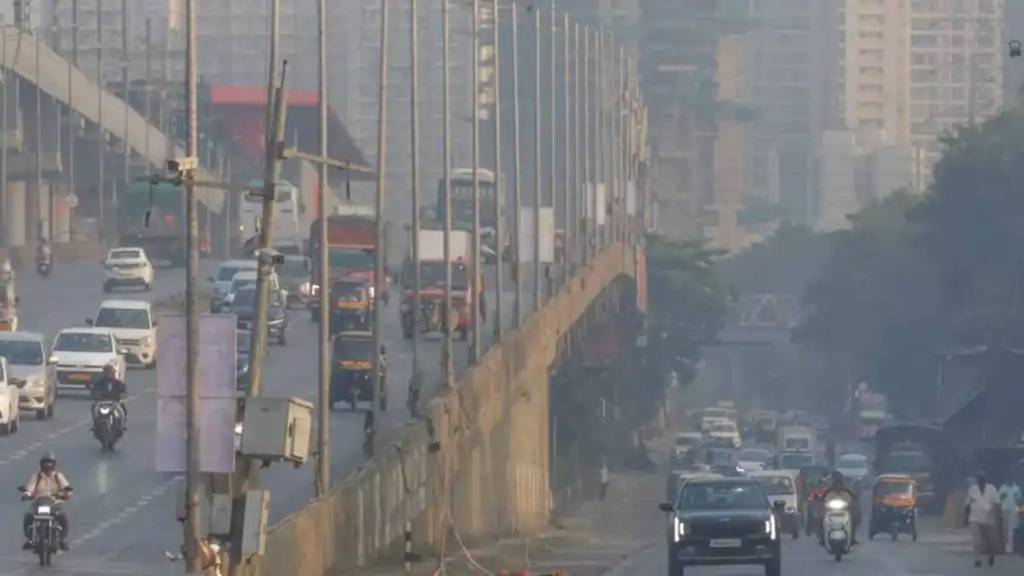

Mumbai’s worsening air quality is driven by a combination of weak winds, unusually hot weather and pollution from construction, traffic and waste burning. With less air circulation to disperse emissions, pollutants accumulate closer to the ground, while strong sunlight can help form harmful ground-level ozone.
The deterioration pushed Mumbai to fifth place globally and the highest position among Indian cities in a snapshot of IQAir’s major-city pollution ranking, with an Air Quality Index (AQI) of 152, classified as “unhealthy” on the platform’s US AQI scale. Ground-level ozone was identified as the main pollutant in that reading. IQAir classifies readings between 151 and 200 as unhealthy.
But the description of Mumbai as India’s most polluted city needs qualification. The reported ranking covered 122 cities, rather than every city in India, and represented conditions at a particular time—not a long-term assessment. The Central Pollution Control Board’s dashboard presented a different picture, recording Mumbai’s overall AQI at 98, in the “satisfactory” category.
The concern is therefore not a ranking alone. It is the combination of emerging pollution hotspots, weather that limits dispersal and exposure to pollutants that can harm breathing even when the citywide average appears less alarming.
Why heat and weak winds are making conditions worse
Mumbai’s air quality has deteriorated during a spell of unusually hot and humid weather following the withdrawal of the monsoon. Temperatures have been around 4–5 degrees Celsius above normal on several days, according to the reports.
Atmospheric scientist Gufran Beig, chair professor at the National Institute of Advanced Studies, linked the conditions to an El Niño-related weather pattern.
“This year, Mumbai is experiencing an El Niño pattern of climate, as a result of which wind speeds have slowed down considerably while temperatures remain hot and humid. This is preventing air circulation, causing pollutants to settle in the lower atmosphere and leading to a rise in pollution levels,” he told The Indian Express.
The distinction is important: weather is not the source of construction dust, vehicle exhaust or smoke from burning waste. It can, however, make their effects worse by reducing the movement of air that would otherwise disperse them.
Heat and sunlight also play a separate role in ozone formation. Ground-level ozone develops when nitrogen oxides and volatile organic compounds react in sunlight; it is not emitted directly from a single source. Hot, sunny conditions can raise concentrations to unhealthy levels.
Why ground-level ozone is dangerous to breathe
The ozone near the ground is different from the protective ozone layer high in the atmosphere. At breathing level, it is a harmful gas that can irritate and damage the airways. Exposure can cause coughing, throat irritation, shortness of breath and pain when taking a deep breath. It can also worsen asthma and other chronic lung diseases. Children, older people and people with existing lung conditions are particularly vulnerable.
That makes ozone an important part of Mumbai’s current pollution problem. Air pollution is not limited to visible dust or a smoky skyline as an ozone episode can create a respiratory risk even when particulate pollution is not the dominant factor in a particular reading.
Other monitoring locations in Mumbai, however, identified PM2.5 and PM10—not ozone—as their main pollutants, showing that the city is facing more than one type of pollution episode.
Why IQAir and CPCB showed different pictures
The reported IQAir snapshot on Thursday placed Mumbai at an AQI of 152, just above Delhi at 151. Kolkata was listed at 124. On the CPCB dashboard, however, Mumbai’s overall reading was 98. These figures should not be presented as though they use identical scales. IQAir’s ranking uses a US AQI scale, under which 151–200 is classified as unhealthy. Under the CPCB categories cited in the reports, 51–100 is “satisfactory” and 101–200 is “moderate”.
The supplied reports do not establish that the readings were taken at precisely the same time or from the same set of monitoring locations. They therefore do not support a direct, like-for-like numerical comparison.
The Central Pollution Control Board data also showed substantial variation within Mumbai. Of 23 operational monitoring stations, 12 recorded satisfactory air quality, while Deonar registered 156, Bandra Kurla Complex 145 and Khindipada in Bhandup 129. PM2.5 and PM10 were identified as the principal pollutants at these locations. A citywide average can therefore coexist with considerably worse conditions in particular neighbourhoods.
Construction dust, traffic and waste burning drive local hotspots
Officials identified construction activity, vehicular emissions and garbage burning as major local contributors to deteriorating air quality. Construction sites and dust displaced from roads are particular concerns where PM10 is elevated. In Deonar, officials pointed to recurring waste-burning concerns around the landfill. Vehicular emissions were also cited as contributors in areas including Navy Nagar and Malad.
Pollution does not remain within the boundaries of the neighbourhood where it originates.
“If garbage or plastic waste is burnt in Deonar, the resulting pollution does not remain confined to that area. This is why places such as Chembur and Kurla, which are close to Deonar, are also recording elevated AQI levels as air currents carry pollutants across locations,” an MPCB official told The Indian Express.
The reports also recorded repeated elevated readings at Navy Nagar, Deonar, BKC, Chembur, Malad, Kurla and Siddharth Nagar in Worli during the early part of October.
BKC’s severe reading comes with a sensor warning
One of the sharpest reported spikes occurred on October 11, when BKC recorded an AQI of 425 on the CPCB dashboard, placing it in the “severe” category. PM10 was identified as the main pollutant. Beig said a nearby dust source could be one possible explanation.
“PM10 generally comprises dust particles displaced from roads and construction sites. It is possible that a source nearby is emitting dust that is not being monitored,” he told The Indian Express.
Civic officials, however, questioned whether the reading reflected actual conditions, pointing to a possible equipment fault.
“The AQI monitoring station recording a reading above 400 is maintained by the Indian Institute of Tropical Meteorology (IITM). There appears to be a malfunction in its PM10 sensor, which is why the readings are unusually high. We have informed the institute and asked it to replace the sensor immediately and stabilise the system,” additional municipal commissioner Avinash Dhakane said.
The 425 reading should therefore be reported alongside that caveat. It was a station-level measurement whose reliability officials questioned—not evidence that all of Mumbai was experiencing severe air quality.
What authorities are doing
The BMC has directed officials across all 26 wards to identify pollution hotspots and introduce local measures. The civic body and MPCB are also issuing notices to construction sites, asking them to comply with pollution-control requirements.
Officials said construction activity in an area would be stopped if AQI readings crossed 200. In BKC, however, they said an immediate halt was not being imposed while the suspected sensor problem was examined. Teams in Deonar, Kurla and Mazgaon are also visiting local communities and conducting awareness campaigns as part of the response.