




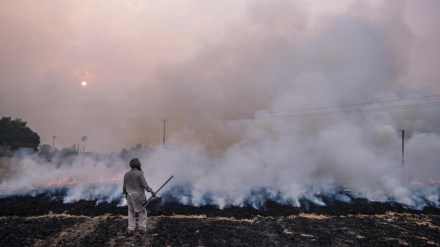
As Delhi struggles under a suffocating blanket of smog, the Supreme Court on Monday issued a sharp rebuke to the Delhi government, demanding answers about the worsening air quality. Meanwhile, Punjab recorded its highest single-day farm fire cases of the season, with 1,251 incidents. This raises the issue of why do farmers burn the crops during this time while the national capital continues to get smoked?
Punjab’s farmers, constrained by tight schedules and financial limitations, continue the age-old practice of setting crop residue ablaze to clear fields for winter sowing. Data from the Punjab Remote Sensing Centre revealed a total of 9,655 stubble-burning incidents in the state this season, with Muktsar leading with 247 cases on Monday. Comparatively, the same date in 2022 and 2023 recorded fewer fires, at 701 and 637 cases respectively.
This practice, while cost-effective for farmers, has devastating consequences for air quality across northern India. On November 13, stubble burning contributed to 31% of Delhi’s air pollution, according to the Indian Institute of Tropical Meteorology (IITM).
Challenges farmers face in adopting alternatives
Despite a 2019 Supreme Court directive to provide non-basmati farmers with Rs 100 per quintal for not burning stubble, Punjab has not implemented the compensation scheme, a report by ThePrint revealed. Farmers claim alternative stubble management methods cost up to Rs 4,000 per acre, including machinery rental, diesel and labor costs.
Although the government has imposed fines and filed police complaints against violators, the lack of adequate financial and logistical support deters many from adopting eco-friendly practices, the report further stated.
Are thermal power plants the bigger culprit?
While stubble burning garners widespread attention, other pollutants significantly contribute to Delhi’s air crisis. Case in point — a study by the Centre for Research on Energy and Clean Air (CREA) revealed that thermal power plants in the NCR produce 16 times more pollution than stubble burning. Between June 2022 and May 2023, these plants released 281 kilotons of sulfur dioxide (SO₂), in turn making the air pollution worse.
The study further called for accelerated implementation of Flue Gas Desulfurization (FGD) systems in coal-fired thermal power plants. These systems could reduce SO₂ emissions by 64% thereby transforming air quality and public health outcomes.
Health and economic costs of air pollution
Delhi’s air quality index (AQI) spiked to an alarming 494 on Tuesday, with several monitoring stations hitting the maximum AQI of 500. The toxic air forced schools to shift online across the Delhi-NCR region. Beyond health concerns, pollution has severe economic implications. A 2019 study estimated that air pollution caused economic losses of $36.8 billion in India, roughly 1.36% of the GDP, due to premature deaths and reduced productivity.
Delhi’s air quality crisis is a stark reminder that collective action is essential to prevent a recurring environmental and public health disaster. Without decisive interventions, the toxic haze will continue to choke the region, year after year.


