



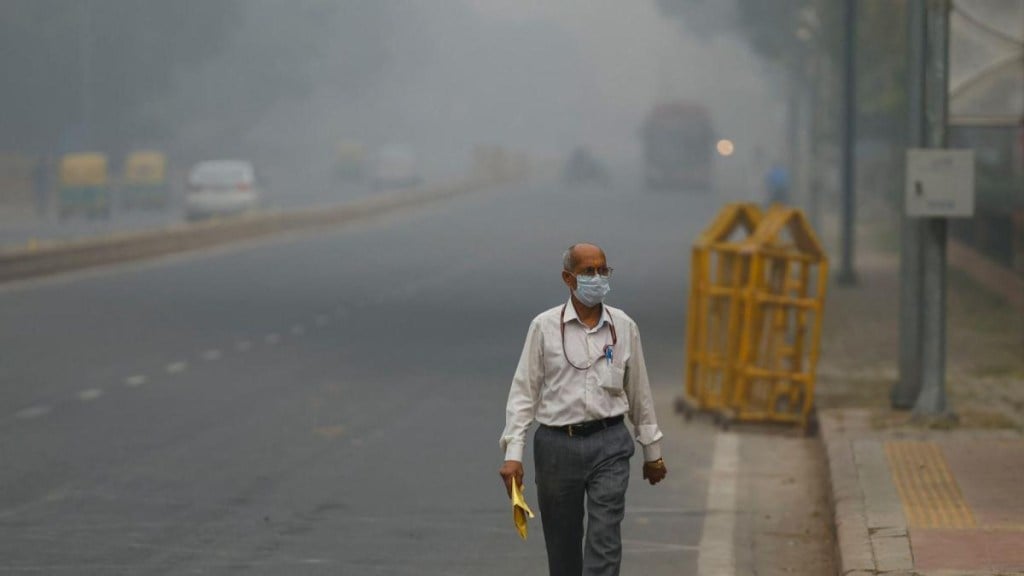
While Delhi is in the spotlight every winter for its polluted air, most Indian cities are also reporting poor air quality. The Indo-Gangetic airshed remains the most polluted region in the country, writes Banasree Purkayastha
Poor air quality across India
As many as 60% of India’s 749 districts breach the annual National Ambient Air Quality Standard (NAAQS) of 40 µg/m3 (microgram per cubic metre) for PM2.5, with no district meeting the 5 µg/m3 guideline of the World Health Organisation. Delhi, Tripura, Punjab, Haryana, Himachal Pradesh, Meghalaya and Chandigarh maintained 100% district-level excess in all seasons except for the monsoon, says the Centre for Research on Energy and Clean Air, an independent research organisation.
Uttar Pradesh accounted for six of the top ten polluted cities in November 2025, followed by Haryana with three, along with Delhi. Delhi ranked as the most polluted state with an annual mean population weighted PM2.5 concentration of 101 µg/m3, 2.5 times the NAAQS and 20 times the WHO guideline. Rajasthan had the highest number of cities exceeding NAAQS, with 23 out of 34 recording PM2.5 higher than NAAQS. Among the metros, Delhi (215 µg/m3) and Kolkata (82 µg/m3) exceeded the NAAQS in November, while Mumbai (54 µg/m3), Chennai (43 µg/m3), and Bengaluru (38 µg/m3) saw monthly average PM2.5 levels below the standard.
Pollution trends in last 10 years
Another recent study reveals that no major urban conglomeration in India has recorded safe air quality levels in the last 10 years. The analysis, ‘Air Quality Assessment of Major Indian Cities (2015–2025)’, by Climate Trends, a Delhi-based climate research organisation, found that while Delhi saw the worst air quality between 2015 and November 2025, Lucknow, Varanasi, Ahmedabad, and Pune also witnessed prolonged periods of elevated air quality index (AQI). The National Clean Air Programme (NCAP) was launched in January 2019.
“Lucknow and Varanasi started with extremely high levels (often above 200), and although both cities show steady improvement after 2019, their 2025 AQI values remain above healthy limits,” it said. In case of Delhi, the annual mean AQI levels were highest in 2016 (more than 250), and since 2019, have seen a dip. However, they remain far from safe levels. In 2025, the AQI stood at 180. Chennai, Chandigarh, Visakhapatnam, and Mumbai fared much better. But here also, the air quality ranged between 80 and 140.
Why the north suffers more
Northern cities such as Delhi, Lucknow, and Varanasi in the Indo-Gangetic airshed experience much worse air quality levels, especially during winters, compared to western and southern cities such as Chennai, Chandigarh, Visakhapatnam, Mumbai or Bengaluru.
This is due to the region’s geography — these northern cities are landlocked, as the Indo-Gangetic plain is surrounded by the Himalayas. Due to this, pollutants get trapped and are not able to disperse. This is compounded by the fact that within cities, dense urban structures create additional “surface roughness,” a frictional effect that further slows wind speeds and limits dispersion.
During winters, the air in the planetary boundary layer (the lowest part of the atmosphere) is thinner as the cooler air near the Earth’s surface is denser. The cooler air is trapped under the warm air above, forming a kind of atmospheric ‘lid’. This phenomenon is called winter inversion. “Since the vertical mixing of air happens only within this layer, the pollutants released lack enough space to disperse in the atmosphere,” the Climate Trends analysis said.
Where are the clean cities?
SHILLONG, IN THE state of Meghalaya, was the cleanest city in India during November, with a monthly average PM2.5 of 7 µg/m3. The top 10 cleanest cities in November comprise six cities from Karnataka, and one each from Tamil Nadu, Meghalaya, Sikkim and Kerala.
Meanwhile, the least polluted cities in India based on the 2024 annual AQI are Tirunelveli (30.34), Madikeri (35.33), Palkalaiperur (35.65), Ramanathapuram (41.82), Thanjavur (41.93), Chamarajanagar (44.59), Ariyalur (45.55), Aizawl (46.39), Bagalkot (47.14), and Gangtok (47.70).
These cities provide a model for sustainable urban planning and environmental conservation, demonstrating how a combination of geography, policy, and lifestyle choices can significantly improve air quality.
National Clean Air Programme
The national clean air Programme (NCAP) aimed to achieve pollution reductions up to 40% or achievement of NAAQS for PM10 concentrations in 131 cities by 2025-26 compared to 2017 levels, through cross-sectoral actions in agriculture, transport, waste, and industry. Under NCAP, 2,394.88 crore has been cumulatively released from FY 2019-20 till date. In addition,11,020.55 crore has been released to 42 million-plus-urban agglomerates under the 15th Finance Commission Grant from FY 2020-21 till date. However, the dismal situation as revealed by these studies indicate that much more needs to be done. While funding is important, governance, policy enforcement, and local pollution sources (like industrial emissions and traffic) play a key role in determining the success of the NCAP.