


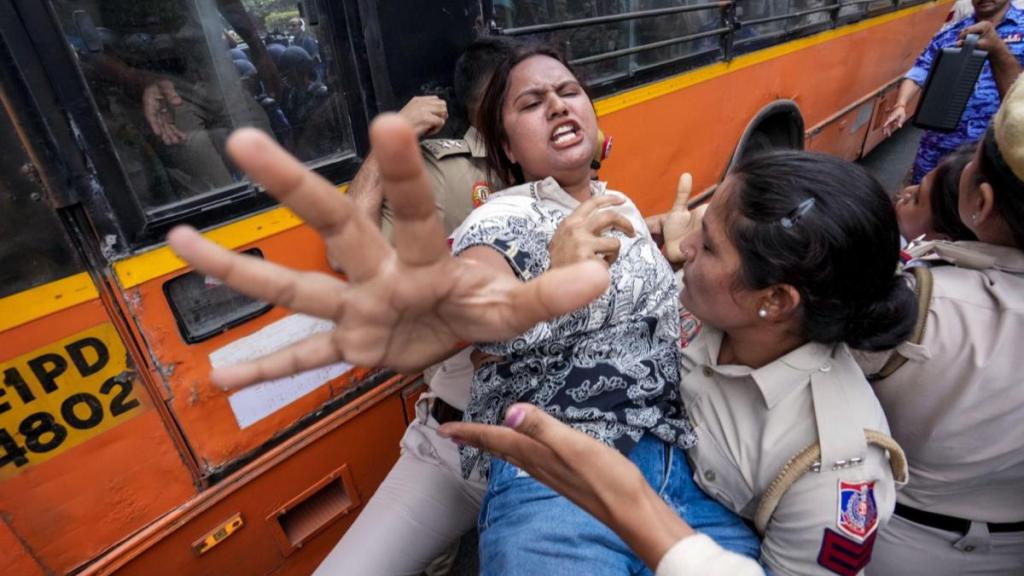

Delhi Police’s crackdown on protests against Chief Election Commissioner Gyanesh Kumar, including the detention of demonstrators and political leaders, has raised questions about the powers of the police and the rights of those taken into custody.
The use of preventive measures has also brought a basic distinction into focus: what does it mean to be detained and how is that different from being arrested? Can police hold someone before an offence has been committed, how long can they remain in custody and what safeguards does the law provide?
Arrest vs detention
Arrest means taking someone into custody under legal authority, commonly in connection with an alleged offence. Detention is a broader description of restraint on liberty; it can include custody following arrest or confinement under preventive detention laws.
The Supreme Court explained in Sundeep Kumar Bafna v State of Maharashtra that every arrest involves custody, but custody does not necessarily involve arrest.
The terminology alone does not settle legality. Article 21 of the Constitution requires any deprivation of personal liberty to follow a procedure established by law. Calling someone a “detainee” creates no independent power to hold them.
Can police act before an offence occurs?
Yes, within specified limits. Section 170 of the Bharatiya Nagarik Suraksha Sanhita (BNSS), 2023, permits preventive arrest when police know of a plan to commit a cognizable offence and believe it cannot otherwise be prevented.
Detention under this provision cannot exceed 24 hours unless further custody is authorised under another applicable legal provision. It is not blanket permission to hold anyone for questioning.
For investigations, Section 35 provides for an appearance notice where arrest is unnecessary. Someone complying with that notice should not be arrested unless police record reasons showing why arrest has become necessary.
What must an arrested person be told?
Article 22 guarantees information about the grounds of arrest and access to a lawyer of the person’s choice.
In its September 21, 2026 judgment in Jaskaran Jeet Singh Deol v State of Punjab, the Supreme Court reiterated that grounds must be supplied in writing in a language the arrested person understands. Where immediate written communication is impracticable, grounds must be conveyed orally and supplied in writing within a reasonable time.
Ordinarily, Article 22 requires production before a magistrate within 24 hours, excluding necessary travel time. Further detention requires the magistrate’s authority; the deadline does not mean automatic release in every case.
What about family, lawyers and medical care?
The Supreme Court’s DK Basu safeguards require an arrest memo recording the date and time, attestation by a witness and the arrested person’s countersignature. A friend, relative or nominated person must be informed of the arrest and place of custody.
The safeguards also require injuries to be recorded and medical examination every 48 hours during custody.
BNSS Section 38 allows an arrested person to meet a lawyer during interrogation, though not throughout it. Article 20(3) protects an accused person against compelled self-incrimination.
Under the BNSS, people arrested for bailable offences must be informed of their entitlement to bail. Women generally cannot be arrested between sunset and sunrise; exceptional arrests require prior permission from a first-class judicial magistrate on a woman police officer’s written report.
How can detention be challenged?
Under Articles 32 and 226, the Supreme Court and High Courts can examine unlawful custody through habeas corpus proceedings and order release where appropriate.
The National Legal Services Authority says people in custody qualify for free legal aid irrespective of income. Assistance is also available at the questioning stage. People can approach the District Legal Services Authority or call 15100.