


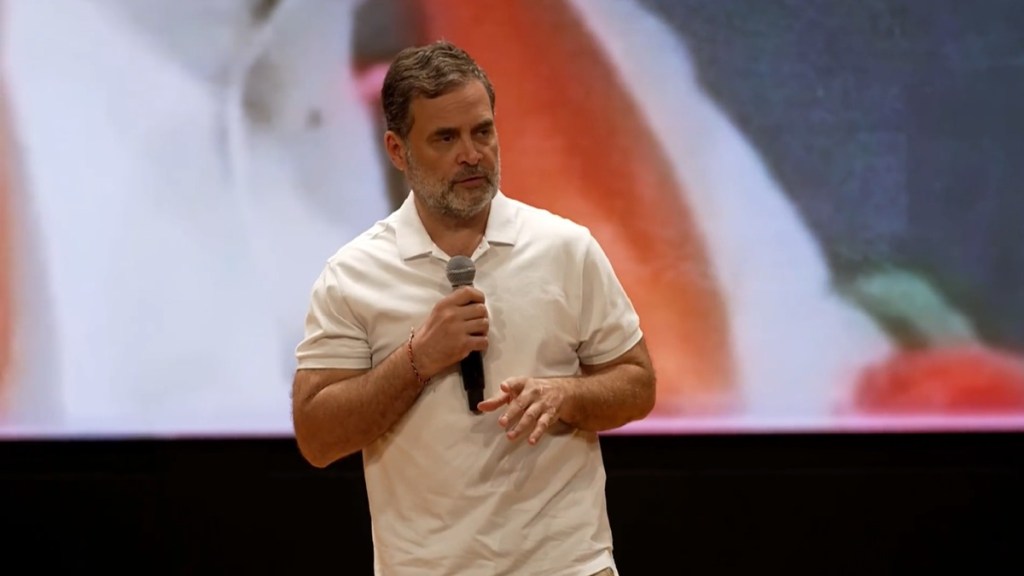

Leader of Opposition in the Lok Sabha and senior Congress leader Rahul Gandhi on Thursday addressed the media and questioned how the phenomenon of anti-incumbency, which he described as a fundamental force in Indian politics, had disappeared in several states. This comes as a reaction to The Indian Express investigation into reported differences within the Election Commission of India (ECI) over the Special Intensive Revision (SIR) of electoral rolls.
Gandhi’s remarks came days after The Indian Express reported that Election Commissioners Sukhbir Singh Sandhu and Vivek Joshi had formally raised objections at least 14 times over 10 months to decisions and orders concerning electoral rolls and the SIR process. The report said the objections included concerns over changes to Form 6 for new voter registration, access to electoral-roll databases, deletion and restoration of names and the filing of appeals in West Bengal.
Speaking about the issue, the senior Congress leader said he had grown up in a political family and had observed the phenomenon of anti-incumbency over several decades.
“In India, there is a fundamental force called anti-incumbency that very quickly starts to resist any government. It does not spare anybody,” Rahul Gandhi said.
He cited former Prime Minister Indira Gandhi as an example, saying that even after winning the Bangladesh war and reaching the height of her popularity, she faced significant anti-incumbency and political pressure within a few years.
“The same exact thing happens to leader after leader after leader. Happens to Congress leaders; it happens to regional parties, but for some reason, it never happens to Mr Narendra Modi, does not happen to Mr Shah, does not happen to the BJP,” he said.
‘How does anti-incumbency disappear?’
The Congress leader then pointed to electoral trends in several states, arguing that regions that historically witnessed changes in political power had recently shown a different pattern.
“Haryana swings from one party to another for 50 years. Suddenly anti-incumbency disappears. Maharashtra swings; suddenly it disappears. Uttar Pradesh swings. Sometimes Samajwadi, sometimes BSP; it disappears. Madhya Pradesh, it disappears. Gujarat, it disappears,” he said.
“This has been a fundamental question for us. We can understand the popularity of a person, and the performance of a government, but we cannot understand how anti-incumbency disappears,” Rahul Gandhi added.
He argued that anti-incumbency was an inherent feature of democratic politics and compared its absence to countries where elections are not considered genuinely competitive.
“Anti-incumbency does not exist in Saddam Hussein’s Iraq. It does not exist in North Korea. There is no democracy on this planet where anti-incumbency does not exist,” he said.
‘There is a chain from the vote to institutions’
The Congress leader then linked the controversy over electoral rolls to the bigger constitutional framework.
“From the vote, which is supposed to be protected by the Election Commission, our Constitution gets its power. From the Constitution, our laws are made, and from our laws emerge our institutions. This is a chain,” he said.
He alleged that any disruption in the electoral process would have consequences beyond individual elections.
“If the vote has been destroyed, then our Constitution has been destroyed. If our Constitution has been destroyed, our laws are illegal. If our laws are illegal, our institutions are meaningless,” Gandhi said.
He described the controversy as extending beyond the question of individual voter names and argued that it concerned the electoral system itself.
“The central question here is this is not just an attack on the vote; this is an attack on the idea, the basic infrastructure, and the expression of every single Indian person. We have been saying it again and again and again that there is a problem with the vote,” he added.
BJP counters Rahul Gandhi’s claims
Reacting to Rahul Gandhi’s argument on anti-incumbency, BJP national spokesperson and Rajya Sabha MP Sudhanshu Trivedi questioned the Congress leader’s reading of India’s electoral history and political trends.
“Congress has not been in power in Tamil Nadu since 1967. BJP didn’t exist back then. In Bengal, there has been no Congress government since 1977. In Bihar, there has been no Congress government since 1990. In UP, Congress has not been in power since 1989. Since 1999, Congress has not been in power in Odisha,” he said.
Taking aim at Gandhi’s contention that anti-incumbency appears to have disappeared in states where governments once regularly changed hands, Trivedi argued that Congress’ own electoral history should also be considered while assessing such trends.
The BJP MP further said that the electoral environment had changed with greater use of technology and increased scrutiny.
“Ever since transparent elections have taken place, CCTV cameras have come in, and independent media has arrived, they’ve started finding it difficult to come to power,” he further said.
Remarks follow reported dissent within ECI
According to the investigation, Sandhu and Joshi objected on record at least 14 times over the previous 10 months. The report said the objections touched on core aspects of electoral-roll management, including the registration of new voters, deletion and restoration of names and the technology used to maintain the rolls.
One major point of contention concerned Form 6, which is used by new voters to apply for registration. According to the investigation, a new SIR-linked declaration was added to the form despite objections from both Commissioners that the statutory form could not be altered without amendments to the relevant rules. Sandhu subsequently described the change as “unauthorised” and “illegal”, according to the report.
The two Commissioners also raised concerns over what Joshi described as the “gradual centralisation” of the electoral-roll database and questioned access available to statutory election officials.