


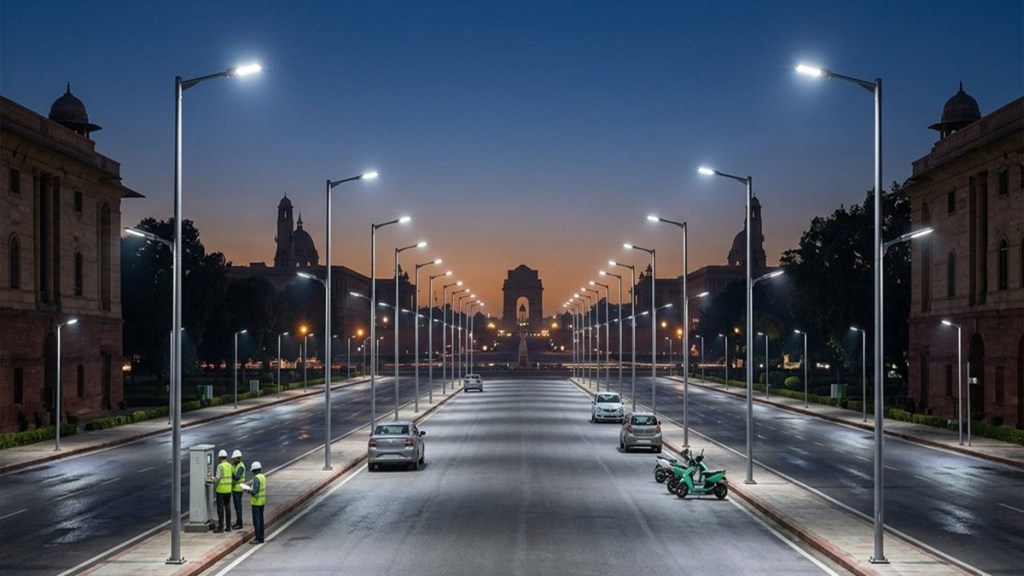

Delhi PWD streetlight project: Delhi is set to replace nearly one lakh streetlights with smart LED fittings in a project the government says will cut electricity costs by about Rs 100 crore over five years, while making repairs faster and more accountable. The Public Works Department (PWD) will spend an estimated Rs 473 crore on the upgrade, including five years of operation and maintenance.
Chief Minister Rekha Gupta launched the project at the Moolchand underpass on Thursday (October 15) in the national capital. The rollout is planned over the next four months and will cover around 96,000 PWD-managed streetlights, including about 45,000 older high-pressure sodium vapour (HPSV) fittings.
Our youth at DU raised concerns about dark spots. Today, their feedback is turning into action.
Delhi’s mission to eliminate dark spots begins with the installation of 1 lakh smart LED streetlights in the first phase.
Women’s safety and a safer Delhi for every citizen remain our top priorities.
#ViksitDelhi
#SevaSankalpAbhiyan— Rekha Gupta (@gupta_rekha) October 15, 2026
What Delhi gets?
The new lights will connect to a central command centre, a dashboard and a mobile application. According to the Delhi CMO, officials will be able to see whether each light is working, identify faults remotely and control individual fittings instead of waiting for complaints or manual inspections. Each smart light will carry a QR code. Residents can scan it to access details about the light and register a complaint if it is not functioning.
“QR codes have also been installed on these new streetlights. You can get all the details of the light and even file a complaint regarding any problems,” CM Gupta said at the launch.
PWD Minister Parvesh Verma said the switch to smart LEDs would save about Rs 100 crore in electricity costs over five years. The savings are expected to come from energy-efficient LED fittings and automatic brightness control.
“Since these are smart LEDs, their switching on and off will be automatic, and as it gets dark, the brightness will gradually increase. At sunrise, the light intensity will decrease automatically. Over five years, this will save Rs 100 crore in electricity,” Verma said.
The government previously estimated annual power savings of about Rs 25 crore from the project. The overall project cost has been put at around Rs 473.24 crore, including installation and five years of maintenance.
Faster fault repair, better lighting and lower use
The existing system does not provide real-time information on whether a streetlight has failed. Under the new arrangement, the command centre will receive live status data for every smart LED, allowing officials to detect outages and dispatch repairs without relying solely on public complaints.
The government has set a target of keeping 99 per cent of the lights functional. Faulty lights must be repaired within 48 hours of a fault being reported. If the deadline is missed, the agency responsible for maintenance will face a penalty of Rs 2,000 per light per day. Verma said the provision is intended to ensure accountability in upkeep.
#WATCH | Delhi: Chief Minister Rekha Gupta said, "Previously, lights would be collected in batches of 20-50, and a tender would be issued for their repair. Once the tender was executed, the lights would be put back into service. With the new smart LED lighting system being introduced in Delhi, an Annual Maintenance Contract (AMC) is already in place for all these lights. If even a single light malfunctions, a notification will be sent to the control room, and the responsible contractor will be required to fix it immediately. No light can remain out of order for more than 24 hours; if it does, the cost will be deducted from the contractor’s payment." (15.10)
— ANI (@ANI) October 15, 2026
The project will replace conventional HPSV lamps and older LED fittings with smart LEDs. The government says the new system will provide better illumination, consume less electricity and last longer than the existing fittings.
The lights will adjust automatically through the evening and morning. Brightness will increase as darkness sets in and reduce around sunrise, reducing unnecessary power use.
The average illumination is to be maintained at 35 lux on main roads and 25 lux on service roads for seven years. The lights are specified to have a colour temperature of 3,000 kelvin and a minimum luminous efficacy of 150 lumens per watt.
Delhi’s streetlight upgrade aims for more than lower bills. The government linked the rollout to removing dark spots and improving safety for women and other road users, particularly around public spaces and educational institutions.
The pilot began at the Moolchand underpass, while reports also identify Andrews Ganj bus stop as an early rollout location under the government’s ‘Seva Sankalp Abhiyan’. The full replacement is expected to be completed in about four months.