


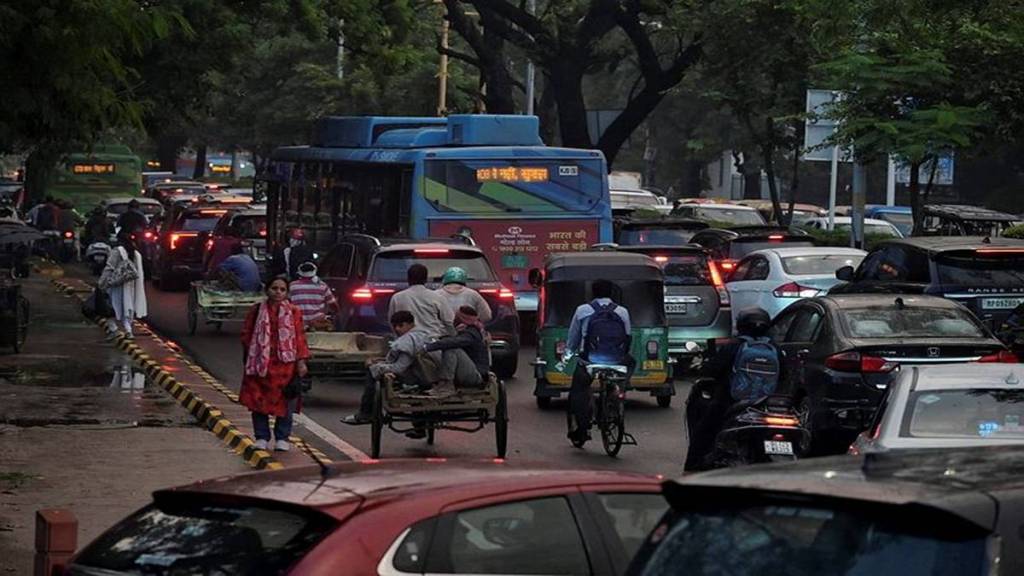

Around 48 lakh vehicles that do not meet BS-VI emission standards are registered in National Capital Region (NCR) districts near Delhi, posing a major enforcement challenge as restrictions on older petrol and diesel vehicles entering the capital come into force today, November, 1, 2026.
As per The Indian Express report, the restrictions will remain in force until January 31, 2027, and will apply to non-Delhi-registered petrol and diesel vehicles that are below BS-VI emission standards. The rules could impact motorists travelling from neighbouring cities, including Faridabad, Noida, Ghaziabad and Gurugram.
Haryana records over 30 lakh older vehicles
Citing Ministry of Road Transport and Highways data, The Indian Express report states that Haryana’s NCR districts account for around 30.65 lakh pre-BS-VI vehicles. This includes vehicles that are registered in Faridabad, Rohtak, Gurugram, Nuh, Rewari, Sonipat, Jhajjar, Rewari and Palwal.
Uttar Pradesh’s NCR districts comprise around 11.57 lakh such vehicles, whereas Rajasthan’s NCR districts account for about 5.62 lakh. Two-wheelers represent the largest category, totalling around 36.55 lakh. Cars and cabs account for 7.26 lakh, followed by 1.70 lakh goods vehicles, around 2.26 lakh in other categories and 25,053 buses.
The above numbers are registration figures, not the number of vehicles likely to enter Delhi.
Why implementation at Delhi borders could be difficult
Delhi has 23 entry points, with officials evaluating that more than 12 lakh vehicles enter the capital on a daily basis. Traffic Police officers told The Indian Express that checking every vehicle would be difficult without leading to traffic congestion. They also pointed out the need for coordination with neighbouring districts and the challenge of turning vehicles back after they have entered Delhi.
“It is virtually impossible to ensure that every vehicle is turned around and sent back without causing massive traffic congestion,” an officer stated to the Indian Express.
The report stated violations could attract fines ranging from Rs 20,000 to Rs 40,000, depending on the applicable provisions. Surveillance cameras may also be used to flag the vehicles breaking the restrictions.
Delhi CMO advisory: Vehicle exemptions and other restrictions
The Delhi Chief Minister’s Office, in an official post on X, confirmed the Winter Action Plan 2026-27 that takes effect on November 1. As per the advisory, CNG-powered vehicles, emergency vehicles and electric vehicles are exempt from the ban on non-Delhi-registered vehicles below BS-IV standards.
The government has also stated a “No PUCC, No Fuel” requirement, making a valid Pollution Under Control Certificate compulsory for refuelling.
Other measures announced by the Delhi government include doubled parking penalty from November 1 to February 28, 2027, excluding Delhi Metro Rail Corporation parking facilities. A 50 per cent work-from-home arrangement until January 31, subject to essential-service exemptions.
The advisory also mentions staggered office timings from 8:30 am to 5 pm for the Municipal Corporation of Delhi offices and 10 am to 6:30 pm for Delhi government offices.
Dust-generating construction and demolition activities will also see curtailments from November 1 to January 31, with a stricter ban slated between December 10 and January 20, subject to exemptions.
Why older vehicles are under watch
Transport-related pollution contributes an estimated 15-20 per cent of Delhi’s winter air pollution, as per the Decision Support System developed by the Indian Institute of Tropical Metrology.
For motorists travelling to Delhi from nearby NCR cities, verifying their vehicle’s emission standard and a valid PUCC certificate is crucial under new norms.