


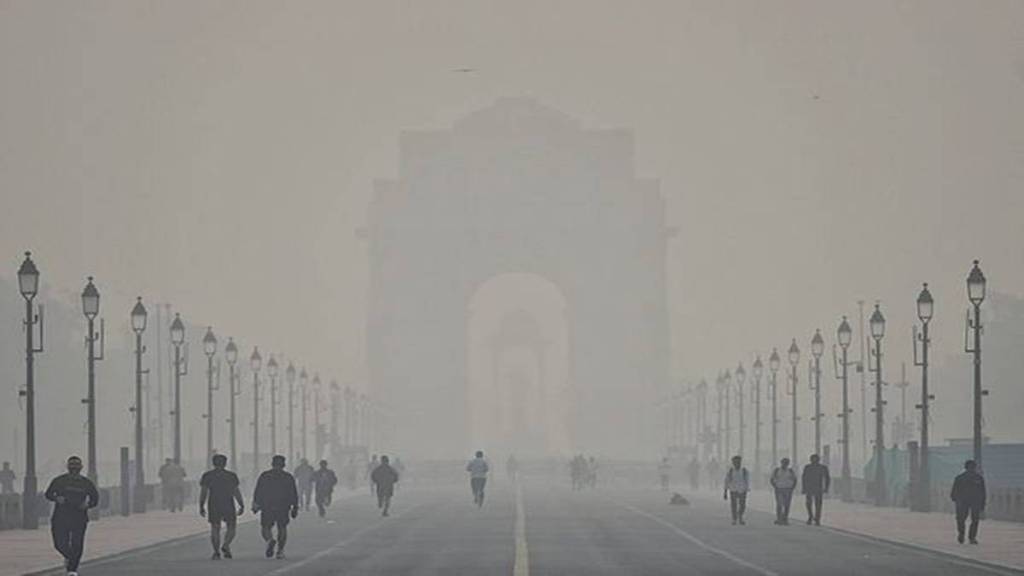

Delhi’s air quality plummeted to the ‘Very Poor” category on Wednesday, with the national capital marking an overall Air Quality Index (AQI) of 379 at 10 AM, as per the live data displayed on the Central Pollution Control Board’s CPCB) official dashboard. Punjabi Bagh recorded the worst air quality at 458, falling in the ‘severe’ category.
The city’s AQI breached the 300-mark on Tuesday also, when it stood at 350. Out of the 60 monitoring stations, 59 were reporting, with PM2.5 identified as the leading pollutant at 54 stations.
The Delhi Government’s station-wise dashboard also showed 25 monitoring stations in the ‘Severe’ category, 33 in ‘Very Poor’.
Delhi pollution: Which areas recorded the highest AQI?
According to the Delhi Government’s official station-wise air quality dashboard, Punjabi Bagh recorded the highest AQI of 458, followed by IIT Delhi at 455 and Jahangirpuri at 451. Mundka, Vivek Vihar, Rohini and several other locations also recorded pollution levels in the ‘Severe’ category.
The following area-wise readings were displayed on the official dashboard on November 4:
| Monitoring station | AQI | Category |
| Punjabi Bagh | 458 | Severe |
| IIT Delhi | 455 | Severe |
| Jahangirpuri | 451 | Severe |
| Mundka | 444 | Severe |
| Vivek Vihar | 437 | Severe |
| Rohini | 436 | Severe |
| DTU | 435 | Severe |
| RK Puram | 432 | Severe |
| Sonia Vihar | 427 | Severe |
| Alipur | 423 | Severe |
| ITO | 421 | Severe |
| Patparganj | 421 | Severe |
| Bawana | 413 | Severe |
| Chandni Chowk | 371 | Very Poor |
| IGI Airport (T3) | 362 | Very Poor |
| Anand Vihar | 302 | Very Poor |
Source: Department of Environment, Government of NCT of Delhi.
GRAP-II restrictions: Police check vehicles at Delhi-Gurugram border
Currently, Delhi is under Stage II of the Graded Response Action Plan (GRAP) to control the worsening air quality. Under these measures, enforcement officials are ensuring regular mechanical road cleaning, water sprinkling, and the use of anti-smog guns to reduce dust. Parking fees will also be increased as part of the measures.
Meanwhile, Union Environment Minister Bhupender Yadav said on Tuesday, November 3, that the Commission for Air Quality Management (CAQM) was monitoring weather conditions and taking necessary steps to tackle pollution.
“CAQM is continuously monitoring meteorological conditions, including wind direction, wind speed and the movement of air. Based on these assessments, the necessary steps are being taken,” Yadav stated ANI.
The minister also referred to agricultural residue management, saying that around 40 per cent of paddy stubble had been utilised through ex-situ management.
His remarks came amid questions about persistently high pollution levels despite a reported decline in stubble-burning incidents compared with previous years.
What does the worsening AQI mean for residents?
Under India’s National AQI classification, readings between 301 and 400 fall in the ‘Very Poor’ category, while those between 401 and 500 are classified as ‘Severe’.
According to CPCB’s health impact classifications, ‘Very Poor’ air quality can cause respiratory illness during prolonged exposure. ‘Severe’ air quality can affect healthy people and seriously impact those with existing medical conditions.
Residents, particularly children, older adults and people with respiratory or cardiovascular conditions, should minimise prolonged outdoor exertion when pollution levels remain elevated.