


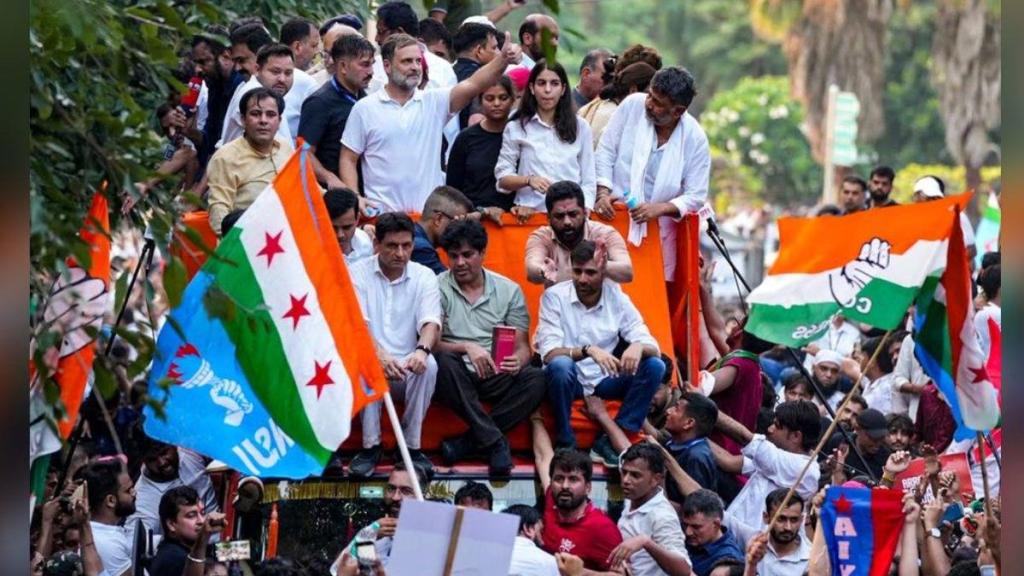

The INDIA bloc march led by Leader of Opposition Rahul Gandhi was stopped on Bhagwan Das Road, around 600 metres from the Supreme Court, on Monday. However, Gandhi and other INDIA bloc leaders reached the top court later in the evening, where his legal team completed the formalities related to the petition against the Election Commission.
A petition has been filed in the Supreme Court against the Chief Election Commissioner (CEC), alleging large-scale voter deletions and irregularities in the Special Intensive Revision (SIR) of electoral rolls. The petitioners include Congress president Mallikarjun Kharge, Trinamool Congress leader Saugata Roy, Samajwadi Party chief Akhilesh Yadav and Rashtriya Janata Dal leader Tejashwi Prasad Yadav.
Earlier today, Rahul Gandhi claimed that CEC Gyanesh Kumar has been in touch with him. The Congress leader was addressing a press conference where he further added that Kumar should turn approver.
Gandhi argued that the CEC might have made mistakes under pressure from others and urged him to acknowledge his role rather than protect those who may have directed the decisions.
He also questioned why Kumar continued to hold office despite the Opposition’s allegations. Gandhi claimed that the detention of Opposition leaders was linked to their demand for answers about electoral irregularities, similar to concerns previously raised by the two Election Commissioners, as reported by The Indian Express.
“Why is the Chief Election Commissioner Gyanesh Kumar not giving his resignation? The Opposition leaders were detained. Why is this happening is because we are asking the same question as two Election Commissioners asked. We know Gyanesh Kumar has not been able to sleep at night. You will not be spared as the CEC,” Gandhi said.
Government officials in touch with the Opposition?
During the press conference, Gandhi also claimed that around 200 government officials were communicating with the Opposition. He said the movement would continue until the Constitution was protected and the electoral system was made fair.
He described the campaign as a struggle to defend constitutional values and insisted that the youth of the country would not give up until their concerns were addressed.
Gandhi rejected the suggestion that different groups were organising separate demonstrations against Chief Election Commissioner Gyanesh Kumar. He said all such protests should be viewed as part of a common movement, regardless of the political party or organisation involved.
To support his allegations of police action against demonstrators, Gandhi played several videos during the press conference that he claimed showed officers using force against protesters.
Rahul Gandhi urges citizens to support the Constitution
Gandhi appealed to members of the public to stand in solidarity with those participating in the march towards the Supreme Court. He said people who could not join the demonstration in person could still express their support for constitutional rights and speak out against what they believed was wrong.
He encouraged citizens to discuss the issue openly, even within their own homes, and make their commitment to protecting the Constitution clear.
Gandhi also alleged that women participating in the protests had been assaulted by police personnel. He claimed that such incidents could create fear among parents and discourage young people from joining demonstrations. According to him, the security response was contributing to an atmosphere intended to make people afraid of protesting.
During the interaction with journalists, Gandhi posed a question of his own, asking how many reporters believed that the actions taking place were justified.
Rahul Gandhi on Delhi’s tightened security
Responding to questions about barricades and the deployment of security personnel across Delhi and the National Capital Region, Rahul Gandhi said the movement was not simply about access to roads and public spaces. He argued that its larger purpose was to influence public opinion and challenge what the Opposition considers electoral wrongdoing.
Gandhi also suggested that the Chief Election Commissioner was in contact with him. He claimed that the President of India had agreed to meet Opposition leaders, but that the proposed meeting was subsequently denied following intervention by the Prime Minister’s Office.
Tight security is in place across Central Delhi as the INDIA bloc marches towards the Supreme Court. The parties are protesting SIR related electoral irregularities and are demanding the resignation of the Chief Election Commissioner Gyanesh Kumar. They have also urged people from all over the country to join the protest.
Gandhi said the INDIA bloc would take to the streets again after accusing Delhi Police and BJP workers of using force against students and women during an earlier protest that demanded the resignation of Chief Election Commissioner Gyanesh Kumar. He claimed the young protesters had come out with peaceful intentions but were attacked, and that this was not the kind of India people wanted.
Why is INDIA bloc marching to SC?
On Sunday, Gandhi announced that people from across party lines, gender, caste and regions would march to the Supreme Court and submit a memorandum to the Chief Justice.
The demands include an end to what he called “vote theft”, a halt to the Special Intensive Revision of electoral rolls, and the resignation of CEC Gyanesh Kumar.
Gandhi also accused Union Home Minister Amit Shah of allowing RSS-BJP workers to attack women and youth. Addressing Shah directly, he said no amount of police force or party workers would intimidate the protesters or make them back down.
Congress General Secretary KC Venugopal backed the call, saying the protest had grown into a larger movement to protect the country’s democratic values. He urged people to come out and join the march.
CJI Surya Kant refused to meet Opposition
After Rahul Gandhi called for a march to the apex court, Chief Justice of India Surya Kant turned down the Opposition’s request for a meeting. According to The Indian Express, the CJI gave four reasons for his decision.
First, he explained that the issues the Opposition wanted to discuss, including SIR and matters concerning the Chief Election Commissioner (CEC), were already before the court.
Second, he clarified that the Constitution does not allow the court to take up such complaints through its administrative process.
The CJI also pointed out that the court could examine these issues through judicial review under Article 32 of the Constitution and other legal provisions. He said that if the Opposition filed a petition on Monday, the court could hear it the next day, along with other related cases already scheduled for hearing.
He also reaffirmed the Supreme Court’s commitment to safeguarding citizens’ fundamental rights, making it clear that people could approach the court whenever they needed legal protection.
CJI leaders seek fresh date for Jantar Mantar protests
The Cockroach Janata Party (CJP) leaders, including Saurav Das, visited the Parliament Street Police Station at 10 am on Monday to request permission for a peaceful demonstration at Jantar Mantar.
The party has given the Delhi Police 24 hours to confirm a date for the protest. CJP leader Ashutosh Ranka said the party would announce its own protest programme if the police failed to respond within the deadline.
Kerala Assembly to move resolution today
The Congress-led government in Kerala is set to move a resolution in the state Assembly on Monday, asking the Union government to remove Gyanesh Kumar from the post of Chief Election Commissioner.
If passed, Kerala will become the first state Assembly in India to formally seek the CEC’s removal through a resolution. According to the Assembly’s official bulletin, Chief Minister V D Satheesan will present the resolution.
Earlier, in September last year, the Kerala Assembly, under the then Left Democratic Front (LDF) government, had passed a resolution opposing the implementation of the Special Intensive Revision (SIR) of electoral rolls.
Besides calling for the removal of the Chief Election Commissioner, the resolution will seek the restoration of voting rights for eligible voters whose names were deleted from the electoral rolls. It will also demand that errors in the Special Intensive Revision (SIR) process be corrected.
Another key demand will be to change the committee responsible for selecting Election Commissioners. The proposed panel would include the Prime Minister, the Leader of the Opposition in the Lok Sabha and the Chief Justice of India.
Delhi metro and traffic curbs today
Security arrangements have been strengthened across several parts of Delhi, with barricades set up at multiple locations. Police and security personnel have been deployed near Barakhamba Road and Mandi House, including teams from the Delhi Police, Rapid Action Force (RAF) and Central Reserve Police Force (CRPF).
As a precautionary measure, entry and exit gates at six metro stations will remain shut from 6 am to 4 pm on October 12, 2026. The affected stations are Patel Chowk, Janpath, Rajiv Chowk, Mandi House, Central Secretariat and Barakhamba Road.