


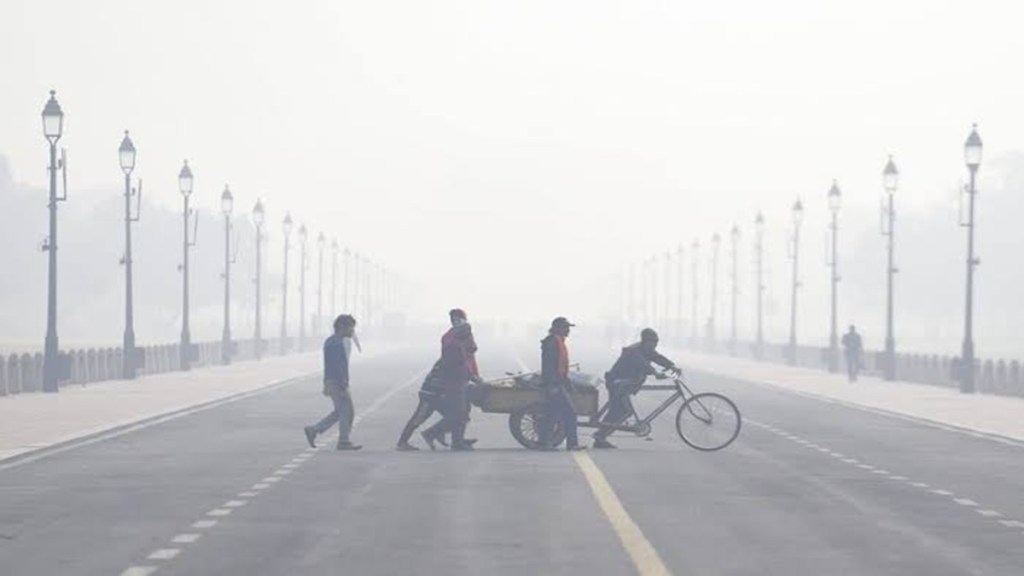

Delhi’s air quality turned hazardous on Thursday morning (November 5), with the overall Air Quality Index (AQI) touching around 482, according to the Central Pollution Control Board (CPCB). Several parts of the national capital recorded severe pollution, while authorities in Delhi, Punjab and Haryana intensified anti-pollution measures as farm fires rose sharply in Punjab.
Seven monitoring stations in Delhi recorded AQI levels above 400, placing them in the severe category. Punjabi Bagh recorded the highest reading at 446, followed by Narela at 434, Rohini at 431, RK Puram at 416, Bawana at 412, North Campus at 408 and Patparganj at 405.
Which areas in Delhi remain in ‘very poor’ category?
Several other Delhi areas remained in the very poor category. Okhla Phase-2 and India Gate recorded an AQI of 399 each, followed by ITO at 397, Dwarka Sector 8 at 396, Chandni Chowk at 356 and Vasundhara Enclave at 330. Anand Vihar recorded 293, while the IMD Lodhi Road station reported 268, both in the poor category.
An AQI between 0 and 50 is considered good, 51-100 satisfactory, 101-200 moderate, 201-300 poor, 301-400 very poor, and 401-500 severe. On Wednesday, Delhi’s AQI had settled at 377, the worst reading since January 20, when it was 378.
The minimum temperature at Safdarjung, Delhi’s primary weather station, was 16.4 degrees Celsius on Thursday, 1.1 degrees above the season’s average, according to the India Meteorological Department (IMD). The maximum temperature was likely to remain around 28 degrees Celsius.
‘CAQM continuously monitoring weather,’ says Bhupender Yadav
Union Environment Minister Bhupender Yadav said the Centre’s air quality panel is continuously monitoring meteorological conditions, including wind direction, wind speed and the movement of air. He said necessary action is being taken based on these assessments.
“CAQM is continuously monitoring meteorological conditions, including wind direction, wind speed and the movement of air. Based on these assessments, the necessary steps are being taken,” Yadav said.
He also said that, despite the deterioration in air quality, stubble-burning incidents have declined compared with previous years. “Yes, I have already stated that around 40 per cent of the paddy stubble has been utilised through ex-situ management this time,” he said.
How are Delhi schools managing?
Private schools in Delhi are planning to postpone outdoor activities after Diwali, install air purifiers and place snake plants in classrooms. Many schools have also advised students to wear masks when stepping outdoors.
“We are planning to postpone outdoor activities after Diwali until the air quality improves. We have also installed air purifiers in classrooms, placed snake plants and advised students to wear masks while stepping out. The safety and health of children remain our priority,” said Sudha Acharya, principal of ITL International School in Dwarka.
The Directorate of Education has directed all government and private schools to hold special assemblies on November 5 and 6 to sensitise students against bursting firecrackers. Schools have been asked to promote safer alternatives such as earthen lamps, candles and electric decorative lights.
Schools must also inform students that fireworks are prohibited within a 300-metre radius of hospitals, nursing homes, primary and district health centres, old-age homes and notified silence zones. The Directorate has asked district education officials to submit action-taken reports by November 9, along with photographs and videos of the measures implemented.
NDMC doubles parking charges as a measure to reduce pollution
The New Delhi Municipal Council (NDMC) has doubled parking charges at its parking lots from November 1 to February 28, 2027, to discourage private vehicle use and reduce pollution. The higher rates will remain in force for four months or until Stage II of the Graded Response Action Plan is implemented, whichever is earlier.
The measure has been taken in compliance with directions issued by the Delhi government’s environment and forest department under Section 5 of the Environment (Protection) Act, 1986. “The above measure is being implemented… with the objective of discouraging the use of private vehicles during the specified period and addressing air pollution in Delhi,” the NDMC notice said.
Electric vehicles and monthly parking pass holders have been exempted from the higher charges. The civic body said the rates may be modified or withdrawn earlier based on further government directions.