


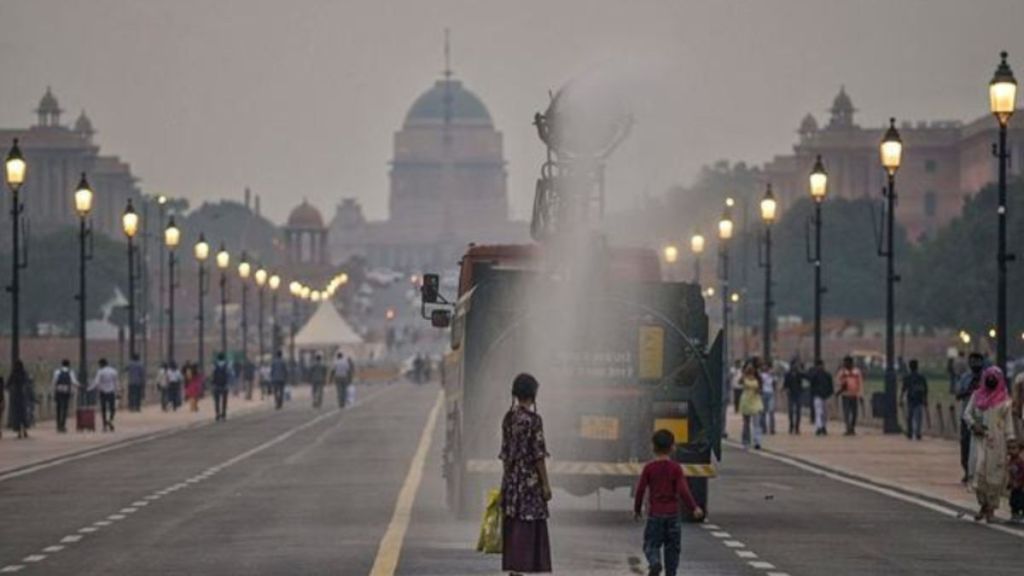

It is that time of year again in Delhi: mornings are turning cooler and concern over the air residents breathe is returning. With the monsoon behind it and winter approaching, the capital is entering a season that has repeatedly left it among the world’s most polluted cities.
The latest readings show how quickly conditions can change. Delhi’s Air Quality Index (AQI) rose from 90 on Friday to 159 on Saturday and 187 on Sunday, according to Central Pollution Control Board (CPCB) data. While the citywide reading remained in the moderate category on Sunday, dry weather and sluggish winds are allowing pollutants to accumulate ahead of winter.
Temperatures have also declined across Delhi and the National Capital Region (NCR) following the withdrawal of the monsoon. The minimum temperature in Delhi stood at 17.1 degrees Celsius on Sunday, 1.3 degrees below the seasonal average, the India Meteorological Department (IMD) said.
With no rainfall expected over the coming week, the accumulation of pollutants could continue to put pressure on the city’s air quality. Several monitoring stations have already reported elevated pollution levels, with ITO recording an AQI of 430 on Sunday, placing it in the severe category.
Delhi pollution levels rise across monitoring stations
On Saturday, Anand Vihar recorded an AQI of 348, while Mundka registered 227 and Jahangirpuri reported 212. Chandni Chowk recorded 188, while Vivek Vihar and Rohini both registered 187.
Punjabi Bagh reported an AQI of 171, followed by Narela at 165, CRRI Mathura Road at 158 and Dwarka Sector 8 at 155. On Sunday, 22 monitoring stations across Delhi recorded poor air quality, indicating that pollution was spreading across several parts of the city.
The deterioration has also been evident over the course of October. On October 1, the AQI at ITO stood at 132 at 5 pm, while Jahangirpuri recorded 216 and Punjabi Bagh registered 178, CPCB data showed. Anand Vihar, which frequently features among the city’s more polluted locations, had an AQI of 96 at the same time.
The recent rise follows Friday’s relatively clean-air reading of 90. The CPCB classifies AQI readings of 101-200 as moderate, 201-300 as poor, 301-400 as very poor and 401-500 as severe.
Dry weather, slower winds contribute to pollution build-up
The absence of rainfall, lower wind speeds and emissions from vehicles, road dust and construction activity are among the immediate factors contributing to worsening air quality. Rain can wash pollutants out of the atmosphere, while stronger winds help disperse them. As these conditions become less frequent after the monsoon, pollution from everyday activities can remain concentrated closer to the ground.
Seasonal changes can further aggravate the situation. As temperatures fall towards winter, lower mixing heights and stagnant winds can limit the vertical and horizontal dispersion of pollutants, allowing pollution levels to rise even without a major increase in emissions.
Despite the recent deterioration, Delhi Environment Minister Manjinder Singh Sirsa said on Saturday that the capital had recorded 211 days of good, satisfactory and moderate air quality so far this year. He described this as the city’s best performance since 2016, excluding the Covid-affected year 2020.
With more than two months remaining in 2026, the number of days with good-to-moderate air quality has already exceeded the full-year totals recorded in several previous years. These included 200 days in 2025, 209 in 2024, 206 in 2023, 159 in 2018 and 110 in 2016.
Sirsa also said the number of days with poor, very poor and severe air quality had declined to 79 during the corresponding period this year, compared with 168 in 2016.
The latest rise in AQI, however, highlights the seasonal challenge facing Delhi as winter approaches. With dry conditions expected to persist, the coming days will be crucial in determining whether pollution levels continue to climb.