


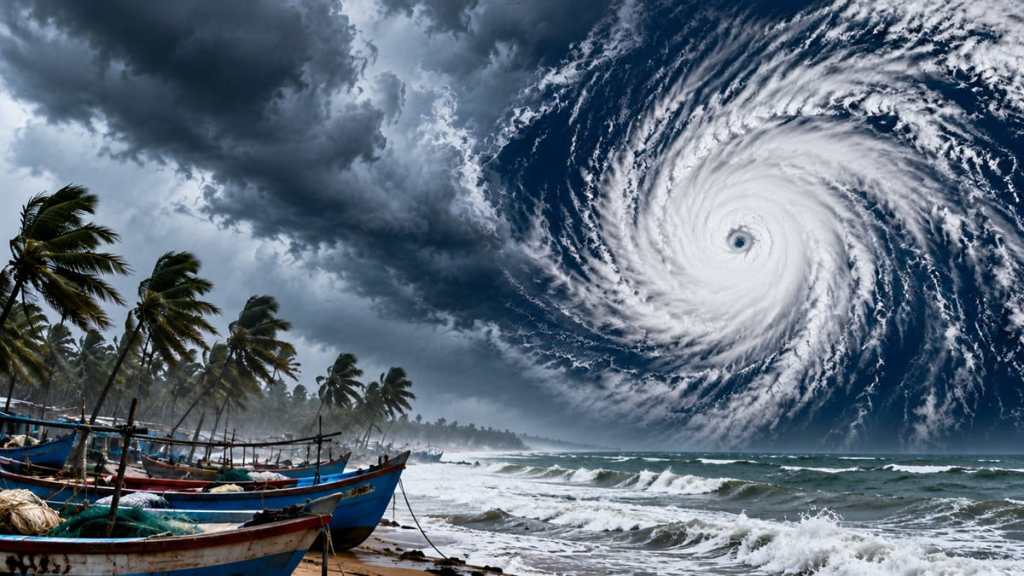

A storm brewing over the Bay of Bengal could soon have a name: Arnab. The depression is expected to strengthen into a cyclonic storm and move towards Andhra Pradesh, putting parts of India’s east coast on alert. If it develops as forecast, it is expected to take the name proposed by Bangladesh.
In its October 24 bulletin, the India Meteorological Department (IMD) forecast that the system would cross the coast between Bapatla and Visakhapatnam by the forenoon of October 28 as a very severe cyclonic storm.
But where does the name Arnab come from, what does it mean, and how are cyclones named in the Bay of Bengal and the Arabian Sea?
Who proposed the name Arnab?
The name Arnab was proposed by Bangladesh and appears in the official list of tropical cyclone names adopted in April 2020 by the World Meteorological Organization (WMO)/United Nations Economic and Social Commission for Asia and the Pacific (ESCAP) Panel on Tropical Cyclones.
The list includes names submitted by 13 countries: Bangladesh, India, Iran, the Maldives, Myanmar, Oman, Pakistan, Qatar, Saudi Arabia, Sri Lanka, Thailand, the United Arab Emirates and Yemen.
Each country contributed 13 names to create a list of 169 names. These are used in sequence as tropical cyclones develop over the North Indian Ocean, which includes the Bay of Bengal and the Arabian Sea.
What does Arnab mean?
Arnab is commonly associated with the Bengali word for the ocean or sea. While the official IMD naming list confirms the proposing country and the name’s pronunciation, it does not provide a definition of the word.
Who names cyclones in the Bay of Bengal and Arabian Sea?
The IMD’s Regional Specialised Meteorological Centre in New Delhi is responsible for naming tropical cyclones over the North Indian Ocean, including the Bay of Bengal and the Arabian Sea.
The process is not based on which country a cyclone is expected to hit. Instead, the IMD assigns names according to the agreed regional list and sequence.
A cyclone bearing a name proposed by Bangladesh can therefore make landfall in India or elsewhere in the region.
Why are cyclones given names?
According to the IMD, naming tropical cyclones helps identify individual systems, raise awareness of their development, reduce confusion when multiple storms occur and make warnings easier to remember and communicate.
The North Indian Ocean’s naming system began in September 2004, initially using names proposed by eight countries. A revised list was adopted in April 2020 after five additional countries joined the panel, taking the total to 13.
Bay of Bengal depression: What does the IMD forecast?
According to the IMD’s October 24 bulletin, the depression was centred at 5:30 pm that day over the east-central and adjoining southeast Bay of Bengal, about 510 km north-northwest of Sri Vijaya Puram in the Andaman and Nicobar Islands, 820 km east-southeast of Visakhapatnam and 910 km east-southeast of Kakinada in Andhra Pradesh.
The bulletin forecast that the system would strengthen into a cyclonic storm by October 26 morning and a severe cyclonic storm around October 27 morning, before intensifying further ahead of landfall. Maximum sustained winds at landfall were forecast at 115-125 kmph, with gusts of up to 140 kmph.
In Odisha, authorities put rescue teams on alert for deployment and directed district officials to identify vulnerable areas and prepare cyclone and flood shelters for evacuations, The Indian Express reported. Chief Minister Mohan Charan Majhi asked officials to ensure zero casualties.