


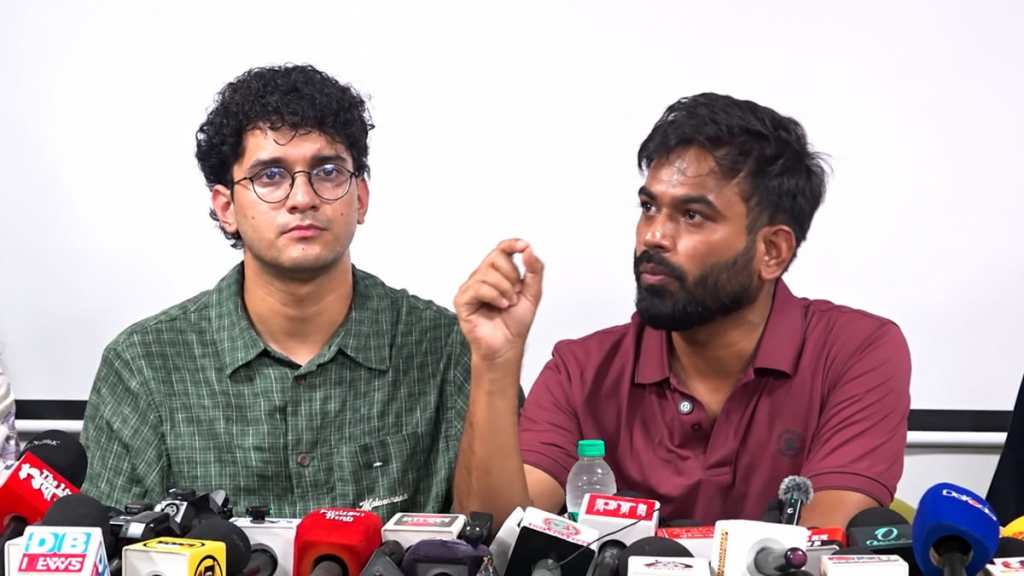

Cockroach Janta Party (CJP) founder Abhijeet Dipke on Thursday launched a sharp attack on Chief Election Commissioner Gyanesh Kumar, calling him “anti-national” and demanded his immediate resignation over the Election Commission’s handling of electoral rolls and the Special Intensive Revision (SIR).
Addressing a press conference in New Delhi, Dipke said that the Election Commission’s actions under Kumar had raised serious questions about the right to vote and the functioning of Indian democracy.
“A report concerning the Election Commission that surfaced yesterday proves that Chief Election Commissioner Gyanesh Kumar is the country’s biggest traitor. He is the biggest anti-national in this country, and he should resign immediately,” Dipke said.
He further alleged that Kumar posed a threat to the democratic process and questioned the manner in which electoral rolls were being revised.
“Ever since Gyanesh Kumar became Chief Election Commissioner, the government has been deciding who gets to vote and who doesn’t. Is this democracy?” he asked.
Dipke’s remarks come a day after an investigation by The Indian Express reported that Election Commissioners Sukhbir Singh Sandhu and Vivek Joshi had formally objected at least 14 times over 10 months to decisions and orders concerning electoral rolls and the SIR process. The report said the two Commissioners had raised concerns over issues including changes to Form 6, access to electoral-roll databases, deletion and restoration of voters’ names, and appeals filed in West Bengal.
‘Why delete so many votes?’
Referring to the scale of the electoral-roll revisions, Dipke alleged that more than 13 crore names had been deleted and questioned the rationale behind the exercise.
“In total, more than 13 crore votes have been deleted. This is not a small number,” he said.
Dipke linked the figure to the 2024 Lok Sabha election and the vote difference between the ruling NDA and Opposition. He also argued that the scale of the deletions warranted scrutiny.
“Is Gyanesh Kumar deleting them intentionally to widen that 2% gap so that they never lose office? Why is this being done? What was the need to delete so many votes?” he asked.
The CJP founder also questioned whether the SIR process could disproportionately affect political opponents of the BJP-led government.
Dipke alleges pattern involving Opposition leaders
Dipke went on to say that the BJP’s performance in the 2024 Lok Sabha election, in which it fell short of a majority on its own, triggered a political response aimed at regional opposition leaders.
“The BJP failed to secure a majority in the 2024 election. The panic button was pressed when they fell short of that majority,” he said.
He also said that several prominent regional leaders, including former Maharashtra Chief Minister Uddhav Thackeray, NCP leaders, Tamil Nadu Chief Minister MK Stalin, Kerala Chief Minister Pinarayi Vijayan, former Delhi Chief Minister Arvind Kejriwal and West Bengal Chief Minister Mamata Banerjee, had subsequently faced political challenges.
“This cannot be a mere coincidence; there is a clear pattern,” Dipke alleged.
He then cited voter-deletion figures in constituencies associated with some of these leaders and suggested that the deletions had influenced their electoral outcomes.
“In West Bengal, 50,000 votes were deleted from Mamata Banerjee’s constituency, and she lost by a margin of around 15,000 votes. In MK Stalin’s constituency, 100,000 votes were deleted, and he lost by about 45,000 votes. In Delhi, 40,000 votes were deleted from Arvind Kejriwal’s constituency, and he lost by a margin of 4,000-5,000 votes,” he claimed.
He also referred to Pinarayi Vijayan and alleged that voter deletions in Kerala had affected his political prospects.
These specific claims require separate verification and should not be treated as evidence that voter deletions caused the electoral outcomes cited by Dipke.
‘If you wipe out Opposition, can it still be democracy?’
Dipke said the CJP did not have an “affinity” towards any particular Opposition party but argued that the functioning of electoral institutions was an issue affecting the democratic process as a whole.
“Now, we have no particular affinity for the Opposition or any specific party. But in a democracy, if you wipe out the entire Opposition, can it still be called a democracy? Is it a free and fair election?” he asked.
The report said Sandhu and Joshi had objected to a series of decisions, including a change to Form 6 that required new voter applicants to answer a question linking their application to the electoral roll of the previous SIR. The two Commissioners had reportedly described the change as “unauthorised and illegal”.
The investigation also reported that Joshi had raised concerns about the “gradual centralisation” of the electoral-roll database, while Sandhu questioned whether state-level election officials had proper and complete access to the ERONet system.
The two Commissioners also separately approached Cabinet Secretary TV Somanathan over changes to the allocation of work concerning the ECI’s information-technology systems, according to The Indian Express report.
Opposition criticism intensifies
The findings have already triggered criticism from several Opposition leaders, with Congress general secretary KC Venugopal demanding Kumar’s removal and calling for a Supreme Court-monitored investigation.
Trinamool Congress MP Derek O’Brien has also revived the demand for action against the CEC, while Samajwadi Party chief Akhilesh Yadav called on the Supreme Court to take suo motu cognisance of the reported disagreements within the poll panel.
Rajya Sabha MP Kapil Sibal and Shiv Sena (UBT) MP Sanjay Raut have also criticised Kumar over the reported functioning of the ECI.
The Election Commission, however, has rejected the suggestion that its decisions, including those concerning SIR, were taken without the approval of all three Commissioners. Sources in the poll panel said that decisions of the Commission were unanimous and had the approval of Kumar, Sandhu and Joshi.