


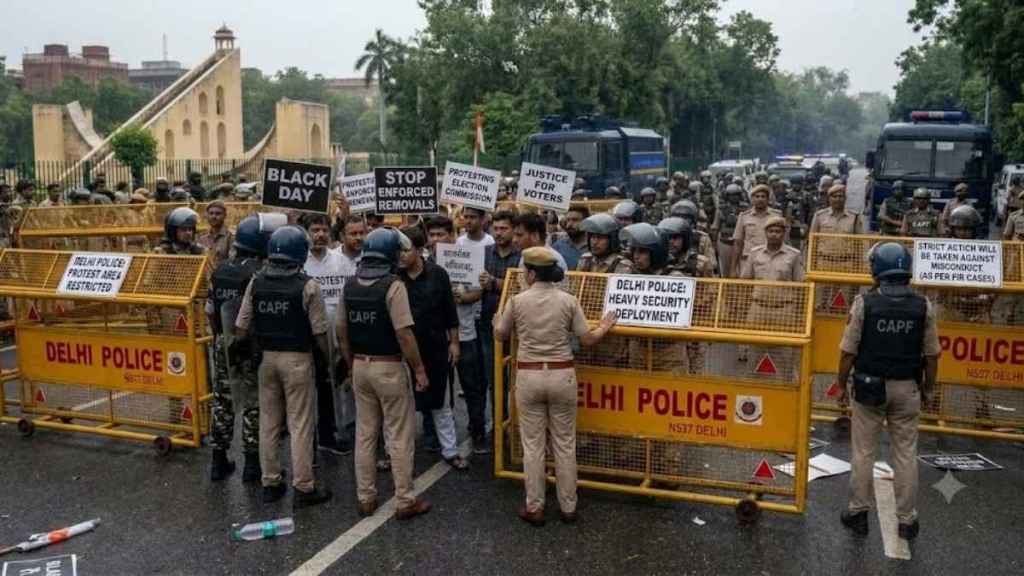

Amid ongoing protests against Chief Election Commissioner (CEC) Gyanesh Kumar, authorities have registered FIRs against senior Congress leaders. Alongside police action, heavy security—including Central Armed Police Forces (CAPF) personnel—has been deployed near the protest site. The BJP has criticised the Congress for its unruly behaviour, while Congress leaders declared Thursday a “Black Day.”
Following the latest developments, security has been tightened at Rajghat after the Congress announced plans to hold a demonstration at the memorial site. Delhi Police have imposed Section 163 of the Bharatiya Nagarik Suraksha Sanhita (BNSS) in the area, as reported by Indian Express. Security has also been increased outside the BJP headquarters.
Additionally, Delhi traffic police issued an advisory for the general commuters. The advisory stated that traffic congestion is likely on Rajghat–Kishan Ghat Road and adjoining stretches due to the proposed dharna at Kishan Ghat Road.
FIRs registered against Rahul Gandhi and Priyanka Gandhi Vadra
The Delhi Police have registered three FIRs stemming from the Opposition’s Wednesday protest, with additional cases filed on Thursday. The charges include alleged assault on police personnel, obstruction of government duty, pushing, manhandling, and misbehaviour with law enforcement officers. The FIRs explicitly name Congress leaders Rahul Gandhi and Priyanka Gandhi Vadra.
The legal action follows Delhi Police stopping INDIA bloc MPs on Wednesday as they attempted to march toward Jantar Mantar. Rahul Gandhi was seen attempting to open a barricaded gate as police personnel prevented protesters from moving ahead. Gandhi was among the detained MPs brought to the Barakhamba Road police station, while Priyanka Gandhi was detained and taken to Chhatrasal Stadium.
Earlier on Wednesday, Delhi Police had registered an FIR after Congress MPs Rahul Gandhi, Priyanka Gandhi Vadra, and other INDIA bloc leaders allegedly entered the Akashvani Bhavan premises without permission during their protest against the Election Commission of India on Tuesday.
Reaffirming the opposition’s stance, Rahul Gandhi stated that the Congress and INDIA bloc would continue to take to the streets, face arrests, and navigate legal cases to “save the Constitution and democracy.” In a post on X, Gandhi wrote: “To save the Constitution and democracy, the Congress Party and the opposition are ready to take to the streets as many times as needed, face arrests, or endure legal cases.”
Gyanesh Kumar’s security upgraded
The Delhi Police have increased security outside Chief Election Commissioner Gyanesh Kumar’s residence following fresh threat inputs, according to a report by The Indian Express. The security enhancement comes as the Congress and Opposition INDIA bloc continue to demand Kumar’s resignation following recent demonstrations near his Delhi residence and another outside his family home in Agra.
Kumar already receives Z-Plus security cover; however, additional police personnel have been stationed at his residence in light of recent intelligence reports and ongoing demonstrations in New Delhi.
A police officer quoted in the report noted that local district police have been asked to step up deployment. In addition, all security agencies have been directed to coordinate closely to prevent any untoward incidents while protests remain underway.
Heavy security deployment in the capital
The Ministry of Home Affairs (MHA) has made 221 companies of the Central Armed Police Forces (CAPFs)—totalling roughly 23,000 personnel—available to the Delhi Police from October 8 to 12. This includes 111 companies previously allocated during the Cockroach Janta Party (CJP) protests in July, alongside 110 companies sanctioned on October 6.
To meet this requirement, Central Reserve Police Force (CRPF) companies are being redeployed from the Jammu region (retained after the Amarnath Yatra), West Bengal (stationed since last year’s elections), and Chhattisgarh (where they were assigned to anti-Naxal operations).
Root cause of the protests
Revisions to the voter list conducted by the Election Commission have driven ongoing demonstrations led by opposition parties. Because the Election Commission determines voter eligibility and oversees election administration, updates to electoral rolls carry significant political weight.
The controversy stems from a nationwide voter list audit known as the Special Intensive Revision (SIR). Initiated last year in Bihar prior to local elections, the audit expanded across most states and Union Territories. Under this process, voters must submit documentation proving their eligibility to remain on the rolls, leading millions to file appeals against unexpected removals.
The Election Commission maintains that the revision is necessary to remove duplicate or ineligible entries and safeguard legitimate registrations. Critics counter that the process risks disenfranchising eligible citizens, particularly lower-income and vulnerable communities.
BJP sharpens attack
BJP National President Nitin Nabin criticised Rahul Gandhi on Thursday over the protests, accusing him of operating with an “anarchist mindset” and attempting to spread social division. His comments followed Gandhi leading INDIA bloc street protests on Wednesday prior to his detention.
BJP National Spokesperson C.R. Kesavan also criticised Gandhi over allegations of inappropriate conduct toward female police officers during the New Delhi demonstration, arguing that the behaviour undermined constitutional institutions.
In a post on X, Kesavan questioned whether an MP or the Leader of the Opposition should conduct themselves in such a manner toward female officers, demanding an apology if the claims are verified: “Will any decent individual, let alone a Member of Parliament or the Leader of the Opposition, behave in such an inappropriate manner with women police personnel?”
(With Agency Inputs)