


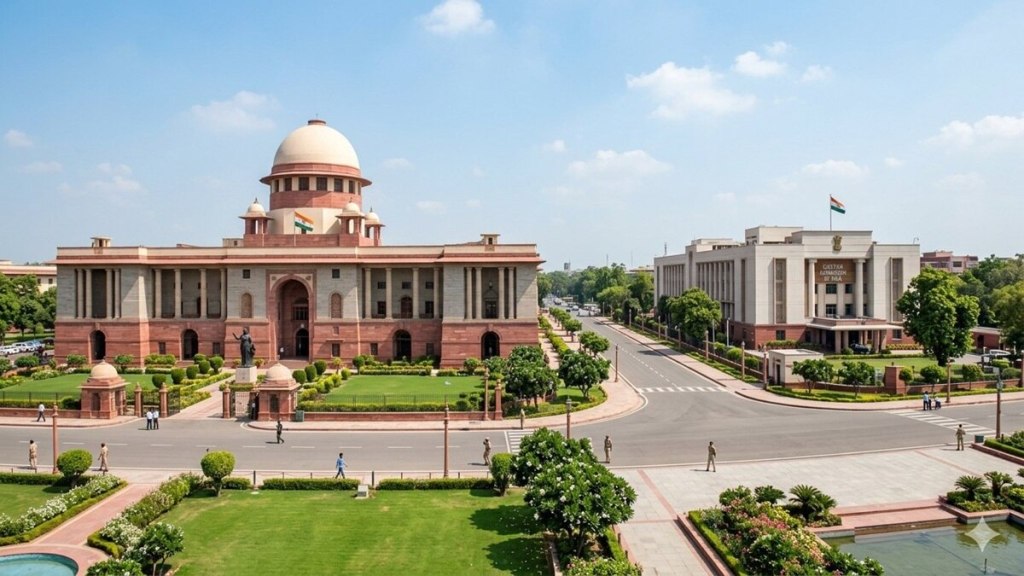

The Supreme Court has sent petitions challenging the 2023 law on appointing the Chief Election Commissioner (CEC) and other Election Commissioners (ECs) to Chief Justice of India (CJI) Surya Kant.
According to a news report and court developments stated by The Indian Express, the CJI will now consider whether the case should be heard by a Constitution Bench.
The law is controversial because it replaced the Chief Justice of India with a Union Cabinet minister nominated by the Prime Minister on the three-member selection panel, giving the executive two members on the committee.
The decision followed a split view between Justices Dipankar Datta and Satish Chandra Sharma on whether the case should be heard by a larger bench. Both judges, however, agreed that the matter should be placed before the CJI instead of being sent first to another three-judge bench, a step they said could cause further delay.
What does the 2023 law provide?
The Chief Election Commissioner and Other Election Commissioners (Appointment, Conditions of Service and Term of Office) Act, 2023 provides for a three-member selection committee.
The committee consists of:
- The Prime Minister.
- A Union Cabinet minister nominated by the Prime Minister.
- The Leader of the Opposition (LoP) in the Lok Sabha.
The committee recommends the names of the CEC and ECs, after which the President formally appoints them. The main dispute concerns the replacement of the CJI with a Cabinet minister. Under the 2023 law, the Prime Minister and the minister nominated by him are both part of the panel, while the Leader of the Opposition is the only member outside the government.
Petitioners argue that this arrangement gives the executive a dominant role in selecting the officials responsible for conducting elections.
What did the Supreme Court say in Anoop Baranwal?
The challenge to the law goes back to the Supreme Court’s 2023 judgment in Anoop Baranwal v. Union of India. In that case, a Constitution Bench noted that Parliament had not enacted a law under Article 324 of the Constitution to govern the appointment of Election Commissioners.
Until Parliament enacted a law, the Supreme Court directed that the Prime Minister, the Leader of the Opposition in the Lok Sabha and the Chief Justice of India should jointly recommend candidates for appointment as the Chief Election Commissioner and other Election Commissioners.
The court said the Election Commission must be protected from exclusive executive control because it conducts elections, which are central to the functioning of a democracy.
Parliament later enacted the 2023 law but removed the CJI from the selection committee and replaced the office with a Cabinet minister nominated by the Prime Minister.
Why are petitioners challenging the law?
The petitioners’ main argument is that the law weakens the independence of the Election Commission. They contend that a selection panel dominated by the executive could affect public confidence in the appointment process. The concern is not only whether the Election Commission acts independently after appointment, but also whether the process appears neutral to the public and political parties.
Justice Datta referred to this issue while examining the request for a larger bench. “It is not enough for the ECI to be independent, it must also appear to be independent,” he said.
The Indian Express report stated that Justice Datta also expressed concern about the role of the Cabinet minister nominated by the Prime Minister. A minister who is part of the government, he observed, “cannot be expected to defy his own nominator”.
He said this could make the presence of the Leader of the Opposition on the committee “largely ornamental”. He added that the petitioners’ argument that the law gives the executive overwhelming influence “does appear to have substance”, while clarifying that these were prima facie observations and not a final ruling on the law’s validity.
Why did Justice Datta not favour a Constitution Bench?
Justice Datta took the view that the existing two-judge bench could decide the petitions. According to him, the Supreme Court had already laid down the relevant constitutional principle in Anoop Baranwal: appointments to the Election Commission cannot remain under “exclusive executive control”.
The question before the court, he said, was whether the 2023 law violated that principle. In his view, this was an application of an already settled legal rule to the new law and did not necessarily require a Constitution Bench.
The report further stated that Justice Datta therefore held that there was no constitutional or legal obstacle preventing the present bench from hearing the petitions.
He also rejected the government’s comparison between the Election Commission appointment process and the collegium system used for appointing judges. He described the comparison as “disingenuous, evasive and disquieting”.
Why did Justice Sharma favour a larger bench?
Justice Sharma disagreed with Justice Datta and said the challenge should be heard by a Constitution Bench of at least five judges. He noted that the Supreme Court had not previously ruled on the constitutional validity of the 2023 law. The question, therefore, was not merely whether an existing legal principle should be applied, but whether Parliament was constitutionally entitled to replace the CJI with a Cabinet minister nominated by the Prime Minister.
“There is no authoritative decision of this court till date pronouncing on the constitutional validity of the said Act,” Justice Sharma said.
He added that the case would represent the first direct examination of the law by the Supreme Court. Justice Sharma identified the central question as whether Parliament was justified in excluding a neutral constitutional authority from the selection committee.
“Whether or not Parliament was justified in not including a neutral selector in the selection committee” was an important question arising before the court for the first time, he said.
He concluded that Article 145(3) left “no room for a decision on such question finally by the present combination” of two judges.
Why was the matter sent to the CJI?
The two judges disagreed on whether the case should be referred to a Constitution Bench, resulting in a split verdict on that procedural issue. However, they agreed that the matter should go to the CJI. The judges did not want the disagreement to first be sent to a three-judge bench, which would then have to consider whether the matter should be placed before an even larger bench.
They said that process could create another round of hearings and delay the final decision. The joint order noted that referring the matter first to a three-judge bench would be of “little worth” and could delay the determination of important constitutional questions.
The CJI, acting on the administrative side, will now decide whether to constitute a five-judge Constitution Bench or a bench of another appropriate strength.
What is a Constitution Bench?
Under Article 145(3) of the Constitution, a Constitution Bench must have at least five judges when a case involves a substantial question concerning the interpretation of the Constitution. A case does not automatically go to a Constitution Bench merely because it involves a constitutional provision. The question must generally be important and unsettled, meaning that the Supreme Court has not already authoritatively decided it.
Constitution Bench rulings carry greater precedential weight and are intended to settle significant constitutional questions for future cases.
Concern over delays in constitutional cases
The judges also expressed concern over the time taken by the Supreme Court to decide matters referred to larger benches. They referred to the Anoop Baranwal case, which took eight years to reach a final judgment. They also pointed to other constitutional references that remained pending for long periods.
The judges described these delays as “a source of institutional embarrassment” and asked the CJI to consider whether a permanent five-judge bench should be created to hear constitutional matters. Their concern was that sending the case through multiple procedural stages could delay a decision on a law that directly affects the appointment of officials responsible for conducting elections.
What happens next?
The CJI will consider the two judges’ opinions and decide whether to constitute a Constitution Bench. If such a bench is formed, it will examine the constitutional validity of the 2023 law.
The larger bench may have to consider several questions:
- Whether the 2023 law violates the requirement of an independent Election Commission.
- Whether Parliament can replace the CJI with a government-appointed minister on the selection panel.
- Whether the selection committee gives the executive excessive influence.
- Whether the law is consistent with the principles laid down in Anoop Baranwal.
- Whether the presence of the Leader of the Opposition provides an adequate institutional check.
The Supreme Court has not yet ruled that the 2023 law is unconstitutional. The present order only sends the issue to the CJI for consideration of a larger bench.