



The Central Board of Secondary Education (CBSE) on Monday released fresh guidelines on the implementation of its new three-language policy, clarifying that students currently studying in Class 10 will not be affected by the revised framework for the 2026-27 academic year.
Under the new policy, the board said the existing batch of Class 10 students will continue under the old system of studying two languages, with no requirement to take a third language as part of board examinations. The revised language framework forms part of a phased implementation plan that will gradually become fully operational up to Class 10 by the academic session 2030-31.
Current Class 10 students exempt from new rule
According to CBSE, students who are currently in Class 10 during the 2026-27 academic session will continue following the earlier structure, which requires only two language subjects.
The board clarified that this batch will not need to adopt the newly introduced compulsory third-language requirement, offering relief to students preparing for upcoming board examinations.
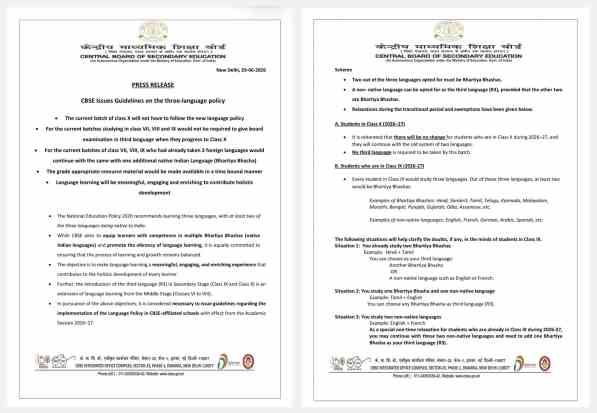
What does the revised guidelines say about Class 7, 8, 9 and 10 students?
For students currently studying in Class 9 during the 2026-27 academic year, the new structure will begin to apply partially. CBSE said these students will now study three languages, with at least one required to be a Bhartiya Bhasha (Indian language). However, the third language, referred to as R3, will only be assessed internally by schools.
Importantly, when this batch moves to Class 10 in the 2027-28 academic year, they will not have to appear for a CBSE board examination in the third language. The board also announced transitional relaxations for students already studying in Classes 7, 8 and 9.
Students who had previously opted for two foreign languages will be allowed to continue with their existing language combination, but they will be required to add one Bhartiya Bhasha as an additional subject.
CBSE clarified that these students will not be required to take board examinations for the newly added third language when they reach Class 10.
New three-language formula explained
Under the revised curriculum, language education will now be organised into three levels:
R1 (Language 1): Student’s primary language
R2 (Language 2): A second language different from R1
R3 (Language 3): A compulsory third language from Class 6 onwards
CBSE said two out of the three languages selected must be Bhartiya Bhashas.
A non-native or foreign language can be chosen as the third language, but only if the other two selected languages are Indian languages. The new policy has been introduced from the 2026-27 academic session and will be implemented in phases over the next few years.
Which languages qualify under the policy?
CBSE has classified Indian and foreign languages separately under the framework. Bhartiya Bhashas include Hindi, Sanskrit, Tamil, Telugu, Kannada, Malayalam, Marathi, Bengali, Punjabi, Gujarati, Odia, Assamese and other Indian regional languages.
Non-native languages include English, French, German, Arabic, Spanish and other foreign languages.
The board added that all scheduled languages listed under the Eighth Schedule of the Constitution of India, along with several regional and foreign languages, remain available as options.