


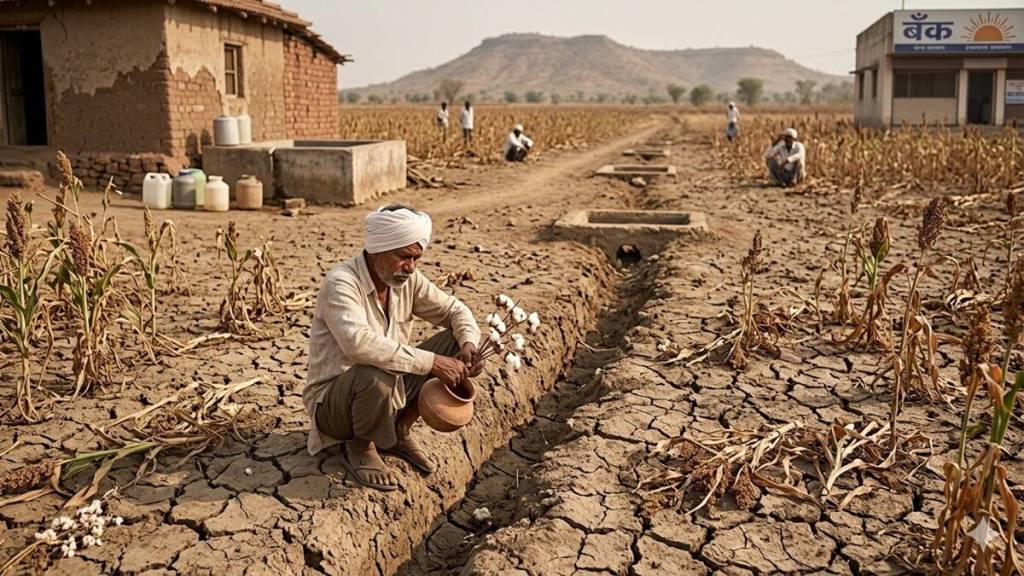

Several Indian states are battling drought after the country faced its weakest monsoon in nearly two decades. An unprecedented El Niño is now fast approaching its peak — with around 3 billion people across the world predicted to experience unusually high temperatures till the end of this year. Against this backdrop, Andhra Pradesh Chief Minister N Chandrababu Naidu has renewed calls for interlinking of rivers to make the southern states drought-free.
“If we link five rivers — Godavari, Krishna, Tungabhadra, Penna and Cauvery — all water problems will be sorted out. Karnataka, Telangana, Andhra Pradesh and Tamil Nadu…all problems will be solved. Right now there are water wars…” he said during an event last week.
The Andhra CM also discussed the Godavari–Cauvery river interlinking project with Prime Minister Narendra Modi and appraised Home Minister Amit Shah about the “drought situation prevailing in Andhra Pradesh due to the impact of El Niño” on October 8. Naidu said he had sought Central government support “in addressing the challenges arising from the deficient rainfall and its impact on the agricultural sector”.
“We also discussed the proposal to take forward the Godavari–Krishna–Penna–Palar–Cauvery river-linking project, which has the potential to provide a sustainable solution to the water requirements of Andhra Pradesh, Telangana, Tamil Nadu and Karnataka, while strengthening water security across southern India,” he wrote on X.
The assertion came days after he contended that “2,000 thousand million cubic feet of river water is flowing into the sea”. Indian Express quoted him as saying during the launch of Jal Jeevan Mission 2.0 that the Rayalaseema region “would flourish with abundant greenery and crops if at least 200 TMC of Godavari floodwater was utilised”.
States declare drought for Kharif season
Several states in the Deccan region have declared drought at the taluk or mandal level over the past two months. Karnataka became the first state to declare drought conditions at the end of August — with 101 taluks affected for the Kharif season. The tally hit 217 (out of 240 taluks) by October 2 as a Central government team visited to assess the damage. Multiple reports also cited Deputy Chief Minister G Parameshwara as saying on Friday that eight to 10 taluks more could be added to the list before a final memorandum is submitted to the Centre.
“The farmers are facing an acute drought situation, drinking water problems, and crop failure…nearly Rs 46,000 crores of crop loss has been estimated and submitted to them. We expect a rightful response from the Government of India. Last time they gave only Rs 3,400 crores; this time we expect much more than that because the impact is so big,” he had said earlier this month.
Maharashtra declared drought in 265 of its 358 talukas on September 25 as crops wilted in the fields and farmers stared at massive losses. The state is also preparing to tackle possible shortages of drinking water and livestock fodder in some areas. According to reports, the Telangana and Rajasthan governments are also working to identify drought-hit mandals and conducting a field-level assessment of crop losses.
Andhra Pradesh joined the list on October 2 — declaring 388 mandals across 21 out of 28 districts as drought-affected for the 2026 Kharif season. A government order cited by Indian Express added that the state had recorded a rainfall deficit of 53.4% during the months of June and August 2026. It added that an average rainfall of 197.6 mm has been received against the normal rainfall of 424.3 mm from June 1 to August 31.
Govt intervention and key challenges
The Indian government has spent tens of thousands of crores in drought-proofing and water conservation schemes over the past few decades. But the extensive interventions have not made the country impervious to drought conditions. According to the India Drought Monitor maintained by the Water and Climate Lab of IIT Gandhinagar, around 52.5% of the country was under dry or drought conditions by mid-September.
“India’s drought vulnerability is not solely a consequence of inadequate rainfall; it is equally a challenge of how water resources are managed, replenished and utilised,” Shailesh Tyagi, partner and leader, Climate Change & Sustainability, Deloitte South Asia told Financial Express.
He noted that the Central Ground Water Board had flagged 730 groundwater assessment units across India as over-exploited — “underscoring the persistence of localised water stress despite significant investments in irrigation, watershed development and water conservation infrastructure”. Data from the CGWB indicates that India extracts around 247 billion cubic metres of groundwater every year, the largest consumer in the world.
“While these interventions have strengthened water security, their long-term effectiveness depends on addressing groundwater over-extraction, fragmented water governance, inadequate maintenance of existing infrastructure and agricultural practices that are often misaligned with local water availability. The priority must therefore shift from measuring infrastructure created and expenditure incurred to evaluating measurable outcomes, including groundwater recharge, reliability of irrigation supply, improvements in water-use efficiency and the resilience of agricultural communities to prolonged dry periods,” Tyagi adds.
Why are states pushing for river interlinking?
A plan to connect rivers across the country was first formulated in 1980 — intended to secure long-term water needs and channel surplus water into drought-prone areas. The river-linking scheme envisages a system of dams, storage reservoirs, heavy-duty pumps, tunnels, and more than 14,000 kilometers of canals.
According to details shared by PIB, the Ken-Betwa Link is the only priority link project under the National Perspective Plan that has entered the implementation stage. The project is being built at an estimated cost of Rs 44,605 crore — is envisaged to provide irrigation to about 11.88 lakh hectares and drinking water supply for 62 lakh people in the Bundelkhand region. It is also expected to generate 103 MW of hydropower and 27 MW of solar power.
Work is also underway on the Polavaram Irrigation Project in Andhra Pradesh that incorporates the Godavari–Krishna link. The project envisages irrigation to about 7.2 lakh acres and stabilisation of 23.5 lakh acres in the Godavari and Krishna delta systems. It will entail diversion of 80 TMC of Godavari water to the Krishna basin, drinking and industrial water supply, domestic water supply to about 28.5 lakh population in 611 villages, and hydropower generation of 960 MW. The project has received cumulative central assistance of Rs 20,658 crore.
Solution to drought in south India?
The river-linking project has faced extensive scrutiny and pushback from environmentalists over the years — with many flagging the possible damage to forest and water ecosystems. The installation of dams and large-scale canals also risks displacing hundreds of thousands of local residents. A pan-India linking project also presents major logistical hurdles and water-sharing debate among states. It may also require the formulation of international treaties for rivers that flow into neighbouring countries.
“If you link all rivers, India will be unstoppable. If you link Brahmaputra, Ganga, Mahanadi, Kaveri and Godavari, then India will be a different India,” Naidu said in September.
The official government stance appears to be somewhat more reserved — clarifying that these links were expected to “substantially improve water security” and drought resilience in arid areas.
“It would not be appropriate to claim that the project will completely eliminate drought. Rather, it is intended to substantially improve water security and drought resilience in its command and beneficiary areas by providing dependable irrigation and drinking-water support,” a PIB press note said of the Ken-Betwa link.
Tyagi told Financial Express that river interlinking could “complement” existing efforts by redistributing water between basins where sustainable surplus availability is scientifically established.
“But it cannot be viewed as a standalone solution to drought. Its viability depends on robust hydrological assessments, environmental flow requirements, ecological and social safeguards, interstate cooperation and long-term economic feasibility,” he added.
According to the Deloitte partner, long-term drought resilience would depend on “integrating surface water and groundwater management, strengthening aquifer-level water budgeting, restoring watersheds and promoting water-efficient agricultural practices.
“The objective should be to build a water system capable of withstanding rainfall variability, rather than one that responds only after water scarcity becomes a crisis,” he reiterated.