


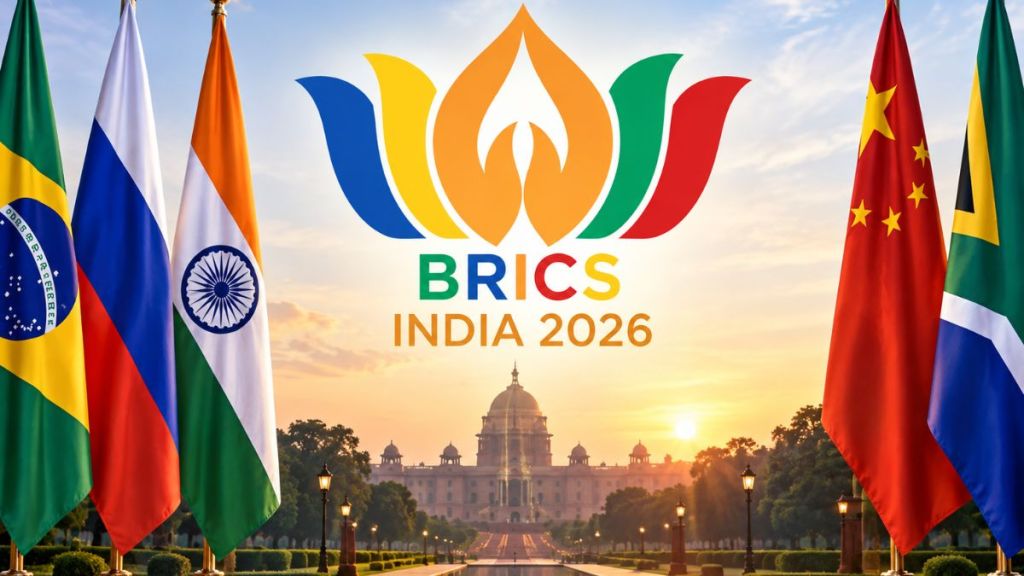

India is preparing to host the 18th BRICS Summit in New Delhi on September 12-13, bringing together leaders of one of the world’s largest groupings of emerging economies and developing countries.
The summit at Bharat Mandapam comes at an important moment for India. New Delhi holds the BRICS Chairship in 2026 and is seeking to use the platform to strengthen its position as a leading voice of the Global South while pushing for more practical cooperation on trade, investment, finance and technology.
India’s chairship is guided by the theme, “Building for Resilience, Innovation, Cooperation and Sustainability.” More than 350 meetings and high-level engagements have already been held across 25 cities in India during the year. The final meeting of BRICS Finance Ministers and Central Bank Governors is scheduled to be held in Mumbai on September 9-10, just days before the leaders’ summit.
What India wants from BRICS
India’s objective is to move BRICS beyond political statements and towards practical outcomes that can benefit businesses, economies and people.
New Delhi’s agenda focuses on cooperation across commerce, agriculture, healthcare, energy, digital technology, urban development, small businesses, startups, climate action and cultural exchanges. The framework is built around four pillars: resilience, innovation, cooperation and sustainability.
Resilience focuses on protecting economies, institutions and societies from supply-chain disruptions, health crises, geopolitical shocks and climate risks. Innovation covers areas such as artificial intelligence, financial technology, digital public infrastructure and data-driven systems.
Cooperation focuses on expanding trade, strengthening institutional links, improving development financing and increasing economic policy coordination. Sustainability includes climate action, green finance, energy transition and sustainable development.
India is also pushing for stronger and more balanced trade among BRICS members, greater trade in services, resilient global value chains and easier access to finance for small businesses.
At the recent BRICS Trade Ministers’ meeting in Jaipur, members endorsed principles aimed at improving MSME access to global markets and narrowing the trade-finance gap. India also pushed for more resilient and diversified global value chains.
The grouping has advanced the Strategy for BRICS Economic Partnership 2030 and adopted the BRICS Global Value Chains Action Plan 2026-2030.
Making BRICS commercially useful
For India, one of the biggest opportunities is to make BRICS cooperation commercially meaningful. “India should use its BRICS presidency to secure faster export payments, fewer certification hurdles and financed infrastructure projects,” Vaibhav Maloo, managing director of Enso Group and president of Enso Foundation, told Fortune India.
India’s exports to BRICS were estimated at $82 billion in goods in FY2025-26, while services exports stood at $31.3 billion in calendar 2024, according to Maloo. Easier access to BRICS markets could therefore have significant commercial benefits for Indian businesses.
He identified pharmaceuticals, engineering, digital services, energy security and investment in critical mineral supply chains as some of the areas where India could benefit. For businesses, the success of the summit may ultimately depend less on the language of the final declaration and more on whether it reduces the friction involved in doing business across BRICS markets.
Maloo said BRICS should focus on MSME export finance, mutual recognition of testing and simpler customs procedures. Tariff concessions, however, could be more difficult because member countries have divergent interests.
UPI and India’s digital payments push
Payments could become one of the clearest areas where India can offer something tangible to the expanded BRICS grouping. Rather than pursuing a common BRICS currency in the near term, the focus has increasingly shifted towards local-currency settlement and improving cross-border payment infrastructure.
India’s UPI and Account Aggregator framework could give New Delhi a stronger role in this conversation. A CareEdge-ORF report on SME financing across BRICS+ economies argues that India’s digital finance infrastructure offers a scalable model for cross-border SME payments and trade finance.
The report recommends developing a BRICS+ Digital Payments and Open Finance Framework based on interoperable national payment systems, common technical standards and secure data-sharing protocols.
Startups, technology and innovation
India is also looking to build a broader innovation ecosystem across BRICS. Its agenda includes the BRICS Incubator Network, which would connect startup incubators across member economies. New Delhi has additionally proposed the BRICS Startup Innovation Fund to support early-stage and growth financing for promising enterprises.
Digital cooperation could expand through the proposed BRICS Digital Public Infrastructure Repository, aimed at sharing knowledge and testing scalable DPI solutions. Human capital development is another part of India’s agenda through BRICS CONNECT, a cooperative network focused on labour-market intelligence, skill forecasting and digital employment services.
India’s chairship has also included proposals around youth cooperation, women’s digital capacity, student and faculty exchanges and traditional knowledge systems.
Former BRICS Sherpa Sanjay Bhattacharya said BRICS needs to embrace technology. “Rules-based and inclusive BRICS Plus ecosystem can serve as a stabilising force amid growing geopolitical fragmentation. For this reason, South-South partnerships must now move beyond declarations to delivery – through joint investments, digital partnerships, and shared innovation ecosystems,” he told IANS.
Agriculture, health and energy
India is also using its chairship to push cooperation in areas that can have a direct impact on societies. The BRICS Network on Digital Agriculture, where India is coordinating the initial phase, aims to bring artificial intelligence, geospatial tools and digital public infrastructure into farming.
The initiative is accompanied by the Global Forum on Farmers’ Rights in Seed Systems and the BRICS AGRIN — Agro-Inputs, Genetic Resources and Information Network — to strengthen cooperation in seeds and agricultural inputs.
In healthcare, the unanimous adoption of the 16th BRICS Health Ministerial Declaration in Chandigarh reinforced commitments towards universal health coverage, pandemic preparedness, digital health tools and affordable medicines. India has also led the creation of mechanisms for mental-wellness cooperation coordinated through NIMHANS.
Energy security remains a major focus because BRICS includes both major energy producers and consumers. Following the BRICS Energy Ministers’ Meeting in Gurugram, members adopted guiding principles on smart grids and launched the BRICS Digital Centre of Excellence for Smart Grids and Energy Storage.
The initiative is expected to support pilot projects, technical exchanges and regulatory cooperation across renewable energy, hydrogen, biofuels, critical minerals and carbon-capture technologies.
A bigger role in the Global South
India’s BRICS strategy is also closely linked to its larger foreign-policy objective of positioning itself as a leading voice for developing and emerging economies.
BRICS has evolved from being largely an economic grouping into a broader platform through which countries of the Global South seek greater influence over the global economic and political order.
For India, the grouping provides an important platform to engage with China and Russia while maintaining strategic partnerships with the US, Europe, Japan, Australia and other countries.
BRICS has consistently pushed for reforms in institutions such as the United Nations, International Monetary Fund and World Bank, arguing that their governance structures do not adequately reflect the growing economic weight of emerging economies.
At a conference titled ‘An Emerging BRICS Vision for the Global South’, Sudhakar Dalela, Secretary (Economic Relations) at the Ministry of External Affairs, said BRICS had evolved into a platform for the developing world.
“BRICS has evolved beyond an economic grouping into a dynamic platform for the Global South’s strategic and developmental aspirations,” he told IANS.
He said India’s 2026 chairship presented an opportunity to institutionalise cooperation in areas such as digital public infrastructure, sustainable finance and resilient supply chains.
“The next phase of BRICS cooperation will be defined by how effectively the grouping integrates technology and trade policies. Therefore, BRICS Plus must leverage its vast resource base to develop joint ventures in rare earth extraction, renewable energy, and green manufacturing,” Dalela told IANS.
Pradeep S Mehta, Secretary at CUTS International, said the Global South was at an important moment. “The Global South today stands at an inflection point. For the first time since the Non-Aligned Movement, developing countries have a collective institutional platform capable of influencing the rules of global trade, technology, and finance,” he told IANS.
Managing China, Russia and a divided bloc
Hosting the summit also gives India an important diplomatic opportunity. A Modi-Xi bilateral and a Modi-Putin bilateral are expected on the sidelines, both carrying important economic implications.
With China, India has been working to stabilise ties following the 2020 border crisis, with trade normalisation, market access and supply chains likely to remain important areas of discussion.
With Russia, energy, fertilisers, trade payments and the large bilateral trade imbalance remain central to the relationship.
The likely participation of Chinese President Xi Jinping is particularly significant because it could provide another high-level channel for managing the complex India-China relationship. India’s challenge, however, will be to balance the interests of an increasingly diverse bloc.
The expanded BRICS includes countries with competing geopolitical interests, including Iran and the UAE. India also maintains important strategic and economic relationships with Washington and Gulf countries.
Energy security raises the stakes
The geopolitical environment has also made the summit more important for India’s economic interests. The US-Iran war has affected energy security, shipping and global oil markets, with the Strait of Hormuz becoming a major vulnerability.
Reuters reported on August 31 that analysts expected oil prices to remain above $80 per barrel in 2026 because of ongoing supply disruptions linked to the US-Iran conflict.
For India, West Asia is central to energy security, trade and diaspora interests. A prolonged disruption in the region could increase India’s import bill, put pressure on inflation and complicate economic growth. Energy cooperation within BRICS could therefore become increasingly important for New Delhi.
What India could gain
India’s biggest gain from hosting BRICS may be the opportunity to turn its diplomatic influence into concrete economic outcomes.
The grouping now comprises 11 members including Brazil, Russia, India, China, South Africa, Egypt, Ethiopia, Iran, Saudi Arabia, the UAE and Indonesia, alongside partner countries including Belarus, Bolivia, Cuba, Kazakhstan, Malaysia, Nigeria, Thailand, Uganda, Uzbekistan and Vietnam. The expanded bloc represents significant economic, demographic and geopolitical weight.
India can use the platform to push for easier market access, faster cross-border payments, stronger trade finance, greater investment in infrastructure and deeper technology cooperation.
The New Development Bank could also play an important role. The multilateral development bank, set up by the BRICS founding countries in 2015, finances infrastructure and sustainable-development projects in member and other emerging economies.
IIndia is seeking to use BRICS to strengthen its influence across the Global South, but it also has a chance to make that influence commercially relevant through payments infrastructure, trade finance, development funding and easier access to markets.
“Summit commitments should name implementing agencies and require public progress reviews, with success measured through lower costs, quicker payments and new orders,” Maloo said Fortune India. The summit will give India a major diplomatic platform, but its bigger success may depend on whether New Delhi can turn the group’s growing economic and political influence into practical outcomes for businesses and developing economies.