


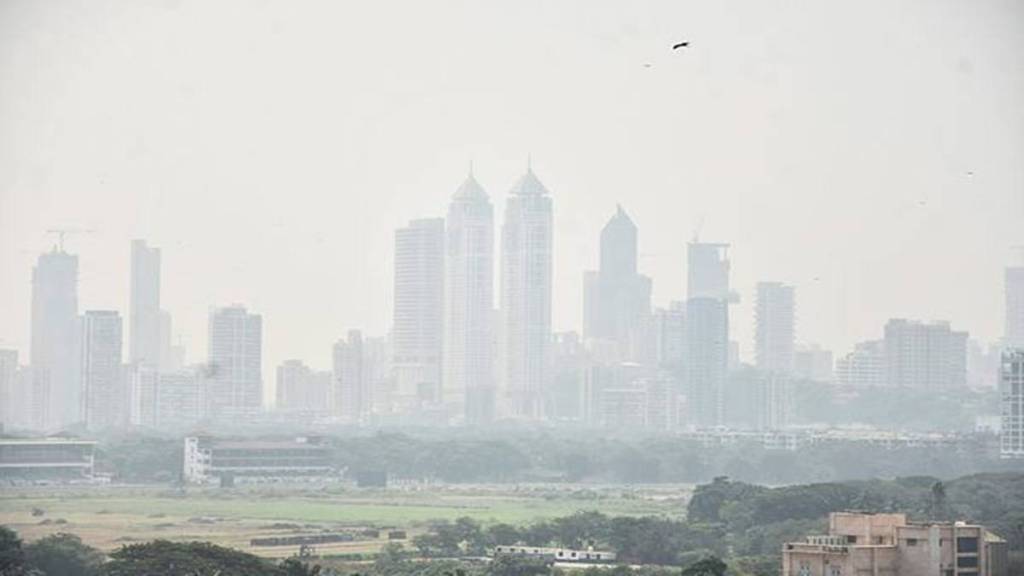

The Bombay High Court has raised serious concern over Mumbai’s worsening air pollution, calling the situation an emergency and questioning the failure of authorities to impose measures against air and noise pollution. According to a report by The Indian Express, the court observed on Wednesday, October 21, that Mumbai was surpassing Delhi pollution levels despite its coastal location.
A bench of Justices Girish S Kulkarni and Neela K Gokhale slammed civic, pollution control and police authorities for inadequate implementation of earlier court directions, particularly restrictions on firecrackers and noise during the festivals.
‘This is an emergency situation’: Bombay High Court
Questioning the authorities’ action, Justice Kulkarni observed, as quoted by The Indian Express, “We don’t understand how those who are supposed to implement this can even have a peaceful sleep, because this is an emergency on their part.”
The court also voiced its concern that lakhs of residents were suffering because of deteriorating air quality. It also questioned the lack of effective action against construction-related pollution.
“The smog is very bad and we do not know where we are heading,” Justice Kulkarni remarked, as per an Indian Express report. The bench also underlined the difficulties faced by residents, including those unable to comfortably go for morning walks because of pollution.
What did the court say about firecrackers?
The High Court flagged the implementation of its earlier order restricting firecrackers on public roads and streets.
As per The Indian Express, the court cited an incident near Crawford Market in south Mumbai, where firecrackers were reportedly burst on a busy street near a police station despite the restrictions.
The bench raised concerns over the enforcement of requirements concerning licences for sound systems used during processions. It also cautioned that officials failing to impose court directions could face accountability for neglecting their duties.
What directions were issued to authorities?
The court ordered the Mumbai Police Commissioner to conduct a meeting with police station in-charges to ensure stricter implementation of its orders. The commissioners of the Brihanmumbai Municipal Corporation (BMC) and Maharashtra Pollution Control Board (MPCB) were also instructed to attend the next hearing on October 26.
They will all need to present the steps taken to implement pollution-control measures, including public notices and awareness campaigns explaining the harmful effects of firecrackers and excessive noise.
What does this mean for Mumbai residents?
The court’s observations underline the importance of enforcing pollution restrictions in residential areas and public spaces.
Justice Kulkarni observed, as reported by The Indian Express, “We don’t want Mumbaikars to have a situation to see AQI levels first and then step out.”
The bench also questioned whether air quality readings from cleaner areas adequately reflected conditions in more polluted neighbourhoods.
Stubble burning’s share in Delhi pollution likely to rise above 13%
Stubble burning is expected to contribute more than 13 per cent to Delhi’s air pollution on Thursday, October 22, compared with around 8 per cent on Wednesday, according to a PTI report citing forecasts from the Decision Support System for Air Quality Management under the Ministry of Earth Sciences. Its contribution is projected to fall to 10.369 per cent on Friday.
Meanwhile, Delhi recorded its first day of ‘poor’ air quality this season on Wednesday, with the Air Quality Index (AQI) reaching 245, its highest level in 100 days. The city last recorded a comparable AQI of 246 on July 13. The transport sector’s estimated contribution to pollution is also expected to change, declining from 20.513 per cent on Wednesday to 17.282 per cent on Thursday before increasing to 18.171 per cent on Friday.
What did the HC say in its earlier order?
In an October 16 report, PTI said the Bombay High Court had warned that unchecked festival celebrations were turning urban centres into “toxic gas chambers”.
The court clarified that its August ban on bursting firecrackers on public roads and streets would apply throughout the year.
It also noted that AQI readings in some Mumbai locations had recently reached 425.
The bench directed pollution-control authorities, municipal corporations and police to establish complaint mechanisms, appoint nodal officers and conduct awareness campaigns.
The latest hearing has renewed scrutiny of how effectively these directions are being implemented.