


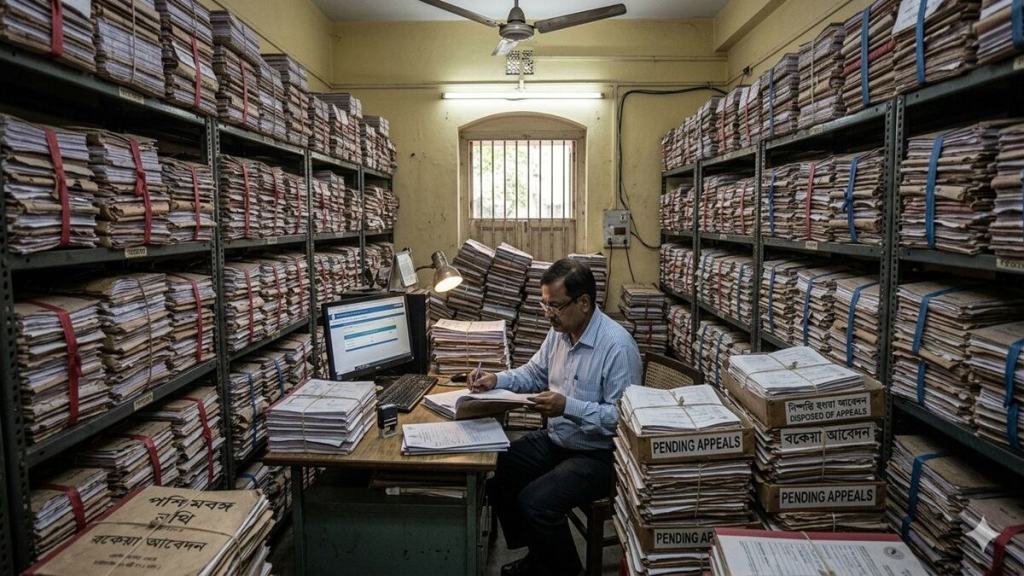

The Special Intensive Revision (SIR) of electoral rolls in West Bengal has become the focus of a fresh controversy in the Supreme Court, after the Election Commission of India (ECI) said that around 37.18 lakh out of 38.20 lakh appeals against inclusion and deletion of names are still pending—but did not provide a break-up of how many relate to voters seeking inclusion versus those challenging inclusions.
The Indian Express obtained a counter-affidavit which was filed on Thursday (September 17) and the Election Commission informed the court that only 1.02 lakh appeals have been disposed of so far by the appellate tribunals set up on the Supreme Court’s directions, even as five months have passed since these tribunals began functioning in April.
The affidavit, however, did not specify how many of the 38.20 lakh appeals were filed by the 27.16 lakh electors whose names were deleted and who want to be restored to the rolls, and how many were filed by parties or individuals seeking exclusion of names that were included.
What the EC affidavit says on pending appeals?
The EC’s counter-affidavit was filed in response to a July 17 notice on a petition by West Bengal Congress leader Prasenjit Bose, who had sought details of pending appeals as well as data on additions and deletions in the state’s electoral rolls during the SIR process.
These appeals are against orders passed by around 700 judicial officers who were tasked by the Supreme Court to decide the eligibility of electors marked “under adjudication” during the SIR.
On August 25, during a hearing on a batch of petitions relating to the West Bengal SIR, a Supreme Court bench headed by Chief Justice of India Surya Kant had specifically asked the EC to clarify the nature of the appeals, the affidavit data added.
“Get your data, the nature of the appeals that are filed, whether it is for inclusion or for exclusion. And then we will take a call as to whether we prioritise the exclusion and then inclusion because an inclusion is not affecting an individual right, but an exclusion is denuding a voting right,” Justice Joymalya Bagchi, a member of the bench, told Senior Advocate DS Naidu, appearing for the EC.
The court suggested that prioritising exclusion appeals could reduce the burden on tribunals while protecting voting rights, since deletion of a name directly affects an individual’s franchise.
SIR process: How names were deleted and included?
The SIR of electoral rolls was launched in nine states and three Union Territories from October 2025. In West Bengal, the process assumed special significance after the Supreme Court, noting a “trust deficit” between the EC and the then Trinamool Congress (TMC) government, took the unusual step on February 20 of ordering that the eligibility of electors be decided by judicial officers.
Around 700 judicial officers examined 60.06 lakh electors who had been marked “under adjudication” by the EC.
Their orders resulted in:
- Deletion of 27.16 lakh names from the draft rolls
- Inclusion of 32.9 lakh names in the rolls
On March 10, the Supreme Court directed the creation of an appellate mechanism so that those aggrieved by the judicial officers’ orders could appeal. On March 20, the EC notified 19 appellate tribunals, each headed by a retired High Court judge. The tribunals started functioning on April 13.
Despite this, the EC’s latest affidavit shows that only about 2.7 per cent of the total appeals have been decided so far.
Form 6 and Form 7 data: Enrolments and deletions during SIR
The EC affidavit also provided data on voter registration forms filed during the SIR period. From December 17, 2025, when the SIR draft roll was published, until August 7, a total of 34.13 lakh Form 6 applications were received. Form 6 is the statutory form used for new voter registration and for inclusion of names.
Of these:
- 4.86 lakh forms were unprocessed
- 7.26 lakh forms for enrolment were rejected
- 14,079 forms were accepted
The EC said this figure would include both first-time applicants and those from the 58.20 lakh electors who were deleted at the draft stage of the SIR and were seeking re-enrolment.
On the deletion side, a total of 6.39 lakh Form 7 applications were filed. Form 7 is used for seeking deletion of names from the electoral roll.
Of these:
- 14,506 forms were rejected
- 3,355 forms were accepted
The EC affidavit, however, did not link these figures directly to the 38.20 lakh appeals now pending before the appellate tribunals, nor did it clarify how many appeals relate to inclusion versus exclusion.
Gender ratio and electors-to-population ratio in Bengal rolls
The affidavit also shared key demographic indicators for West Bengal’s electoral rolls.
Gender ratio (female voters per 1,000 male voters):
- 969 as on January 1, 2025
- 970 as on October 27, 2025 (the day SIR was announced)
- Fell to 956 in the draft electoral roll as of December 16, 2025
- Recovered slightly to 964 in the final SIR roll published on February 28
The dip in the gender ratio during the SIR process has been a point of contention, with opposition parties alleging that large-scale deletions disproportionately affected women voters.
The EC also provided the electors-to-population (EP) ratio:
- Projected population as on January 1: 10.40 crore
- Total electors: 6.44 crore
- EP ratio: 0.62, or 62 electors per 100 population
The EP ratio is seen as a measure of the health of the electoral roll. Ideally, the number of voters should be close to the population above 18 years. For comparison, during the 2024 Lok Sabha elections, India’s overall EP ratio was 66.76.
Why the break-up of appeals matters?
The Supreme Court’s observation in August underlined why the distinction between inclusion and exclusion appeals is important. Exclusion appeals challenge the inclusion of names in the rolls. If upheld, they lead to deletion of voters.
Inclusion appeals seek restoration or addition of names. If rejected, the person remains off the rolls. The bench suggested that prioritising exclusion appeals could help protect individual voting rights while gradually reducing the tribunals’ workload.
Without a clear break-up, however, it remains unclear how many of the 37.18 lakh pending appeals directly involve voters fighting to get their names back after deletion.
The Indian Express further stated in its news report that the petitioner Prasenjit Bose and other critics have argued that the lack of transparency makes it difficult to assess whether the SIR process has been balanced and whether deleted voters are getting a fair chance to appeal.
What happens next in the Supreme Court?
The EC’s counter-affidavit is likely to be closely examined by the Supreme Court bench, which has been monitoring the West Bengal SIR process and the functioning of the appellate tribunals.
Key issues before the court now include:
- Whether the EC should be directed to provide a detailed break-up of appeals by type (inclusion vs exclusion).
- Whether exclusion appeals should be prioritised to protect voting rights.
- Whether the pace of disposal by the 19 tribunals needs to be accelerated, especially with future elections in view.
- Whether additional safeguards are required to ensure that genuine voters are not left off the rolls due to delays in the appellate process.
For now, the EC’s admission that over 97 per cent of appeals remain pending, coupled with the absence of a clear inclusion–exclusion break-up, keeps the Bengal SIR at the centre of a heated legal and political debate over the integrity and inclusiveness of the state’s electoral rolls.