


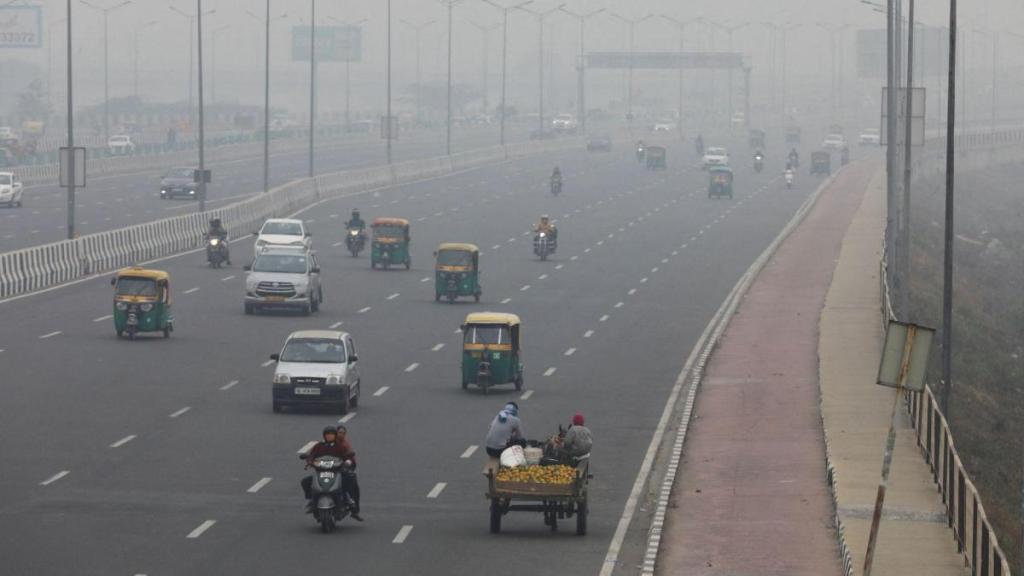

The season of air pollution is upon us. To begin with, Delhi’s air quality slipped into the ‘poor’ category on Wednesday (October 28), with an AQI of 229, according to the Central Pollution Control Board’s 4 pm bulletin. It was 197 a day earlier.
The CPCB bulletin listed 23 of 265 cities in the ‘poor’ category. None recorded a city-level AQI in the ‘very poor’ or ‘severe’ categories.
Air quality worsens in MP, UP cities
Pithampur in Madhya Pradesh recorded the highest AQI in the bulletin at 286, followed by Khora in Uttar Pradesh at 277 and Panipat in Haryana at 274. Gummidipoondi in Tamil Nadu recorded 238, showing that elevated pollution extended beyond northern India.
Across the National Capital Region, Noida recorded 246, Greater Noida 220, Ghaziabad 210 and Gurugram 203, all in the ‘poor’ category. Faridabad remained ‘moderate’ at 126.
Major metros elsewhere reported lower readings. Mumbai’s AQI stood at 90, Kolkata’s at 59 and Hyderabad’s at 65, placing them in the ‘satisfactory’ category. Chennai recorded 115 and Bengaluru 107, both ‘moderate’. Aizawl recorded 17, in the ‘good’ category.
These data represent averages for the preceding 24 hours, reported at 4 pm. CPCB also excluded 63 cities because data were insufficient.
Pollution controls and stubble fires
The Commission for Air Quality Management invoked Stage I of the Graded Response Action Plan across Delhi-NCR on October 21, after Delhi’s AQI reached 245.
According to the environment ministry’s announcement, the decision activated 25 measures, including mechanised road sweeping, water sprinkling, construction dust controls and enforcement against open waste burning. Agencies were also directed to inspect polluting industries, enforce vehicle emission requirements and expand public transport services.
The Stage I measures also require enforcement of the ban on coal and firewood in restaurant tandoors, checks on industrial fuel use and action to prevent diesel generators from becoming a regular electricity source. The commission urged offices to organise shared commuting and asked agencies to keep monitoring conditions.
Separately, CAQM raised concerns over increasing paddy-stubble fires during an October 24 review covering Punjab’s Amritsar and Tarn Taran districts, according to a government release.
The commission directed officials to ensure farmers received residue-management machinery promptly and to increase the use of paddy straw in power plants, brick kilns and industry. Tarn Taran was identified as reporting among the highest numbers of stubble-burning incidents.
Those enforcement concerns do not establish how much crop burning contributed to Wednesday’s AQI readings.
Improvement forecast for Delhi
The Ministry of Earth Sciences’ Air Quality Early Warning System forecast Delhi’s air to improve to ‘moderate’ between October 29 and 31 in its latest assessment. Its outlook for the subsequent six days indicated conditions ranging from ‘moderate’ to ‘poor’.
The October 28 bulletin also forecast rain, thunderstorms and stronger winds on Thursday.
Under CPCB’s classification, AQI readings of 201-300 are ‘poor’ and 301-400 ‘very poor’. The board warns that prolonged exposure to ‘poor’ air can cause breathing discomfort for most people, while prolonged exposure to ‘very poor’ air can cause respiratory illness.