


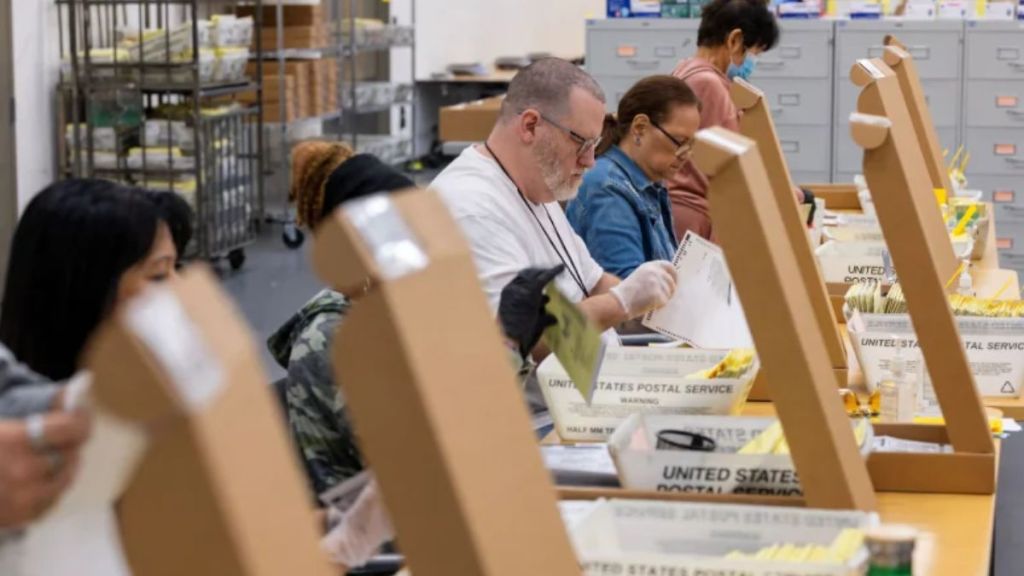

The US Supreme Court on Monday dealt a setback to President Donald Trump’s administration on the eve of the midterm elections. The court refused to order California to separate up to 20,000 mail-in ballots that federal officials suspect may have been cast by noncitizens, Reuters reported.
The order was brief and did not explain the reasons behind the decision. It came just hours after the Justice Department approached the court with an emergency request, making it a last-minute legal battle ahead of the elections. The Supreme Court also did not ask California to respond before issuing its order, a step it usually takes in such cases.
Lower courts had already rejected the administration’s request.
What did the Trump administration want?
The Justice Department had asked the Supreme Court to direct California election officials to set aside ballots linked to voters whose names appeared on a federal list of suspected noncitizens.
The administration wanted these ballots to be kept out of the counting process until officials could confirm whether the voters were US citizens.
It argued that once these ballots were mixed with other votes, it would become impossible to identify and remove them later.
Solicitor General D. John Sauer described the request as a limited measure to prevent illegal votes from affecting the results of a lawful election. The administration also argued that a federal law banning noncitizens from voting gave it the authority to intervene, even though elections are managed by state and local officials.
Why did California oppose the request?
California officials challenged the administration’s demand, pointing out that noncitizens are already barred from voting under state law. They also questioned whether the federal government’s list was accurate.
There was also a practical problem with the request. Thousands of mail-in ballots had already been submitted and processed.
Under California’s election process, officials check a voter’s signature against their registration records before counting the ballot. Once the verification is complete, information identifying the voter is separated from the ballot.
This means officials cannot later identify which votes came from people whose names appeared on the federal list.
The 9th US Circuit Court of Appeals also found no evidence that Congress intended the federal law banning noncitizens from voting to override state election rules.
Earlier, US District Judge David Carter had warned that the administration’s demand could prevent eligible American citizens from having their votes counted in the midterm elections.
Trump’s wider push to check voter citizenship
The California case is part of a wider effort by the Trump administration to increase checks on voters’ citizenship status.
On Saturday, federal judges directed the Justice Department to stop warning California election officials that they could face prosecution if noncitizens cast ballots.
The administration has also pushed several states to verify voters’ citizenship using federal databases.
However, its efforts have faced questions in other states as well.
In Nevada, the federal government said it had identified 185 noncitizens on the state’s voter rolls. State officials responded that all 185 people were US citizens.
Trump has repeatedly claimed, without providing evidence, that millions of noncitizens vote illegally in US elections. However, election experts say such cases are extremely rare.
Why does the Supreme Court’s decision matter to immigrants?
Although the case is about California’s election process, it has wider implications for immigrants living in the US, particularly those who have become American citizens.
Naturalised citizens could have been wrongly flagged
One of the biggest concerns was that naturalised US citizens could be wrongly identified as noncitizens.
While noncitizens are not allowed to vote in federal elections, millions of people born outside the US have legally become American citizens and have the same voting rights as those born in the country.
However, government records may not always reflect a person’s updated citizenship status. Someone who was earlier listed as a noncitizen may have since completed the naturalisation process.
Reports on similar cases in other states have found that people flagged by the government as possible noncitizens were, in fact, naturalised US citizens.
Plaintiffs in the California case also argued that such lists could disproportionately affect naturalised citizens. Voting rights groups have raised concerns that errors in citizenship records could lead to eligible voters being wrongly removed from voter rolls.
Court’s decision protects eligible voters for now
The Supreme Court’s refusal means California will not have to set aside the disputed ballots as demanded by the administration.
Had the request been accepted, naturalised citizens wrongly identified on the federal list could have had their votes held back or excluded from the count.
Since the ballots had already been processed and separated from voter details, recovering such votes later would have been extremely difficult.
Immigrant families could still be worried about voting
The legal battle could also make some immigrant families hesitant about voting, even when they are legally eligible.
Warnings of possible prosecution and reports about lists of suspected noncitizen voters may create fear among immigrants, including US citizens and green card holders.
Immigrant rights groups have repeatedly warned that such actions could discourage eligible citizens from voting because they may fear that their citizenship or voter registration could be questioned.
Immigrants applying for citizenship are also watching the case
The dispute has also drawn attention to immigrants who are still waiting to become US citizens.
Earlier reports mentioned concerns among lawful permanent residents caught up in California’s voter fraud crackdown.
Green card holders are not allowed to vote in federal elections. However, an incorrect voter registration, even if made without any intention to break the law, could create problems for someone going through the US citizenship process.
What happens next?
The Supreme Court’s order does not settle the wider legal question of how much power the federal government has to check voter rolls and verify citizenship.
Since the justices did not explain their decision, the ruling does not establish clear limits on the administration’s authority in this area. The issue is likely to remain a point of dispute even after the midterm elections.
For now, California’s election process will continue as planned, with officials counting mail-in ballots without setting aside a separate group for the 20,000 disputed votes.