




The US suspension of employment-based green-card labour certification applications at eight major technology companies raised concerns among Indian professionals approaching the end of their H-1B visa limit.
The key question for affected workers is whether they can extend their stay in the US if their employer-sponsored green-card process is delayed or put on hold.
Financial Express Digital spoke to immigration experts Mithi Jaiswal and Sai Srinivas Reddy Bhumireddy about the options available to workers at different stages of the green-card process, including those whose H-1B status is nearing its six-year limit.
The US administration suspended eight technology companies from the Permanent Labour Certification programme, or PERM, on October 8. The companies include Microsoft, Adobe, Cognizant, Infosys, Tata Consultancy Services (TCS), Wipro, HCL Technologies and Capgemini. The suspension covers new applications and pending cases, according to the information available at the time of reporting.
The suspension follows allegations by US officials that the companies misused the employment-based immigration system. However, the suspension itself does not establish that the companies violated the law.
The move does not automatically cancel existing H-1B status, but it could complicate the plans of workers who depend on employer sponsorship for permanent residency.
H-1B workers nearing six years: What are their options?
The H-1B visa generally allows foreign professionals to work in the US for up to six years, subject to applicable rules and exceptions. Eligible workers may extend their stay beyond this limit under certain provisions of the American Competitiveness in the Twenty-First Century Act (AC21).
Jaiswal says workers approaching the limit should first establish whether they qualify for an extension. “If the employer cannot initiate PERM and the worker does not qualify under either extension provision, the situation becomes more difficult,” she says.
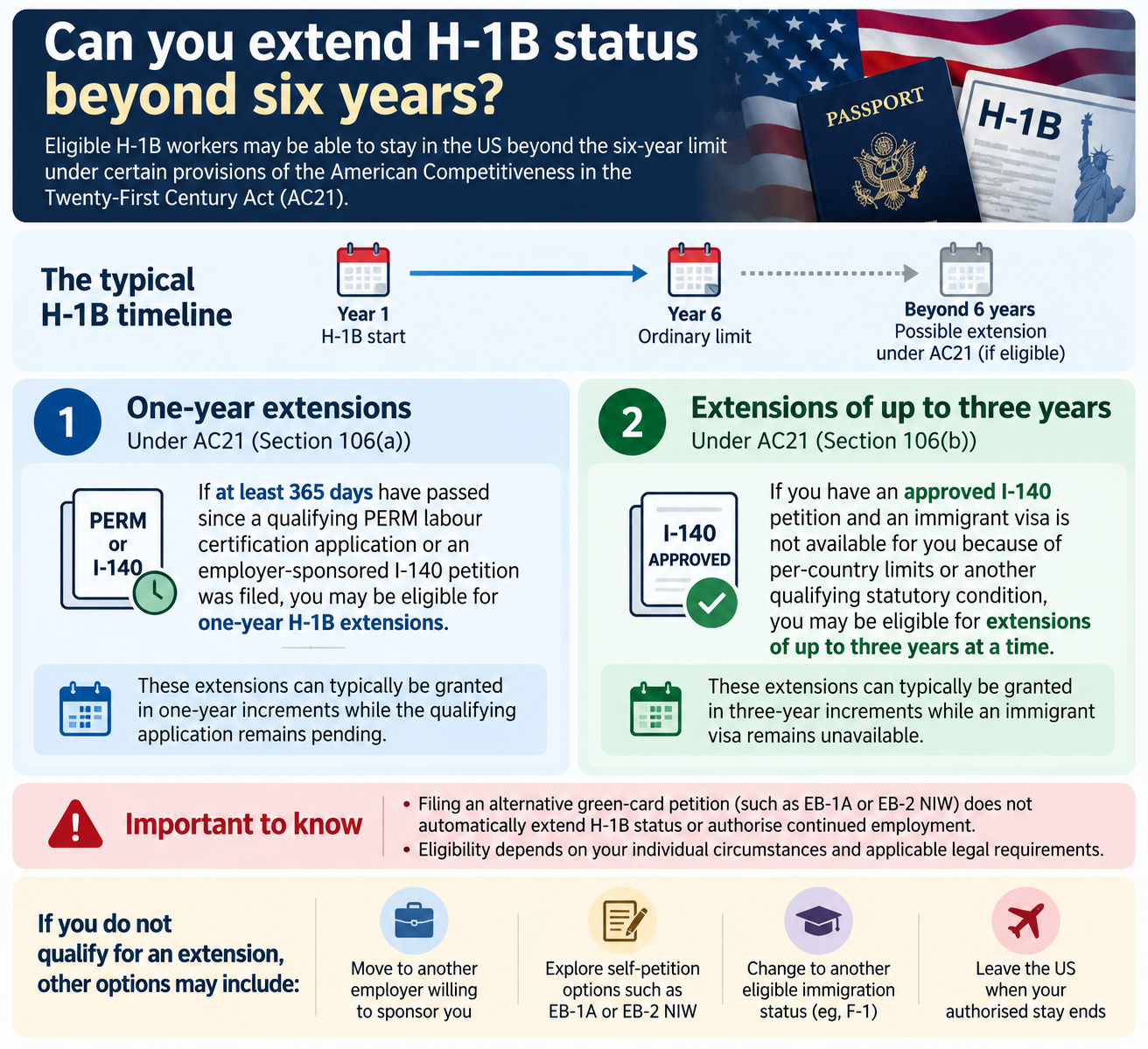
Depending on their circumstances, affected employees could explore moving to another employer willing to sponsor them, applying under an eligible self-petition category such as EB-1A or EB-2 National Interest Waiver (NIW), changing to another qualifying immigration status or leaving the US when their authorised stay ends.
EB-1A is a green-card category for individuals who can demonstrate extraordinary ability in their field. The EB-2 NIW allows certain individuals with advanced degrees or exceptional ability to seek permanent residency without employer sponsorship if they meet the national-interest waiver requirements.
However, filing an alternative green-card petition does not automatically extend H-1B status or authorise continued employment. Eligibility depends on the individual’s circumstances.
Who can extend H-1B status beyond six years?
Under AC21, certain workers may qualify for one-year H-1B extensions if at least 365 days have passed since a qualifying labour certification or employment-based immigrant petition was filed.
A separate provision may allow eligible workers with an approved I-140 petition to obtain extensions of up to three years at a time when an immigrant visa is unavailable because of applicable per-country limits or another qualifying statutory condition.
Form I-140, or the Immigrant Petition for Alien Workers, establishes eligibility for an employment-based immigrant category. An approved I-140 can support an H-1B extension in qualifying circumstances, but it does not itself grant permission to remain in the US indefinitely.
Jaiswal says workers should establish whether their PERM applications were filed, whether their I-140 petitions have been submitted or approved, and how much H-1B time remains. Eligible time spent outside the US may also be recaptured when calculating the six-year limit.
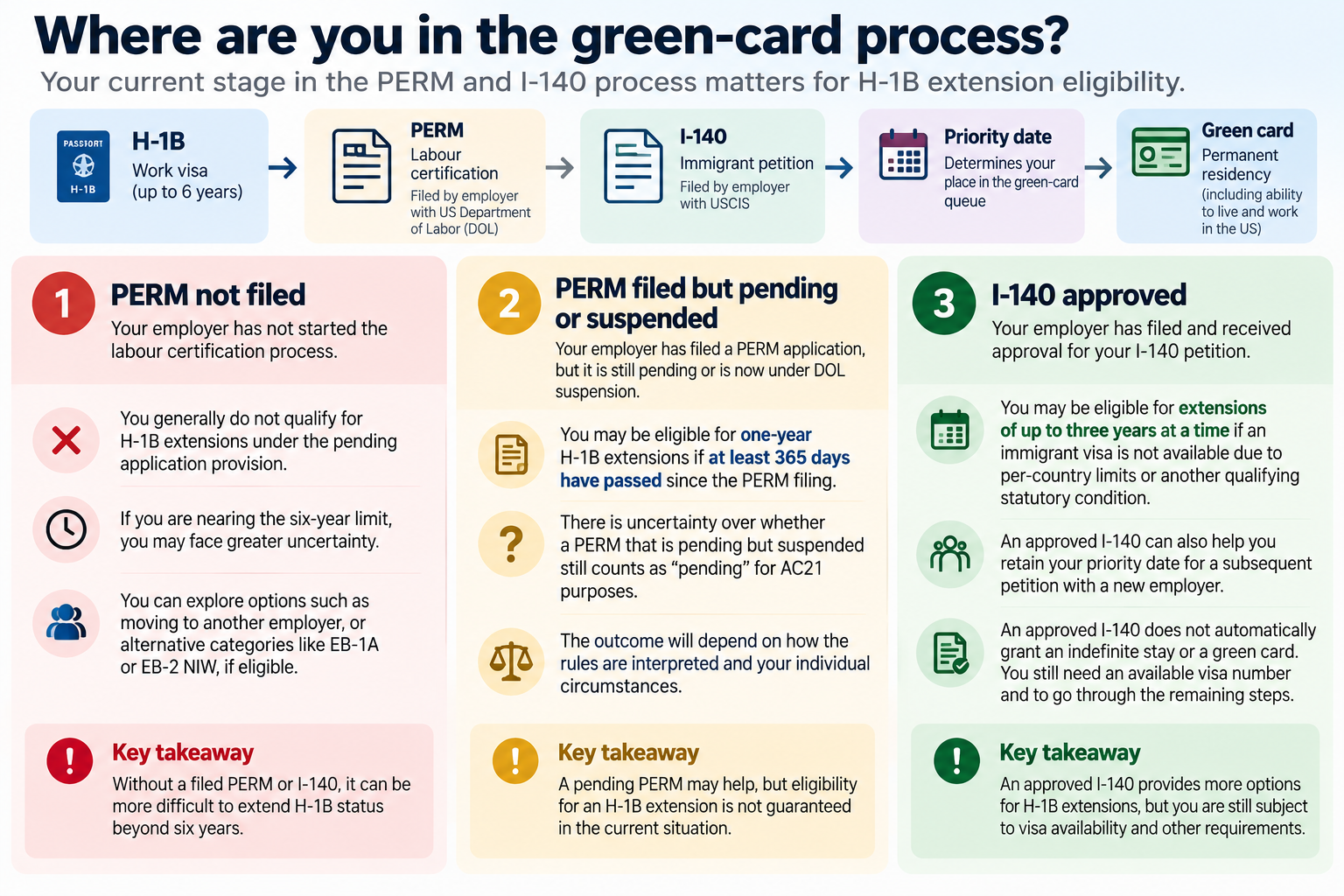
Employees whose employers have not filed PERM face greater uncertainty because they may not meet the filing requirements for an extension under the pending-application provision.
Do pending PERM applications still count towards H-1B extensions?
The treatment of PERM applications that were pending when the suspension took effect is a key unresolved issue for workers approaching the six-year limit.
Bhumireddy says employees whose PERM or I-140 applications were already filed or approved may have more options than those whose employers had not started the green-card process. However, he flags uncertainty over applications that were pending when the US Department of Labor suspended processing.
“The critical legal question right now is whether a PERM that was pending but is now under DOL suspension still counts as ‘pending’ for AC21 purposes,” he says. “That’s a genuine legal limbo that hasn’t been tested or clarified yet,” he says.
This matters for workers relying on the 365-day rule to qualify for an extension. They should not assume that a suspended PERM application automatically guarantees eligibility, or that the suspension necessarily removes an extension for which they otherwise qualify.
The outcome will depend on the applicable legal requirements and the worker’s individual filing history.
Can workers move to another employer?
Changing employers may be an option, but it does not automatically transfer the existing green-card process to a new company.
A new employer would generally need to file the required H-1B petition and, where necessary, begin a fresh PERM process. The labour certification is tied to the sponsoring employer and position.
Bhumireddy says workers can consider moving to an employer willing to sponsor them, but timing is a major concern for those nearing the six-year limit.
“Yes, portability exists – you can move to a new employer willing to file a fresh PERM,” he says. “But the risk is time: if you’re close to six years with no approved I-140, the new employer’s process may not complete before your clock runs out,” he says.
An existing approved I-140 may help a worker retain an earlier priority date for a subsequent qualifying employment-based petition. However, retaining a priority date and qualifying for an H-1B extension are separate matters.
Jaiswal advises employees against resigning or changing jobs solely on the expectation that another company will take over their green-card process. Workers should first obtain an assessment of their immigration status, extension eligibility and sponsorship prospects.
What happens when 6-year H-1B limit expires?
Workers who reach the ordinary six-year limit without qualifying for an extension or another applicable exception generally cannot continue working in H-1B status beyond that limit.
Depending on their circumstances, they may need to leave the US or change to another eligible immigration status. For example, a worker may qualify to change to F-1 status as an international student, but this requires meeting the relevant requirements and obtaining the necessary approval. Employment would still require appropriate authorisation.
The consequences can also affect family members. H-4 is the dependent visa category generally used by the spouses and unmarried children of H-1B workers, and their ability to remain in the US is linked to the principal worker maintaining qualifying status.
Certain H-4 spouses may qualify for an Employment Authorisation Document (EAD), which permits eligible non-US citizens to work. Eligibility depends on specific conditions involving the principal H-1B worker’s approved I-140 or qualifying extensions, it is not automatic.
Jaiswal advises families to assess their options well before the principal worker’s authorised stay expires.
What should affected Indian workers do now?
Workers affected by the suspension should establish the current status of their immigration cases rather than assume that the pause will automatically end their ability to stay in the US.
Jaiswal recommends checking whether PERM applications have been filed, whether I-140 petitions have been submitted or approved, and whether the worker qualifies for an H-1B extension under AC21. They should also review their travel history to determine whether eligible time spent outside the US can be recaptured.
For workers whose employers have not started the green-card process, alternative sponsorship or other qualifying immigration categories may need to be explored well before the six-year limit approaches.
The suspension does not automatically mean that every affected employee will lose the ability to remain in the US. However, the timing and status of each worker’s green-card process could become more consequential, particularly where no qualifying basis for an H-1B extension has been established.
With the treatment of suspended PERM applications still an important legal question, affected workers should seek individual immigration advice before making decisions about employment, travel or their future in the US.
What IT companies said
Tata Consultancy Services (TCS), HCLTech and Infosys have said they do not expect the US suspension of the Permanent Labour Certification (PERM) programme to materially disrupt their workforce strategies or business operations.
TCS said its PERM applications had been in single digits over the past two years, limiting the expected impact of the suspension. “Our PERM applications were in single digits in the last two years and hence we do not expect the suspension of the programme to impact our workforce strategy and customer engagements,” the company said in a statement. TCS also reiterated its plan to hire 15,000 people in the US over the next five years, with a focus on local talent.
HCLTech HR head Ram Sundararajan said on October 12 that the company would comply with the Department of Labor’s directive and respond to any questions raised by the agency. He said HCLTech had increased local recruitment over the years and that its PERM applications had been relatively few in recent years. The company does not expect the suspension to materially affect its workforce plans or client engagements.
Disclaimer: This article is for general informational purposes only. Immigration laws and government policies are subject to frequent change without notice. While we strive to provide accurate updates, readers are strongly advised to verify the latest requirements with the official embassy, consulate, or government portal of the respective country. For personalized guidance, please consult a qualified immigration attorney or a certified professional advisor.