




The US suspension of green-card applications at eight major technology companies has left some Indian professionals uncertain about their plans for permanent residency.
The US Department of Labor suspended the companies from the Permanent Labour Certification (PERM) programme on October 8, halting new applications and affecting pending cases.
The companies include Microsoft, Adobe, Cognizant, Infosys, Tata Consultancy Services (TCS), Wipro, HCL Technologies and Capgemini. PERM is a key step in the employer-sponsored green-card process, generally requiring employers to demonstrate that qualified US workers are not available for a position before sponsoring a foreign employee for permanent residency.
The suspension followed allegations by US officials that the companies misused the employment-based immigration system. However, the suspension itself does not establish that the companies violated the law.
Financial Express Digital spoke to immigration experts Mithi Jaiswal and Sai Srinivas Reddy Bhumireddy about whether affected workers can pursue alternative routes through EB-1A or EB-2 National Interest Waiver (NIW), the evidence required and the costs involved.
Both experts caution that these categories are not automatic substitutes for employer-sponsored PERM. EB-1A is for individuals who can demonstrate extraordinary ability in their field, while EB-2 NIW allows eligible professionals to seek a green card without the usual job-offer and labour-certification requirements if they can establish that waiving them would benefit the US.
“The biggest mistake is treating EB-1A or NIW as a quick workaround simply because an employer has stopped PERM sponsorship,” Jaiswal says. “These categories are evidence-driven, and applicants must qualify on their own merits,” she says.
Can Indian IT professionals apply for EB-1A instead of PERM?
EB-1 is the employment-based first-preference category for certain workers, including individuals with extraordinary ability, outstanding professors and researchers, and qualifying multinational managers and executives. For IT professionals seeking to apply independently, EB-1A is the most relevant self-petition route.
Several years of experience, a senior job title or employment at a well-known technology company is not enough by itself. Applicants must demonstrate sustained national or international acclaim in their field.
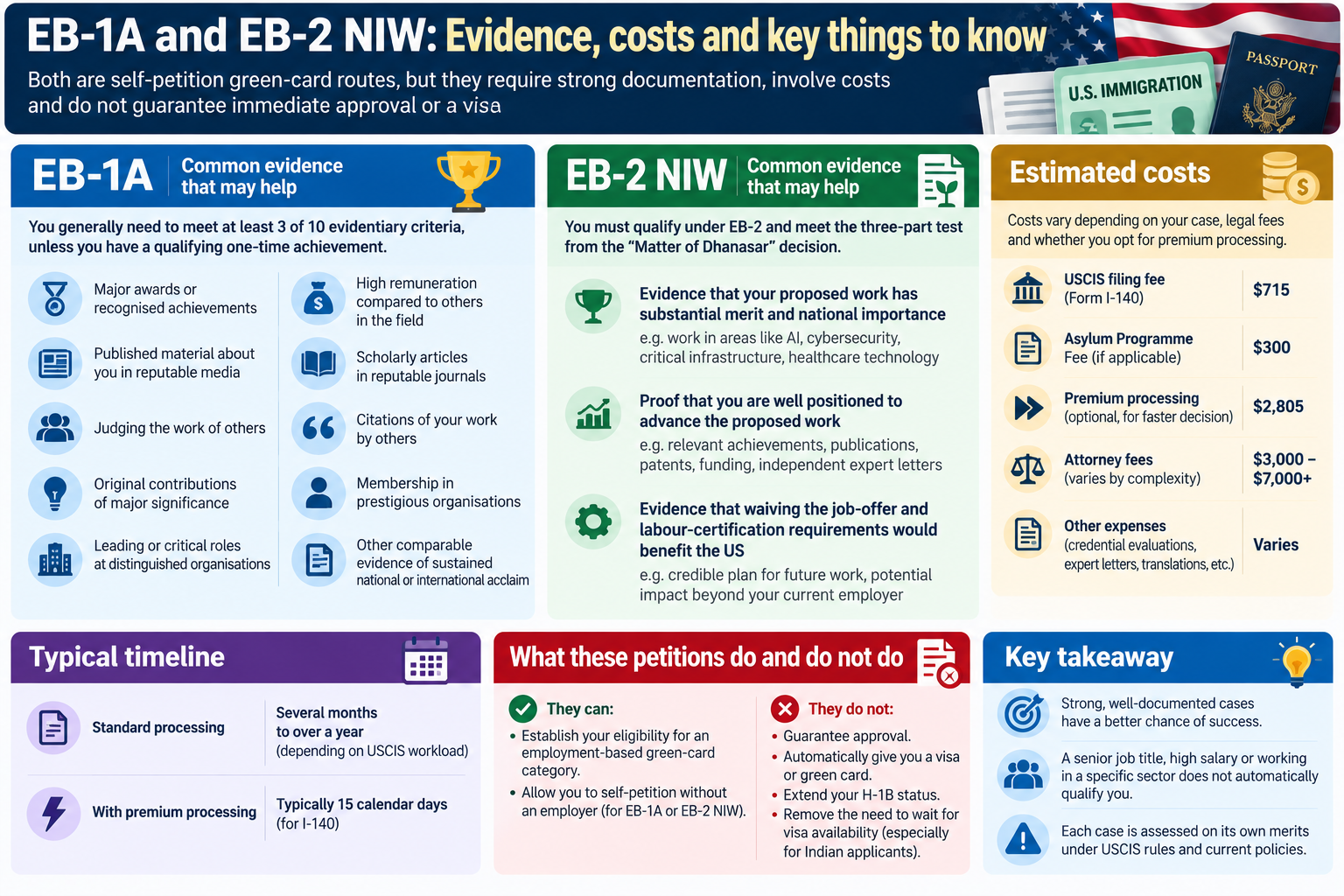
Jaiswal says evidence may include recognised awards, published material about the applicant, judging the work of others, original contributions of major significance, scholarly articles, leading or critical roles at distinguished organisations, or high remuneration relative to others in the field.
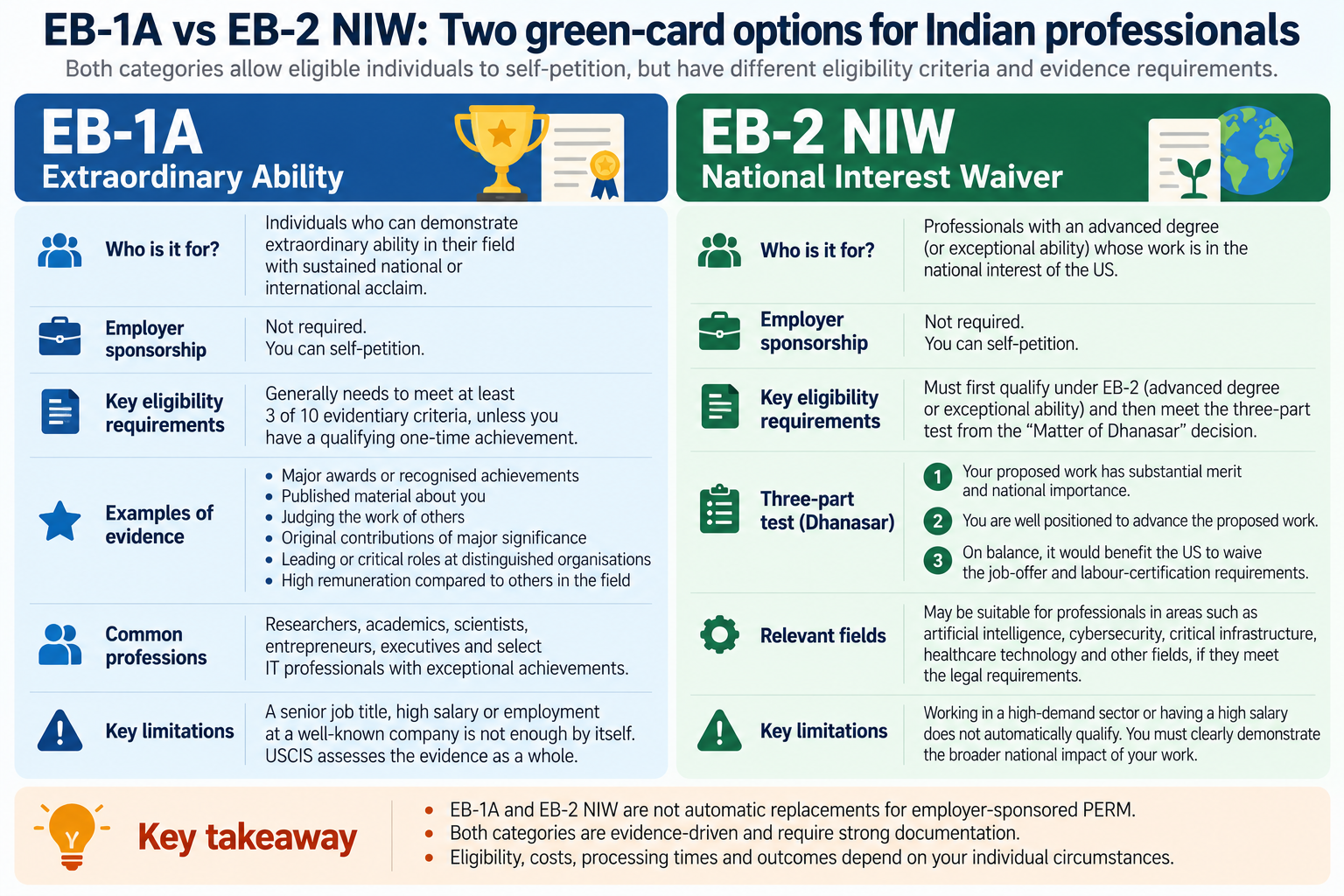
Applicants generally need to meet at least three of 10 evidentiary criteria, unless they have a qualifying one-time achievement. Meeting three criteria does not guarantee approval: US Citizenship and Immigration Services (USCIS) assesses the evidence as a whole. “USCIS applies the totality-of-the-evidence standard; there are no shortcuts,” Bhumireddy says.
EB-1 also includes EB-1C for qualifying multi-national managers and executives, and EB-1B for outstanding professors and researchers. These categories have separate eligibility requirements. EB-1C is not a general alternative for experienced IT professionals, while EB-1B requires employer sponsorship.
Can EB-2 NIW help workers whose PERM applications are on hold?
The EB-2 National Interest Waiver is another potential route for eligible professionals. Applicants must first qualify under EB-2, generally through an advanced degree or exceptional ability, and then meet a three-part legal test established in the “Matter of Dhanasar” decision.
They must show that their proposed work has substantial merit and national importance, that they are well positioned to advance it, and that waiving the job-offer and labour-certification requirements would, on balance, benefit the US.
Jaiswal says NIW may be worth exploring for professionals working in areas such as artificial intelligence, cybersecurity, critical infrastructure and healthcare technology. However, working in one of these sectors does not automatically establish eligibility.
“A routine software development role or a high-paying job does not automatically demonstrate national importance,” she says.
Applicants need to explain their proposed work and its potential impact beyond their current employer. Supporting evidence may include relevant achievements, independent expert letters, publications, patents, funding, adoption of their work and a credible plan for future activities.
Bhumireddy says weak applications often fail to show how the applicant’s work could benefit the US beyond their employer. Generic recommendation letters, insufficient evidence of impact and unclear links between the proposed work and national importance can lead to Requests for Evidence (RFEs) or denials.
For affected IT professionals, the key question is whether their own qualifications, achievements and proposed work meet the legal requirements, not simply whether they work in a strategically important sector.
How much do EB-1A and EB-2 NIW applications cost?
The total cost depends on government filing fees, legal representation, evidence preparation and whether the applicant chooses premium processing.
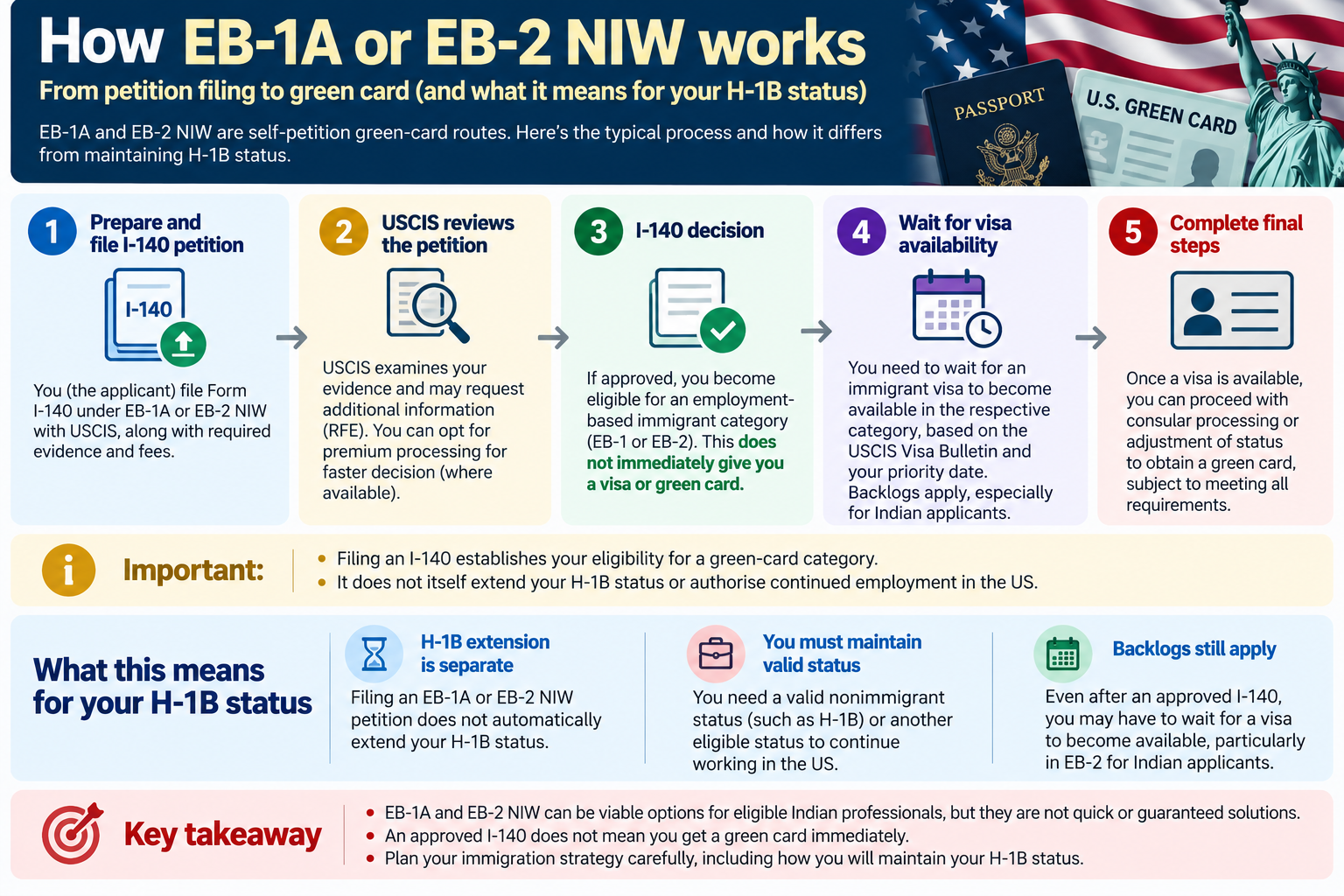
Form I-140, the Immigrant Petition for Alien Workers, is used to establish eligibility for an employment-based immigrant classification. Filing it does not itself grant a visa or permission to remain in the US.
Jaiswal says applicants should budget for government fees, attorney fees, credential evaluations, expert letters, translations and other evidence-related expenses. Combined government and professional costs can run to several thousand dollars, depending on the complexity of the case.
USCIS lists a general Form I-140 filing fee of $715, with an additional Asylum Programme Fee of $300 for a self-petitioner where applicable. That would bring the basic government filing cost to $1,015 for a self-petitioner in that fee category, excluding premium processing and other expenses. Applicants should confirm the applicable fees before filing.
Premium processing is an optional service that accelerates USCIS action on eligible petitions for an additional fee. It does not guarantee approval, make an immigrant visa immediately available or complete the green-card process.
Applicants should seek a written fee breakdown and an assessment of their case before committing to an application.
Would filing EB-1A or NIW protect H-1B status?
Filing an EB-1A or NIW petition does not automatically extend H-1B status or authorise continued employment after existing work authorisation expires.
Jaiswal says workers may generally maintain qualifying H-1B status while an I-140 petition is pending, provided they continue to meet the visa requirements and hold valid work authorization. However, an approved I-140 does not by itself allow someone to remain and work in the US indefinitely.
Workers approaching the usual six-year H-1B limit must separately establish whether they qualify for an extension or another lawful basis to remain. This is particularly important for employees considering an alternative green-card route after their employer suspends or delays PERM sponsorship.
An approved I-140 under an employer-sponsored category also does not automatically establish eligibility for EB-1A or NIW. A new petition must independently meet the requirements of its category.
What do Indian applicants need to know about green-card backlogs?
Approval of an EB-1A or NIW petition does not necessarily mean an applicant can immediately complete the green-card process. They may still need to wait for an immigrant visa to become available.
A priority date determines an applicant’s place in the employment-based immigration queue. Visa availability depends on the category, country of chargeability and cut-off dates published in the US Department of State’s Visa Bulletin.
NIW falls under EB-2, where Indian applicants may face a backlog. EB-1A has a separate queue, but it is not automatically current for Indian applicants either.
An approved I-140 also does not automatically allow someone to apply for adjustment of status, the process through which an eligible person in the US seeks permanent residency. Applicants must meet the relevant filing requirements, including visa-availability rules.
A qualifying earlier priority date may generally be retained for a subsequent employment-based petition, subject to applicable exceptions. However, retaining a priority date does not guarantee that a visa is available or establish eligibility for another category.
Applicants should review the latest Visa Bulletin and USCIS instructions before making decisions.
What are the red flags when seeking help with EB-1A or NIW?
Applicants should be cautious of service providers who guarantee approval, promise that a fixed number of publications or citations will ensure success, sell awards or memberships as shortcuts, or claim that filing an I-140 automatically extends H-1B status.
Bhumireddy also identifies templated recommendation letters, identical petitions prepared for multiple clients and the absence of an individualised legal strategy as warning signs.
“If someone is selling approvals as a product rather than building a legal case, that’s the biggest red flag I can see,” he says.
Applicants should ask for a clear explanation of the legal strategy, a written fee agreement and an assessment of the strengths and weaknesses of their evidence. They should verify the credentials of anyone providing immigration legal advice and avoid submitting fabricated, exaggerated or misleading documents.
What should Indian workers do before switching routes?
Affected employees should review how far their existing employer-sponsored green-card process has progressed, how much H-1B time remains and whether they independently qualify for an alternative category. They should also consider the evidence required, application costs, processing stages and visa availability.
The suspension does not mean every H-1B worker is at immediate risk of losing status, nor does it make EB-1A or NIW available to everyone. Both routes have demanding eligibility requirements and are not universal substitutes for employer sponsorship.
For workers considering a switch, the decision should be based on their individual evidence and immigration history, as well as their ability to maintain lawful status, not on the assumption that another petition will provide an immediate solution.
What IT companies said
Tata Consultancy Services (TCS), HCLTech and Infosys have said they do not expect the PERM suspension to materially affect their workforce strategies or business operations.
TCS said its PERM applications had been in single digits over the past two years. “Our PERM applications were in single digits in the last two years and hence we do not expect the suspension of the programme to impact our workforce strategy and customer engagements,” the company said in a statement.
TCS also reiterated its plan to hire 15,000 people in the US over the next five years, with a focus on local talent.
HCLTech HR head Ram Sundararajan said on October 12 that the company would comply with the Department of Labor’s directive and respond to any questions from the agency. He said HCLTech had increased local recruitment and had relatively few PERM applications in recent years. The company does not expect the suspension to materially affect its workforce plans or client engagements.
Disclaimer: This article is for general informational purposes only. US immigration rules and policies may change. Readers should verify current requirements through official government sources and consult a qualified immigration attorney for advice on their individual circumstances.