




The White House’s regulatory office has completed its review of a proposed Department of Homeland Security (DHS) rule on fees for Optional Practical Training (OPT), bringing the Trump administration’s plan one step closer to publication.
The review was completed on September 11, 2026, according to the official record for the proposal. The development is important for international students in the US, including thousands of Indians who rely on OPT to work in the country after completing their studies.
The completion of the review, however, does not mean that a new OPT fee has been introduced. The proposal is still at the proposed-rule stage and has not yet become a regulation.
What does the White House review mean?
The proposal, titled “Optional Practical Training Fees”, was submitted by US Immigration and Customs Enforcement (ICE), an agency under DHS, to the White House Office of Information and Regulatory Affairs (OIRA) on August 20. OIRA is part of the White House Office of Management and Budget (OMB). It reviews significant regulations before federal agencies publish them.
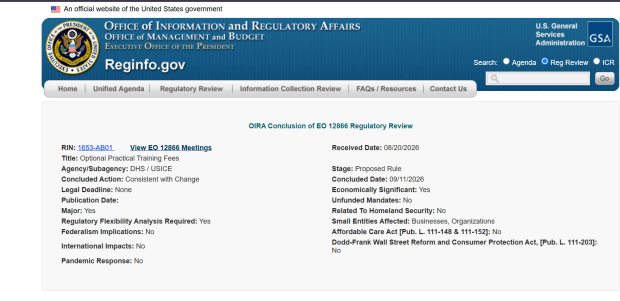
The official record shows that OIRA concluded its review of the OPT fee proposal on September 11. The record lists the conclusion as “Consistent with Change”. This means the White House regulatory review has been completed, but the record does not mean that President Donald Trump personally approved the proposal. It also does not mean that the White House has approved a $100,000 OPT fee specifically.
The exact amount of the proposed OPT fee has not yet been disclosed in the OIRA record.The more accurate way to describe the development is that the White House’s regulatory office has completed its review of the DHS proposal and returned it with changes. The OIRA record identifies the proposal as a “Proposed Rule”. It also shows that the publication date has not yet been listed.
The $100,000 fee has not been imposed
The most important point for students is that there is no new $100,000 OPT fee in effect based only on the completion of the OIRA review. The proposal still has to move through the federal rulemaking process. DHS will have to publish the proposed rule in the Federal Register before the public can see the full details of the plan.
The Federal Register publication is expected to provide more information about the proposed fee, including the amount, who would have to pay it and when the fee could apply. The proposal could therefore change before it becomes a final rule. The public will also get an opportunity to comment after the proposed rule is published.
The process is for an agency to prepare a proposal, send it for regulatory review, complete the OIRA review, publish the proposed rule in the Federal Register, accept public comments, consider those comments and then decide whether to issue a final rule. The completion of the OIRA review is therefore an important step, but it is not the final step.
What is OPT?
OPT is a work programme that allows eligible F-1 international students to work in the US in jobs related to their field of study after completing an academic programme. For many international students, OPT is an important bridge between completing a US degree and starting a career in the country.
Students who qualify for the STEM OPT extension can receive an additional 24 months of employment authorization. This can give eligible graduates more time to work in the US after completing their studies.
OPT can also be an important part of the longer-term employment path for international graduates. Students may use post-completion OPT to work after graduation while looking for longer-term employment opportunities and potentially seeking employer sponsorship for an H-1B visa. Any major change to the cost of OPT could therefore affect students who are planning to study, graduate and work in the US.
Why Indian students could be affected
The proposed change could have a significant impact on Indian students because India is one of the largest sources of international students in the US. For many of these students, the ability to work after graduation is an important part of their plans. OPT allows eligible graduates to gain work experience in the US after completing their academic programme. A large fee could therefore become an important consideration for Indian students who are planning to study in the US and then enter the American job market.
The actual impact, however, cannot be determined until DHS publishes the proposed rule. The OIRA record does not currently provide enough information to know the final proposed fee amount, which students would be required to pay or whether any exemptions would apply. The details will become clearer once the proposal is published in the Federal Register.
The proposal is separate from broader practical training changes. The OPT fee proposal should also not be confused with another DHS regulatory effort involving broader changes to practical training. The proposal currently under OIRA review is specifically focused on OPT fees. It concerns the potential cost associated with the programme rather than representing the broader set of possible changes to practical training rules.
This distinction matters because several immigration-related changes can move through the federal regulatory system at the same time. The completion of the OIRA review for the OPT fee proposal does not mean that all proposed changes to practical training have been approved.
What happens next?
The next major step is publication of the proposed rule in the Federal Register. Once published, the proposal should provide details that are not available in the current OIRA record. These are expected to include the proposed fee amount, the people or applications covered by the fee, any exemptions or other conditions and information about when the proposal could apply.
The publication will also start the public-comment stage of the rulemaking process. Students, universities, employers and other interested groups would then have an opportunity to submit comments on the proposal. DHS would have to consider those comments before moving towards a final rule.
The proposal could also be changed during this process. A final rule would be a separate step from the proposed rule. A new OPT fee would not take effect simply because OIRA has completed its review.
What students should know right now
International students and prospective students should not treat the September 11 OIRA decision as the start of a new OPT fee. The official record shows that the regulatory review has been completed, but it also shows that the proposal remains a proposed rule and that a publication date has not yet been listed.
The $100,000 figure also needs to be treated carefully. The OIRA record does not disclose the proposed fee amount. Any reporting that describes a $100,000 OPT fee should therefore make clear whether that figure comes from a separate source or from the eventual Federal Register proposal.
The key development is the completion of the White House regulatory review. The DHS and ICE proposal was submitted to OIRA on August 20 and its review was concluded on September 11. The record describes the outcome as “Consistent with Change”. The proposal now moves closer to public release, but it has not yet become a final regulation.
Disclaimer: This article is for general informational purposes only and does not constitute legal, immigration, or tax advice. Immigration laws and government policies are subject to frequent change without notice. While we strive to provide accurate updates, readers are strongly advised to verify the latest requirements with the official embassy, consulate, or government portal of the respective country. Financial Express is not responsible for any decisions made based on this information. For personalized guidance, please consult a qualified immigration attorney or a certified professional advisor.