




U.S. Citizenship and Immigration Services has issued a Federal Register notice that will increase certain immigration-related fees for fiscal year 2027. The new inflation-adjusted fees are effective on October 16, 2026. It is scheduled to be published on 10/01/2026. These fee adjustments are minor and account for inflation from July 2025 through July 2026.
On July 22, 2025, USCIS published a Federal Register notice announcing the implementation of these immigration-related fees. Beginning in FY 2026, and continuing for each subsequent fiscal year, the Department of Homeland Security will adjust some of these fees for inflation.
If one submits a request postmarked on or after October 16, 2026, for a benefit that requires one of these fees, they must include the new fee for the specific benefit they are requesting. Any request postmarked on or after October 16, 2026 without the proper filing fee will be rejected.
The Annual Asylum Application Fee will increase from $102 to $105. The fee for Form I-131 (Application for Travel Documents, Parole Documents, and Arrival/Departure Records, including the Immigration Parole Fee) will rise from $1,020 to $1,050.
For Form I-765 (Application for Employment Authorization), the fee for an initial Asylum applicant EAD, Parole EAD, or Temporary Protected Status EAD will go from $560 to $570. Finally, the fee for Form I-821 (Application for Temporary Protected Status) will increase from $510 to $520.
Fee changes in the Federal Register notice
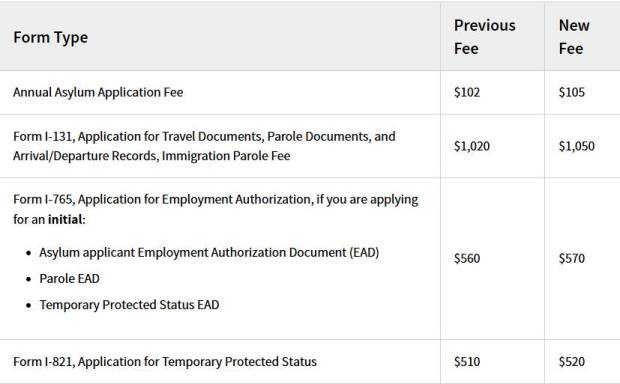
Source: USCIS
Filing fee for Form I-589
On July 22, 2025, USCIS published a Federal Register notice implementing a filing fee for Form I-589, Application for Asylum and for Withholding of Removal, and an Annual Asylum Fee (AAF) to be paid each calendar year an asylum application remains pending.
In an effort to satisfy the statutory mandate that DHS require payment of the AAF, the interim final rule establishes that if a foreigner does not pay the AAF within 30 days of notification, USCIS will reject their pending asylum application. If the foreigner does not have legal status in the U.S., USCIS will also initiate the foreigner’s removal.
If USCIS rejects a foreigner’s asylum application, there are additional consequences that could apply.
Disclaimer: This article is for general informational purposes only and does not constitute legal, immigration, or tax advice. Immigration laws and government policies are subject to frequent change without notice. While we strive to provide accurate updates, readers are strongly advised to verify the latest requirements with the official embassy, consulate, or government portal of the respective country. Financial Express is not responsible for any decisions made based on this information.