


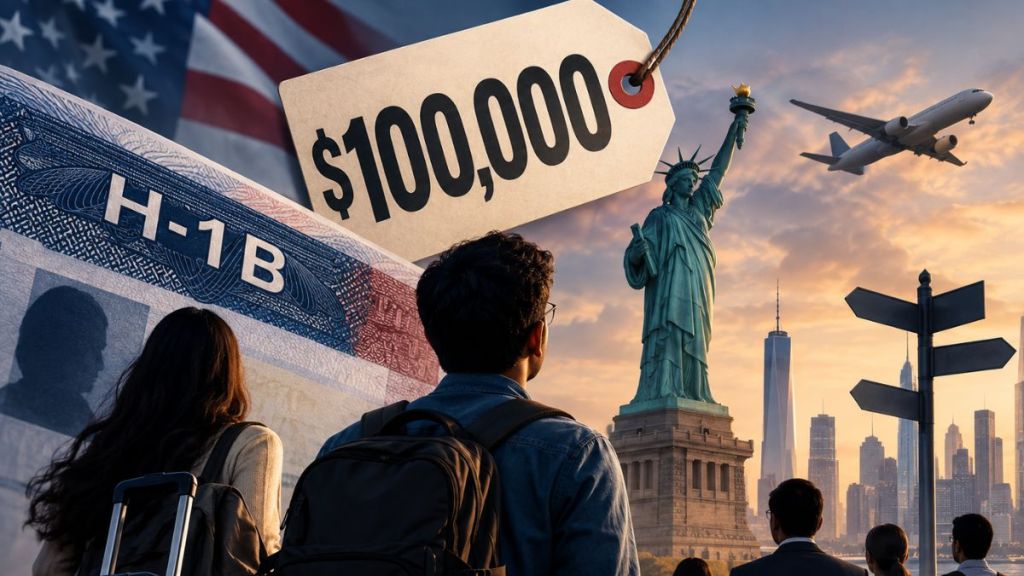

For Indian professionals who have spent years building careers around the possibility of working in the United States, the most significant change brought by the Trump administration’s $100,000 H-1B fee may not be the fee itself. It’s the uncertainty surrounding it.
A year after the Trump administration introduced the steep charge for certain H-1B visa applications, US President Donald Trump has extended the policy for another 12 months, keeping the restriction in place until September 21, 2027.
The extension, announced on September 18, comes even as the $100,000 fee is being challenged in court. In June, a federal judge in Massachusetts ruled that the fee was unlawful, saying the executive branch did not have the authority to impose what amounted to an unauthorised tax. The administration appealed the ruling.
The White House, however, says the policy has worked as intended. According to a September 18 White House fact sheet, more than 700 petitions had paid the $100,000 amount since the restriction took effect. The administration also says H-1B registrations from the largest IT outsourcing companies have fallen sharply and argues that the policy has changed recruitment towards higher-skilled and higher-paid workers.
The administration says the extension is needed because the conditions that led to the original policy have not disappeared. For employers, immigration lawyers, students and Indian professionals, however, the past year has produced a different concern. The rules keep moving, making it harder to know whether a US job offer today will translate into a viable immigration pathway tomorrow.
The fee was meant to change who gets hired
The original proclamation, issued in September 2025, restricted the entry of certain H-1B workers unless their employers made a $100,000 payment. The restriction primarily affected new H-1B workers outside the United States who needed to enter the country to take up their jobs. Existing H-1B workers and people already in the US under qualifying circumstances were not affected in the same way.

The White House has presented the policy as a way to curb what it calls abuse of the H-1B system by outsourcing and staffing companies. The administration says H-1B registrations filed by the largest IT outsourcing firms have fallen by 92% since the 2025 proclamation. It also points to unemployment among recent computer science and computer engineering graduates and argues that the growth of foreign STEM workers has outpaced overall STEM employment.
The administration argues that if hiring a foreign worker from outside the US suddenly costs an employer $100,000, companies will think harder about whom they sponsor and at what salary. There is evidence that employers did respond. However, what that response means is more complicated.
Kevin J Andrews, founder and principal attorney at Kevin J. Andrews Law, LLC, tells Financial Express (Digital) the uncertainty itself has become a deterrent.
“The fee’s legal status has moved four times in about a year. It was struck down, briefly and administratively kept in force pending appeal, struck down again when the First Circuit refused to pause that ruling, and now extended by the President for another year regardless. The uncertainty alone is enough to drive employers away from the H-1B program.”
He points to government data as evidence of the disruption. In a March court filing, the Department of Homeland Security reported an 87% drop in petitions requesting consular processing. The administration also said more than 700 petitions had paid the fee during its first year. “The government’s data shows the fee functioned less like a revenue measure and more like a near-total deterrent,” Andrews told Financial Express (Digital).
For employers, the bigger problem is planning
Immigration attorneys Gnanamookan Senthurjothi and Veena Vijay Ananth, founders of The Visa Code, say the biggest impact has been uncertainty rather than simply the $100,000 price tag. “Employers need to understand the immigration cost before committing to an overseas hire, and changing legal position makes workforce planning difficult,” they told Financial Express (Digital).
They also stated that more than 700 H-1B petitions reportedly involved the $100,000 payment while it was being collected. This shows some employers were prepared to absorb the cost. It does not, however, show how many potential hires were postponed or abandoned because of it.
For a company recruiting a worker from India, the immigration decision is now tied more closely to the question of where the job itself should be performed.
“The fee creates an economic incentive to consider talent already in the US rather than recruiting from overseas,” Senthurjothi and Ananth said. “It can also encourage companies to locate certain functions outside the United States.”
India becomes particularly important in that calculation because it already has a large technology workforce and established operations for global companies. “I would not attribute every expansion in India to the H-1B fee, but the additional immigration cost can reinforce the existing trend toward global delivery,” they said. The clearest changes, Andrews said, can be seen in the H-1B filings of Indian IT services companies.
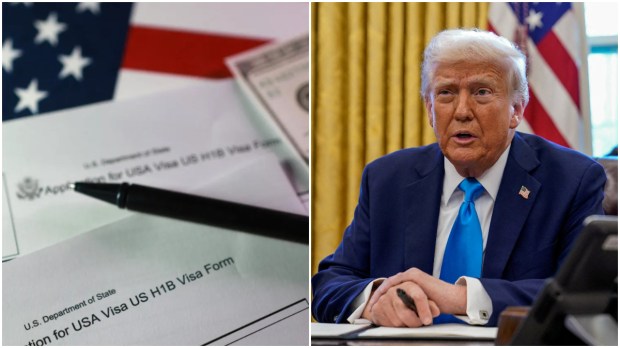
As told to Financial Express (Digital) by Kevin, Infosys and TCS cut their entries by more than 90% year over year, while Cognizant did not enter the lottery at all after submitting thousands of entries the previous year. Andrews noted that these changes happened during the same period as a separate wage-weighted selection rule, meaning the decline cannot be attributed to the $100,000 fee alone. This is one of the recurring complications in measuring the impact of the policy. Several immigration changes have happened at the same time.
The legal fight is far from over
The fee’s legal status has itself become part of the uncertainty. On June 8, US District Judge Leo Sorokin in Massachusetts ruled that the $100,000 charge was unlawful. The court found that the fee functioned as a tax and that Congress had not authorised the president to impose it. The administration appealed. The litigation has moved quickly since then.
The Massachusetts court temporarily stayed its own ruling while the government sought relief from the First Circuit. The appeal remains part of the wider legal battle over presidential authority to impose the charge
There is also a separate case in Washington, brought by the US Chamber of Commerce and universities, challenging the fee. This case has produced a different district court ruling, creating two competing lines of reasoning at the trial court level.
For employers, the legal argument comes down to a basic question: can the president impose a $100,000 charge as an immigration restriction, or does a payment of that size effectively operate as a tax that requires Congress to authorise it?
“Two separate fights are running at once,” Andrews said. “The core legal question in both cases is the same though: is a flat per-petition dollar charge an entry restriction the President can impose on his own, or is it effectively a tax that requires Congress to speak clearly first.”
The legal uncertainty is not limited to the existing fee
The Department of Homeland Security has separately proposed a $103,265 fee for H-1B cap-subject petitions. Unlike the original $100,000 payment, the proposed charge is being pursued through the regulatory process. DHS says the proposed fee would help recover federal government costs associated with administering the immigration system.
The proposed fee would apply to H-1B cap-subject petitions, including those eligible for the advanced degree exemption, and would be in addition to other applicable fees.
This creates another possible layer of cost for employers even as the original $100,000 measure remains tied up in litigation. “Running it as a regulation likely fixes the procedural problem the Massachusetts court found. It does nothing for the tax argument,” Andrews said.
For employers and prospective H-1B workers, that means there is no simple endpoint yet. The First Circuit appeal, the separate litigation in Washington and the proposed DHS rule are all pieces of the larger picture.
The uncertainty is reaching India before workers even get to America
The effects are not limited to companies already recruiting H-1B workers. Indian students and professionals are changing the questions they ask before they even decide to move to the US.
Sanjeev Rai, Vice president of partnerships and enablement at Impel Overseas Consultants Limited, says his company has seen a drop in enquiries about the US alongside greater interest in other countries. “What has also changed is the nature of the conversation,” Rai told Financial Express (Digital)
“Earlier, students would mainly ask us about universities, courses, scholarships and job opportunities. Now, quite early in the discussion, students and parents are asking, ‘What happens after OPT? Will companies still sponsor H-1Bs? What if I don’t get sponsored?,” Rai explained to Financial Express (Digital).
For Indian families taking on a large education loan, the calculation is no longer simply about the quality of an American university. “For an Indian family, a US education is a significant financial commitment. So if there is uncertainty around what happens after graduation, naturally families are going to think more carefully before making that investment,” Rai said.
According to Rai, they are looking for other options. Germany has emerged more frequently in these conversations, he said. Students are looking at German universities because of relatively low tuition costs, while experienced professionals are also enquiring about the Germany Opportunity Card.
“The UK continues to attract interest as well. Canada is being approached more cautiously because of its own policy changes, while Australia has actually seen a decline in interest from our side,” Rai added.
“What students and parents are really asking us is, ‘If we are spending this much on an international education, where does the student have the best chance of building a career afterwards?,” he explained.
The US is still attractive, but the risk calculation has changed
Rai does not believe the H-1B changes will make Indian students abandon the US altogether. Good students, particularly those interested in STEM, technology and research, continue to want American universities.
The difference is how much risk they are prepared to take. “A student with a strong academic profile, good funding or scholarship, and a clear career objective may still say, ‘The US is where I want to be, so I’ll take my chances,'” he said.
“But a student who needs to take a very large education loan and is depending heavily on getting a US job afterwards is understandably much more cautious now.”
For experienced professionals, the calculation could be different. “If employers eventually have to bear such a large additional cost, they are naturally going to reserve sponsorship for candidates whose skills are specialised enough to justify it,” Rai said.
This could make the immigration pathway more difficult for workers in generalist roles while leaving employers more willing to pay for highly specialised talent. The same uncertainty is also changing how students think about backup plans.
“One noticeable difference is that earlier, Plan B was something we discussed when Plan A didn’t work out. Today, we are discussing Plan B before the student even leaves India,” Rai said.
One student’s US plan became a two-country plan
Rai has seen this change play out in individual decisions. One student who had been firmly focused on the US returned to the consultancy after the H-1B developments and asked the team to explore Germany as well.
The family still liked the US universities and opportunities. Their concern was the financial risk involved in making a large investment when the post-study immigration pathway had become less predictable.
“So, in this particular case, the student hasn’t necessarily rejected the US, but the decision has changed from a US-only plan to a multi-country strategy,” Rai explained. “I think that is a good example of the behavioural change we are seeing on the ground.”
Some workers are thinking twice about changing jobs
For people already in the United States, the uncertainty has a different effect. An H-1B visa holder who asked not to be identified told Financial Express (Digital) the issue has made long-term planning more difficult after years of studying and building a career in the US.
“As someone who came to the US as an international student and has spent the last five years studying and building my career here, uncertainty around H-1B policies definitely makes you think more carefully about long-term plans,” he explained to Financial Express (Digital).
For this worker, the concern is not simply whether an employer can or will pay $100,000. It is what the possibility of that cost does to hiring decisions.
“When sponsorship becomes significantly more expensive or unpredictable, companies may naturally become more cautious about roles that require sponsorship, especially when they have other hiring options.” The worker has not received any specific communication from the employer about whether such a cost would be absorbed.
“I wouldn’t want to speculate on their position,” the person said. The uncertainty still affects personal decisions. “From an international candidate’s perspective, even the possibility of such a large additional cost can create anxiety about future job mobility. You start thinking twice before changing jobs because sponsorship becomes another major factor in the decision.”
Many international students spend years paying for education, working under OPT and trying to build careers in the US. A policy change several years into that journey can alter plans that were originally made much further into the future. “I also think this uncertainty affects people beyond those currently looking for jobs,” the H-1B holder said.
“Many international students spend significant amounts on a US education and then spend years building their careers here. When immigration rules keep changing, it becomes difficult to plan five or ten years,” he explained.
The first year has changed the question
The Trump administration says the $100,000 fee has already done what it was intended to do. The White House points to the sharp fall in outsourcing firms’ H-1B registrations and the relatively small number of petitions for which the payment was actually made as evidence that the policy has discouraged lower-paid foreign recruitment. Employers, lawyers and immigration consultants see a more complicated picture.
The fee has become part of decisions about where to hire, whether to sponsor, where to locate work and whether a worker is worth the additional immigration cost. For Indian students, it has entered the conversation much earlier, sometimes before they have even chosen a university. Indian professionals already in the US, it has become another factor in decisions about changing jobs and planning a career.
The Visa Code’s Senthurjothi and Ananth describe the change as a shift in how companies think about immigration. “The $100,000 H-1B measure has moved immigration from being primarily a compliance issue into a workforce-location and cost-allocation issue,” they explained to Financial Express (Digital).
“When the potential immigration cost of an overseas hire becomes extraordinarily high, employers must consider not only who to hire, but also where the work should be performed.” The legal question remains unresolved. The policy has now been extended for another year, while a separate $103,265 fee is also being considered through the regulatory process.
For the people making career and education decisions around the H-1B system, however, the uncertainty itself may be the most consequential change. “People can plan around a known process, even if it is difficult,” the H-1B visa holder told Financial Express (Digital). It becomes much harder when you don’t know what the process or cost might look like a year from now.”
Disclaimer: This article is for general informational purposes only and does not constitute legal, immigration, or tax advice. Immigration laws and government policies are subject to frequent change without notice. While we strive to provide accurate updates, readers are strongly advised to verify the latest requirements with the official embassy, consulate, or government portal of the respective country. Financial Express is not responsible for any decisions made based on this information. For personalized guidance, please consult a qualified immigration attorney or a certified professional advisor.