


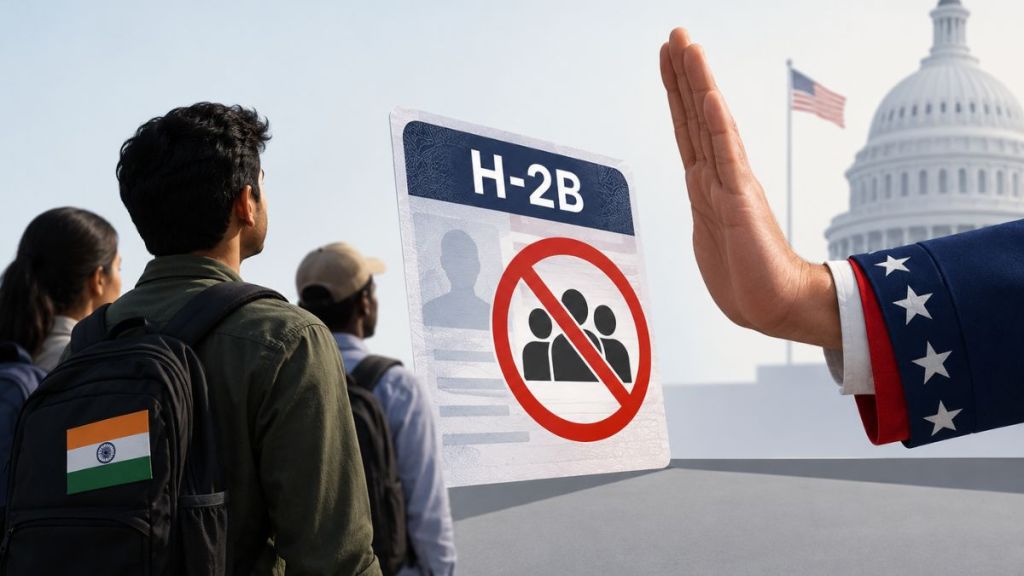

The US has run out of H-2B visas for the first half of fiscal year 2027, closing one of the main routes used by foreign workers to take up temporary, seasonal jobs in the country.
The US Citizenship and Immigration Services (USCIS) said it has received enough applications to fill all 33,000 H-2B visas available for workers whose jobs are scheduled to begin between October 1, 2026, and March 31, 2027.
September 4, 2026, was the final date for employers to submit applications for these workers. Any new applications received after this date will be rejected if they are subject to the H-2B visa limit.
What is the H-2B visa?
The H-2B visa allows US employers to temporarily hire foreign workers for jobs that are not related to farming. The programme is commonly used by hotels, resorts, restaurants, landscaping companies and seafood businesses that need more workers during busy seasons.
For example, a hotel may need additional staff during its peak tourist season but may not have enough workers available locally. The H-2B programme allows the employer to bring in foreign workers temporarily to fill those jobs. The visa is therefore very different from the H-1B visa, which is mainly used by US companies to hire foreign professionals for specialised jobs.
Why has the US run out of H-2B visas?
US law normally allows 66,000 H-2B workers to enter the country each year. This number is divided into two halves. The first 33,000 visas are for workers whose jobs begin between October 1 and March 31. The remaining 33,000 are for workers starting between April 1 and September 30.
The first-half quota for fiscal 2027 has now been filled. This does not mean that the entire H-2B programme has run out of visas for fiscal 2027. Another 33,000 visas are available for workers whose employment begins from April 1, 2027.
The US government can also decide to provide additional H-2B visas if employers continue to face worker shortages. In recent years, the government has repeatedly approved such additional visas, allowing the number of H-2B workers to go beyond the normal annual limit of 66,000. However, these additional visas are not guaranteed. They require a separate decision by the US government.
What does this mean for foreign workers?
Foreign workers who were hoping to take up H-2B jobs starting before April 1, 2027, can no longer enter the programme through the regular quota because all 33,000 places have been filled. Workers seeking jobs that begin from April 1, 2027, still have the second-half quota available.
The H-2B programme has not been closed. It is simply the first-half allocation that has been exhausted.
There are also certain workers who do not count towards the H-2B limit. These include some workers who have already been counted against the quota and are extending their stay or changing employers. Certain workers in fish roe processing are also exempt, as are workers performing certain jobs in Guam and the Commonwealth of the Northern Mariana Islands.
What does it mean for Indians?
For Indians, the impact is more limited than it may initially appear. India is generally not among the countries whose citizens are eligible to participate in the H-2B programme.
There is a limited exception under which a worker from a country outside the eligible list may be allowed to participate if the US government determines that the worker’s presence would be in the US interest.
This means that the exhaustion of the H-2B quota does not directly affect most Indian workers because H-2B is not a major route used by Indians to move to the US.
Indian migration to the US is much more closely associated with routes such as the H-1B programme for skilled professionals, student pathways and family-based immigration. The H-2B programme caters to a different section of the labour market, mainly workers taking up temporary, nonagricultural jobs.
What about workers from other South Asian countries?
The situation can be different for workers from other parts of South Asia. Some countries in the region are included in the US government’s list of countries whose citizens can participate in the H-2B programme. Workers from those countries may therefore be affected by the exhaustion of the first-half quota.
However, being from an eligible country does not automatically guarantee an H-2B visa. A worker must also have an eligible US employer and meet the other requirements of the programme. The H-2B quota also cannot simply be increased by private agents or recruitment agencies. Additional visas can only become available if the US government authorises them.
H-2B cap comes as US tightens immigration rules
The H-2B development comes at a time when the Trump administration is tightening several aspects of the US immigration system. One proposed change could remove the 60-day grace period currently available to H-1B and certain other employment visa holders after they lose their jobs.
At present, eligible workers generally have up to 60 days to find another employer, change their immigration status or make arrangements to leave the US. Removing that period could leave foreign workers with less time to make those decisions.
The proposal is particularly important for Indian professionals because Indians make up a large share of the H-1B workforce. The administration has also increased scrutiny of visa applicants and strengthened immigration enforcement. Higher costs, stricter checks and changes to visa processing are creating greater uncertainty for people planning to study, work or settle in the US.
The immediate question for H-2B employers is whether the US government will approve additional visas during fiscal 2027. The first 33,000 visas have already been taken. Another 33,000 remain available for workers whose jobs begin from April 1 through September 30, 2027. If employers continue to argue that they cannot find enough workers, the government could come under pressure to approve additional H-2B visas, as it has done in previous years.
For Indian workers, however, an increase in the H-2B quota would not automatically create a new opportunity. India is generally outside the programme’s eligible-country framework, meaning Indian workers would still have to meet the separate requirements for nationals of non-designated countries.
Disclaimer: This article is for general informational purposes only and does not constitute legal, immigration, or tax advice. Immigration laws and government policies are subject to frequent change without notice. While we strive to provide accurate updates, readers are strongly advised to verify the latest requirements with the official embassy, consulate, or government portal of the respective country. Financial Express is not responsible for any decisions made based on this information. For personalized guidance, please consult a qualified immigration attorney or a certified professional advisor.