




The US H-1B system has undergone several changes in 2026, affecting everything from visa costs and the H-1B lottery to job changes, international travel, green-card processing and H-4 dependents.
The US H-1B visa allows American employers to hire foreign professionals for specialised jobs. For workers already in the US, however, the visa is not simply a one-time approval. They may have to renew their status, change employers, travel abroad, bring dependents to the US or eventually pursue a green card.
However, not every change affects an H-1B worker immediately. Some rules are already in effect, while others are proposals that could still change or face legal challenges.
Financial Express Digital spoke to immigration attorneys Sai Srinivas Reddy Bhumireddy and Kevin J Andrews to explain what H-1B workers need to know.
Here are nine key developments:
1. Some H-1B extensions now come with $4,000 fee
The $4,000 charge is an additional government fee that some US employers have to pay when they file an H-1B petition with US Citizenship and Immigration Services (USCIS). An H-1B petition is the application an employer files with the US government to sponsor a foreign worker for H-1B status.
Earlier, certain employers had to pay the $4,000 fee when sponsoring a new H-1B worker or when an H-1B worker changed employers. From September 9, 2026, the same fee also applies when these covered employers file qualifying H-1B extension petitions. The rule applies to employers with more than 50 employees where over half of the workforce is on H-1B.
For workers, the key point is that the fee is generally an employer-side cost. It does not automatically mean that an H-1B worker has to pay $4,000 personally.
Bhumireddy says, “The change would extend these surcharges to include every extension and amendment, dramatically increasing the cumulative immigration cost burden on employers over a typical 6-year H-1B period, this could mean paying $8,000 to $12,000 or more in surcharges per worker rather than the current $4,000.”
“This change could largely affect IT companies through the compounding effect of surcharges applied at every extension and amendment rather than only at initial filings – resulting in significantly reduced profitability and substantially increased immigration expenditure across every stage of the H-1B lifecycle,” he says.
Hence, if your employer is filing your H-1B extension, check whether the company falls under the 50/50 threshold and whether the additional fee applies.
2. H-1B lottery is no longer purely random
The H-1B lottery is a random selection process used by the US government when there are more H-1B registrations than available visas, deciding which applicants can move forward with their H-1B applications.
The H-1B cap selection system has changed for the FY2027 registration season. Under the new system, registrations are still selected randomly, but the selection is weighted according to the OEWS wage level associated with the offered position. The wage level is based on the US Department of Labor’s OEWS (Occupational Employment and Wage Statistics) wage data for the particular occupation and location.
Under the new system:
- Wage Level I: 1 entry
- Wage Level II: 2 entries
- Wage Level III: 3 entries
- Wage Level IV: 4 entries
So, a higher wage level does not guarantee selection. It simply gives that registration more entries in the lottery.
Andrews describes this as “the new H-1B lottery”, saying that the system was created through formal rulemaking published in December 2025 and took effect in February 2026. This means the wage level attached to an offered position now matters more than it did under the previous purely random selection system.
However, lower wage-level registrations have not been eliminated. They still remain eligible for selection, but with fewer entries in the selection pool.
For Indian students and professionals entering the H-1B system, this makes the wage level associated with the job an important factor to understand before registration.
3. USCIS can deny some petitions without an RFE
A Request for Evidence (RFE) is a notice from USCIS asking an applicant or employer to provide additional documents or information when the evidence submitted with an immigration petition is not enough to establish eligibility.
A USCIS policy update issued on August 5, 2026 restored adjudicators’ discretion to deny certain cases without first sending an RFE or Notice of Intent to Deny (NOID) when required evidence is missing or the evidence already submitted does not establish eligibility.
Hence, applicants should no longer assume that USCIS will always give them another opportunity to submit missing documents. The responsibility remains with the applicant or employer to prove that the worker qualifies for the requested immigration benefit.
Andrews says this makes the quality of the initial filing particularly important because applicants cannot assume an RFE will give them an opportunity to correct deficiencies.
Bhumireddy highlights another filing issue that H-1B workers and employers need to watch. “The safest practice is to always use the correct, dated edition of each form,” he says.
Bhumireddy notes that several USCIS forms received new editions in 2026. There has also been movement around Form I-539 and Form I-765 editions, making it important to check the applicable form edition immediately before filing.
However, an RFE should not be treated as a guaranteed second chance. The initial petition should be complete and properly supported when it reaches USCIS.
4. Changing jobs still remains possible, but timing matters
An H-1B worker can still change employers in the US. The new employer generally has to file an H-1B transfer petition with USCIS. The important issue is what the worker does between filing that petition and USCIS making a decision.
Both immigration attorneys flagged this period as one where workers need to be particularly careful.
Bhumireddy says the period after the transfer petition has been filed but before USCIS has decided the case is particularly important. “The main risk window is the pendency period,” he says.
He advises workers to maintain complete documentation showing that they have maintained valid H-1B status, particularly if there are questions about their immigration history.
This becomes particularly important when a worker’s I-94 has expired or there are questions about whether the worker has continuously maintained their H-1B status.
Andrews recommends that workers be careful about when they resign from their existing job and when they travel internationally.
He recommends filing the H-1B transfer before the worker’s resignation is final and advises workers to avoid international travel while the transfer petition is pending.
Another issue is third-party placement, which is particularly relevant to some Indian IT professionals.
For example, an H-1B worker may be employed by a consulting company but work at a client’s office or on a client’s project. In such cases, the information in the H-1B petition needs to accurately reflect the worker’s actual employment arrangement.
That means the petition and the worker’s actual situation should be consistent on things such as:
- Job duties — What work the employee actually performs
- Salary — What the worker is actually being paid
- Work location — Where the worker is actually working
- Employment relationship — Who employs the worker and, where relevant, the relationship with the end client
For workers placed at third-party client sites, these details can come under greater scrutiny.
Hence, changing employers remains possible for H-1B workers, but the period around the transfer filing, particularly while the petition is pending, requires careful planning.
5. International travel needs more planning
For H-1B workers and their H-4 dependents, travelling outside the US can now involve additional screening before they can obtain or renew their visas.
The State Department has expanded online-presence review to H-1B and H-4 visa applicants. As part of the screening process, applicants may be required to make their social-media profiles public or open so that officials can review them.
This means that an H-1B worker travelling to India, for example, should not look only at whether their existing visa stamp is valid. They also need to consider their visa appointment, immigration status, pending petitions and the timing of the trip.
Bhumireddy says, “There’s a lot of scrutiny on international travel right now, and social media vetting is the main concern, along with visa appointments, where we’re still hearing of postponements.”
Kevin J Andrews also advises H-1B workers to be cautious about travelling when another immigration matter is pending, particularly when they are in the middle of an H-1B employer transfer.
Leaving the US while a petition is pending can create complications depending on the type and stage of the immigration filing.
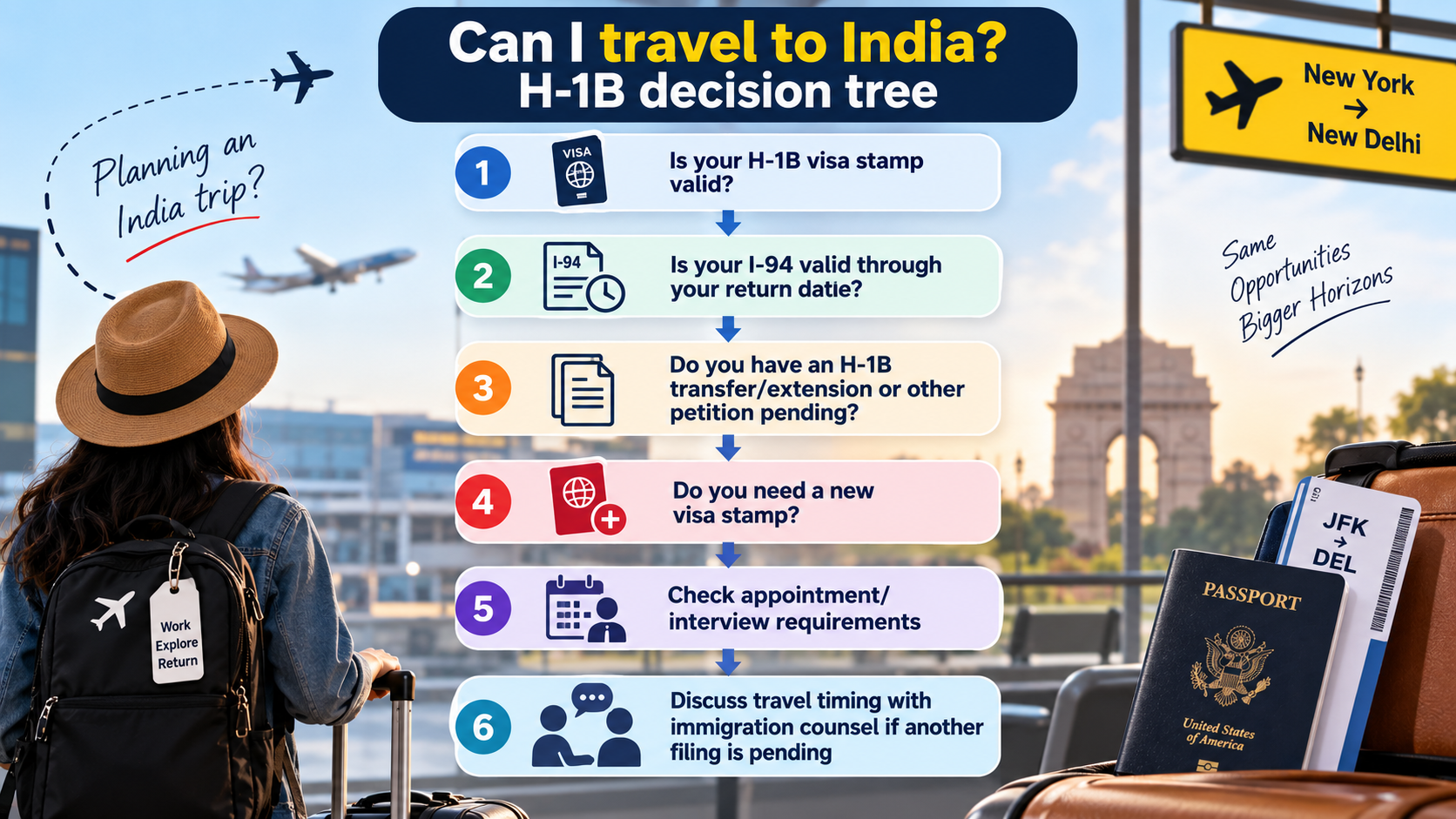
For an Indian H-1B worker planning a trip to India, a valid visa stamp alone should not be the only thing they check before booking a flight.
Workers should also review:
- I-94: Check the date until which you are authorised to remain in the US.
- Visa status: Check whether your visa stamp will remain valid for your planned return.
- Pending petitions: Check whether you have an H-1B transfer, extension or another immigration application pending.
- Visa appointment: If you need a new visa stamp, check appointment availability and the applicable interview requirements before travelling.
- Travel timing: Discuss the trip with your immigration attorney if another immigration filing is underway.
Andrews also recommends that workers maintain a personal immigration calendar rather than relying on news reports or waiting until a deadline is approaching.
The calendar can include important dates such as the I-94 expiry date, visa expiry date, H-1B petition expiry date, expected filing dates and planned international travel.
6. H-4 EAD delays can affect working spouses
H-4 is the dependent status available to certain spouses and children of H-1B workers. An H-4 EAD (Employment Authorization Document) is the separate work permit that allows an eligible H-4 spouse to work in the US.
This means having valid H-4 status and having permission to work are not exactly the same thing. An H-4 spouse may continue to have valid H-4 status but face a problem at work if the required EAD is delayed or expires.
Bhumireddy says some H-4 EAD applications are taking longer than expected. According to Bhumireddy, the delays have already led some applicants to take their cases to court, while others have received approvals or their EAD cards only after pursuing their applications for some time.
The practical concern is particularly important for families where the H-4 spouse depends on the EAD to remain employed.
An H-4 extension and an H-4 EAD application deal with two different things. The H-4 application concerns the spouse’s immigration status as a dependent, while the EAD application concerns the spouse’s authorization to work.
Therefore, an H-4 spouse should not simply assume that an approved H-4 extension automatically resolves the employment-authorisation issue.
If the EAD is pending, families need to keep track of that application separately, including its filing date, status and any applicable deadlines.
7. Six-year H-1B limit has not fundamentally changed
An H-1B worker can generally stay in the US in H-1B status for up to six years. However, certain workers who are already in the employment-based green-card process can qualify for extensions beyond that six-year period under the AC21 (American Competitiveness in the Twenty-First Century Act) rules.
Reaching six years does not automatically mean an H-1B worker has to leave the US. Depending on where the worker is in the green-card process, they may qualify for additional H-1B extensions.
Despite the other changes to the H-1B system, the basic AC21 framework has not fundamentally changed in 2026.
For someone approaching the end of the six-year H-1B period, the timing of the PERM and broader employment-based green-card process can become critical.
PERM is the Department of Labor’s labour-certification process that is generally part of the employment-based green-card process for many employer-sponsored cases.
The Department of Labor reported an average 336 calendar days to process PERM applications in an analyst review in August 2026.
Bhumireddy sees the reduction in processing time as one of the more positive developments. “The really good news is on PERM processing times, which have dropped sharply from more than 550 days to around 365,” he says.
But he cautions that faster PERM processing does not mean the entire green-card process has suddenly become easier.
The important point is not to wait until the sixth year is almost over before discussing the green-card strategy.
PERM is only one stage of the employment-based green-card process. Even if the labour-certification stage moves faster, workers can still face other stages and, for Indian professionals in particular, visa-number backlogs.
Therefore, an H-1B worker approaching the six-year limit should discuss their timeline with their employer and immigration attorney well before the deadline becomes an immediate problem.
8. Indian workers still face a major green-card backlog
An employment-based green card gives a foreign worker permanent resident status in the US. But getting employer-sponsored permanent residence is not only about completing the required paperwork. The US also has a limited number of employment-based immigrant visas available each year, and applicants from some countries can face long waits when demand exceeds the available numbers.
For Indian H-1B workers, this is particularly important because India has a large number of employment-based green-card applicants waiting for immigrant visa numbers.
The September 2026 Visa Bulletin lists EB-2 India as “Unavailable” for final action, meaning the US government does not currently have immigrant visa numbers available in that category for final green-card approvals.
For EB-3 India, the September bulletin lists a January 1, 2014 final-action date. In practical terms, an applicant’s priority date generally needs to be earlier than the applicable cutoff date for a final decision to be possible.
The State Department had also announced in May that the available FY2026 EB-2 immigrant visa numbers for India had been exhausted. The annual allocation resets when the new fiscal year begins on October 1, 2026.
Andrews says the EB-2 situation is an important issue for Indian professionals, particularly because many employment-based green-card applicants rely on the category for permanent residence.
Bhumireddy’s assessment of the broader process is more mixed. While PERM processing times have improved significantly, he says increased scrutiny has made some employers more cautious about starting or continuing employment-based green-card cases.
This means an H-1B worker can potentially face two different timelines – one for completing the employer-sponsored immigration process and another for waiting for a visa number to become available.
The US has an annual limit on employment-based immigrant visas as well as country-specific allocation rules. When there are more applicants from a particular country than available visa numbers, applicants can face a backlog.
So, completing PERM or even reaching later stages of the green-card process does not necessarily mean the worker can immediately receive permanent residence.
9. Scrutiny of wages, job duties and third-party placements rising
US immigration authorities are paying closer attention to whether an H-1B worker’s actual employment matches what the employer reported in the H-1B petition.
That includes basic details such as the worker’s salary, job duties, work location and employment arrangement. The issue can be particularly important for H-1B workers employed through consulting companies or working at a third-party client’s location.
Bhumireddy says some of the areas generating Requests for Evidence (RFEs) include wage levels, specialty occupations and whether the worker has maintained valid immigration status.
He says USCIS is increasingly examining whether the different parts of an H-1B case are consistent with one another — including whether the worker’s duties, salary, work location and immigration filings accurately reflect the actual employment situation.
For Indian IT professionals working through consulting companies, this can be particularly relevant where the worker is employed by one company but performs the work at a client’s location.
Andrews points to increased enforcement activity by the US Department of Labor. “The Labor Department has opened more than 200 H-1B employer investigations since 2025,” he says.
According to Andrews, these investigations include scrutiny of wage issues and third-party placements. Authorities are examining whether the actual employment arrangement is consistent with what the employer represented in the H-1B petition.
What about $100,000 H-1B fee?
The Trump administration had introduced a $100,000 payment requirement for certain H-1B cases involving workers outside the US in September 2025. The measure was designed to make companies pay an additional $100,000 when seeking to bring certain H-1B workers into the country.
But the payment requirement is not currently being enforced.
In June 2026, a federal district court in Massachusetts ruled against the government’s implementation of the $100,000 payment and vacated the policy. The Trump administration appealed the decision, but on July 24, the US Court of Appeals for the First Circuit rejected the government’s request to put the lower court’s ruling on hold while the appeal continues.
The issue remains under litigation. Trump has extended the policy, but the $100,000 payment remains blocked by the courts for now. The government’s appeal is still pending.
That extension keeps the policy on the books, but does not by itself overturn the court ruling that currently prevents the government from collecting the $100,000 payment.
This means H-1B applicants and employers should not treat $100,000 as a currently applicable fee. Its future depends on the ongoing legal proceedings and any further court or government action.
There is also a separate $103,265 H-1B fee proposed by the Department of Homeland Security. That is a different measure, based on a different legal authority, and is only a proposal at present. The public comment period is open until September 24.
What should H-1B workers do now?
With several H-1B changes taking effect or being discussed in 2026, immigration attorneys say workers should first separate rules that are already in force from proposals or measures that could still change.
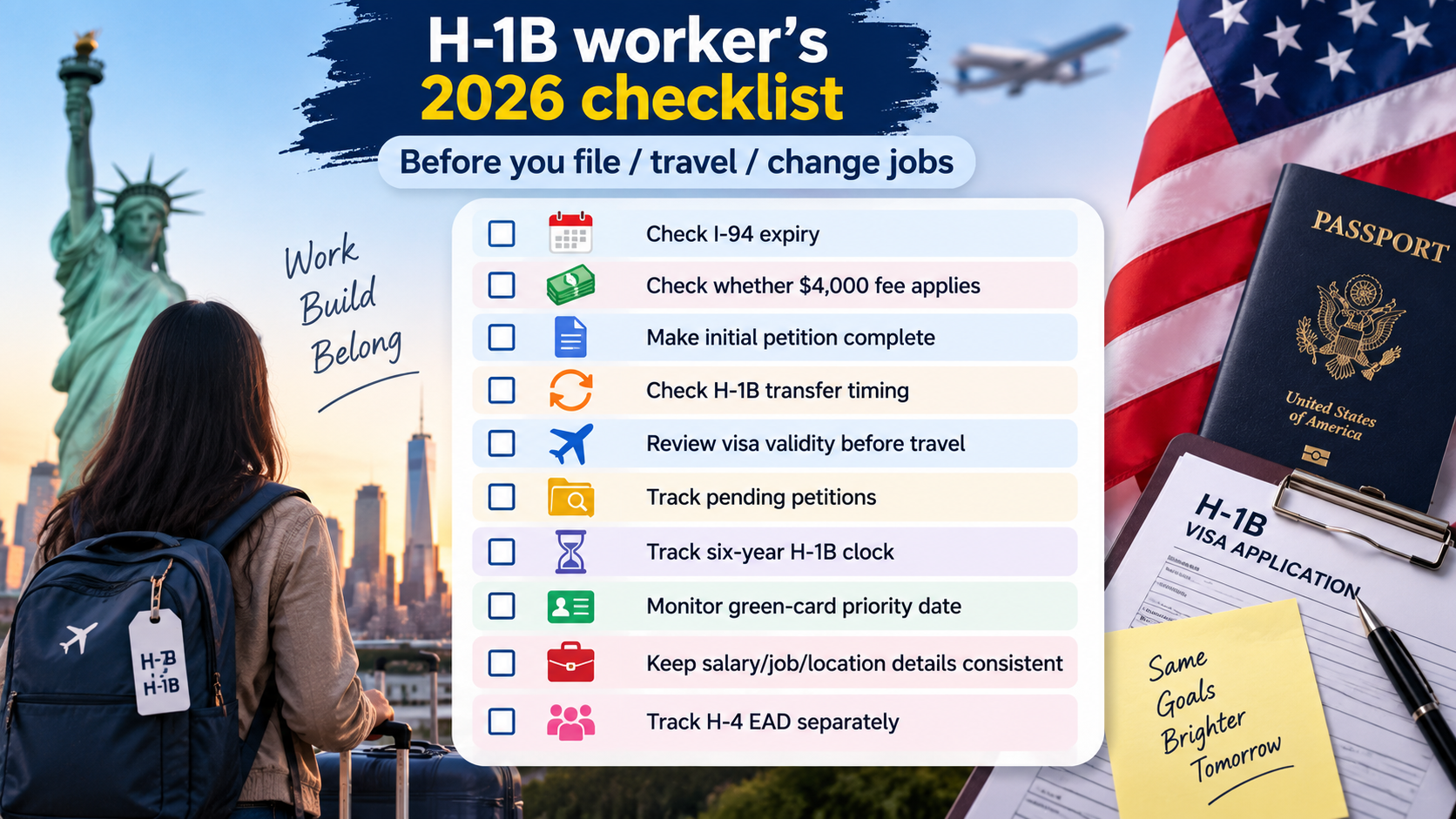
For H-1B workers, the practical checklist is:
- Check your I-94: Know the date until which you are authorised to stay in the US. This is particularly important when planning an extension, job change or international travel.
- Check the $4,000 fee: If your employer is filing an H-1B extension, ask whether the employer falls within the criteria for the additional fee and whether it applies to your petition.
- Make the initial filing complete: USCIS can deny certain petitions without first issuing an RFE. Make sure the required forms, supporting documents and evidence are complete when the petition is filed.
- Plan an H-1B job change carefully: If you are changing employers, discuss the timing of the transfer petition and resignation with your immigration attorney. Keep your I-94, approval notices and other status documents available.
- Check before travelling internationally: Review your visa validity, I-94, any pending immigration petition and current visa appointment or interview requirements before leaving the US. This is particularly important if an H-1B transfer or extension is pending.
- Track your H-1B six-year timeline: If you are approaching the six-year limit, understand whether you may qualify for an AC21 extension and discuss your employment-based green-card strategy well in advance.
- Track your green-card priority date: Indian H-1B workers should monitor the Visa Bulletin and understand that completing PERM does not automatically mean a green card is immediately available.
- Keep your employment details consistent: Your actual salary, job duties, work location and employment arrangement should match the information in your H-1B filing. This is particularly important for workers employed through consulting companies or placed at third-party client locations.
- Track H-4 EAD separately: If your spouse is working on an H-4 EAD, remember that H-4 status and employment authorization are separate. Keep track of the EAD application and expiry date independently.
Disclaimer: This article is for general informational purposes only. Immigration laws and government policies are subject to frequent change without notice. While we strive to provide accurate updates, readers are strongly advised to verify the latest requirements with the official embassy, consulate, or government portal of the respective country. For personalized guidance, please consult a qualified immigration attorney or a certified professional advisor.