



The US State Department has released its October 2026 Visa Bulletin, the first of fiscal year 2027. Every month, hundreds of Indian professionals read the Visa Bulletin as a report card after waiting years, if not decades, for a US green card. For Indian applicants, the changes are uneven.
India remains on the list of oversubscribed countries, along with China-mainland-born, Mexico and the Philippines. That means India continues to have its own, longer cut-off dates.
“The October 2026 Visa Bulletin marks the start of fiscal year 2027, with renewed visa availability for EB2 India and unreserved EB5 India, while several employment-based cutoff dates for countries other than China and India move backward,” wrote Murthy Law Firm on their X handle.
Individuals seeking to file applications for adjustment of status with USCIS must use the “Final Action Dates” charts below for determining when they can file such applications.
Family-sponsored and employment-based visas for FY 2027
Section 201 of the Immigration and Nationality Act (INA) sets an annual minimum family-sponsored preference limit of 226,000. The worldwide level for annual employment-based preference immigrants is at least 140,000. Section 202 prescribes that the per-country limit for preference immigrants is set at 7% of the total annual family-sponsored and employment-based preference limits, i.e., 25,620. The dependent area limit is set at 2%, or 7,320.
With the availability of FY 2027 immigrant visa numbers, dates for filing and final action dates have advanced across various immigrant visa categories. However, some employment-based visa categories for “Rest of World” countries have retrogressed, and these retrogressions are necessary to keep visa issuances within FY 2027 quarterly and annual limits. This situation is being continually monitored, and any necessary adjustments will be made accordingly.
Here is what changed for India, category by category, compared with September.
Two employment categories that were marked “U” (unauthorized) for India in September now have final action dates.
EB-2 moved from “U” to 01NOV13. EB-5 unreserved moved from “U” to 01DEC23.
EB-1 also advanced, from 15OCT22 to 01FEB23. That is a small step, but worth noting. The September bulletin had warned that heavy Indian demand in EB-1 could make the category unavailable before the fiscal year ended. It did not happen.
Which employment categories stayed stuck?
EB-3 and Other Workers are unchanged at 01JAN14. EB-4 and Certain Religious Workers hold at 15DEC22. The three EB-5 set-aside categories remain current.
Religious workers got some separate news. The bulletin says H.R. 6500, signed on September 2, 2026, extends the Certain Religious Workers (SR) category through December 11, 2026. SR follows the same dates as the other EB-4 categories.
Dates for Filing: where did the biggest jump land?
The Dates for Filing chart shows when applicants can begin submitting documents to the National Visa Center. The biggest move here is in EB-4 and Certain Religious Workers, which jumped from 01JAN23 to 01JAN25.
EB-1 also moved, from 01DEC23 to 01JUL24.
Family queues: any good news?
Very little, with two small exceptions. F2A (spouses and children of green card holders) advanced from 22AUG26 to 22SEP26. F4 (siblings of adult US citizens) moved from 01NOV06 to 15DEC06.
F1, F2B and F3 did not move. F2A is marked “C” for India, so applicants can file regardless of priority date. F4 advanced from 15DEC06 to 01FEB07. The rest are unchanged.
For October, F2A numbers exempt from the per-country limit are available to applicants with priority dates earlier than 22MAR26. Numbers subject to the per-country limit cover priority dates beginning 22MAR26 and earlier than 22SEP26. This applies to all countries except Mexico, so it includes India.
What is the fine print?
The October bulletin lists the FY 2027 per-country limit at 25,620. The September bulletin had put the FY 2026 figure at 28,862. The dependent area limit also changed, from 8,247 to 7,320.
The bulletin also says some employment categories for “Rest of World” countries have retrogressed to keep issuances within FY 2027 quarterly and annual limits. India was not among those retrogressions. The State Department says it is monitoring the situation and will adjust as needed.
Allocations in the charts below were made, to the extent possible, in chronological order of reported priority dates, for demand received by September 4th.
“The October bulletin’s Dates for Filing chart (Chart B) is distinct from its final action chart. USCIS decides which chart adjustment-of-status applicants may use each month. As of September 29, 2026, USCIS has not indicated which chart applicants may use for October 2026, so readers should check USCIS’s Adjustment of Status Filing Charts from the Visa Bulletin before filing Form I-485. A priority date generally must be earlier than the applicable listed cutoff date,” informs Murthy Law Firm on X.
A. FINAL ACTION DATES FOR FAMILY-SPONSORED PREFERENCE CASES
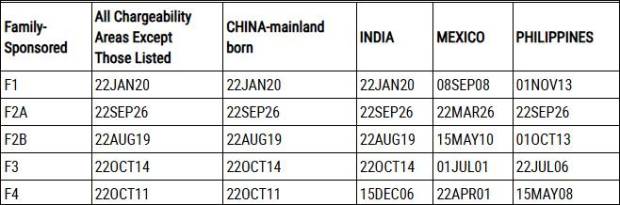
B. DATES FOR FILING FAMILY-SPONSORED VISA APPLICATIONS
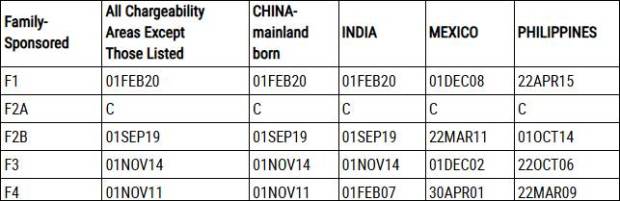
A. FINAL ACTION DATES FOR EMPLOYMENT-BASED PREFERENCE CASES
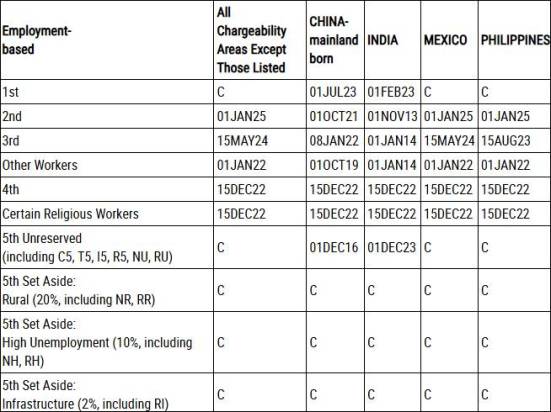
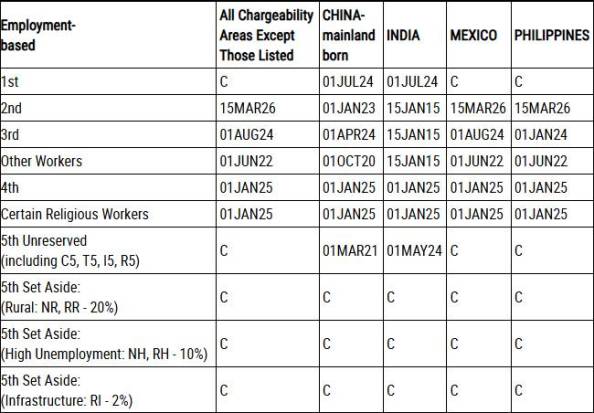
B. DATES FOR FILING OF EMPLOYMENT-BASED VISA APPLICATIONS
Disclaimer: This article is for informational purposes only and is based on the US Department of State’s Visa Bulletins. It does not constitute legal or immigration advice. Applicants should consult a qualified immigration attorney about their individual cases.